Caucasian vs White: Which Word Should You Actually Use?
Caucasian vs white isn't a style choice. One is the official race category on U.S. federal forms; the other is retired 18th-century anthropology.

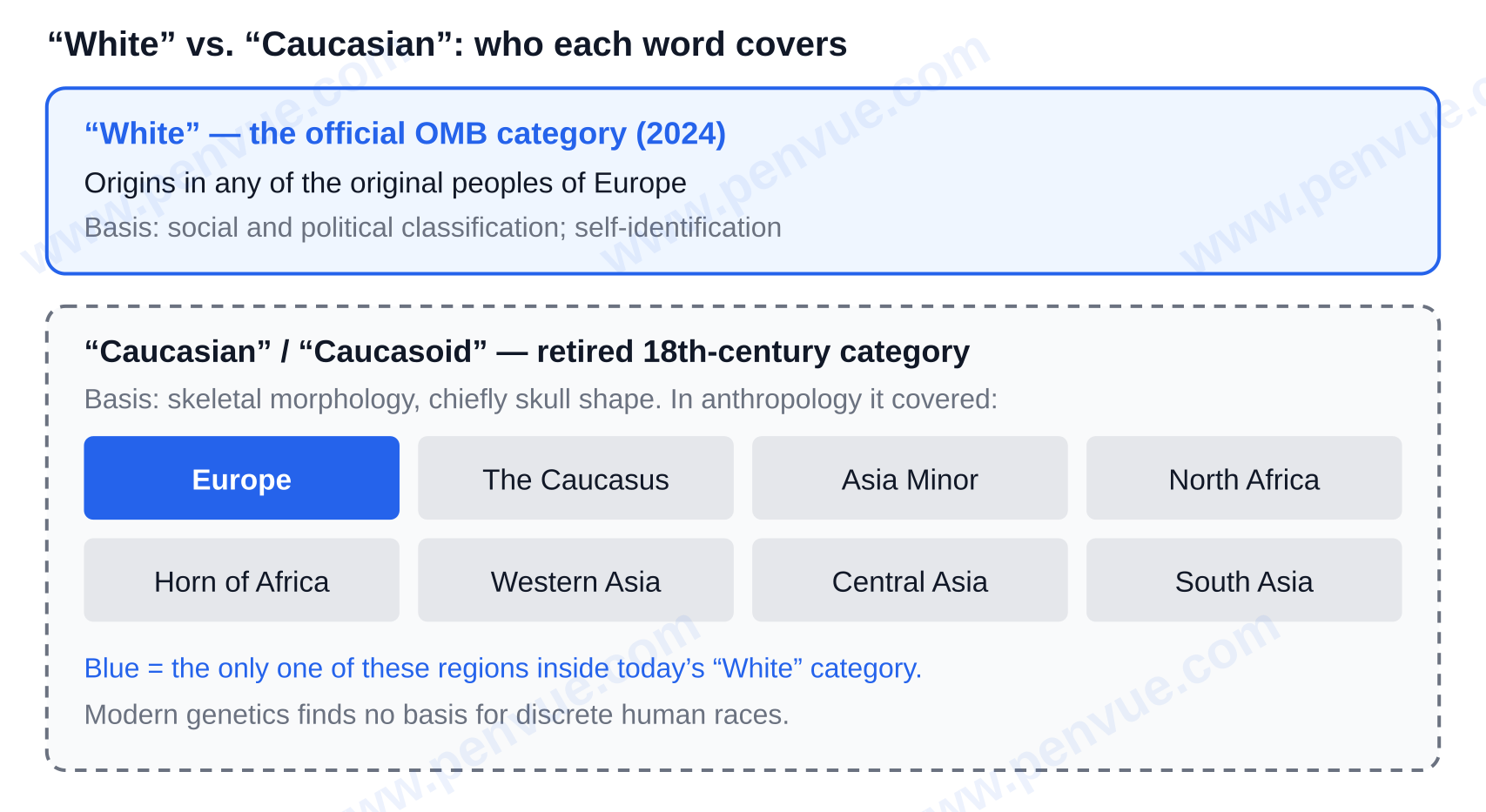
In the caucasian vs. white debate, one word is the official category and the other is a retired piece of 18th century anthropology. The word “white” is the category the U.S. government maintains and prints on government forms. The word “Caucasian” is a defunct, skull-based classification that covered more populations than the “white” race. In almost all modern cases, write “white.”
What’s the Difference Between Caucasian and White?
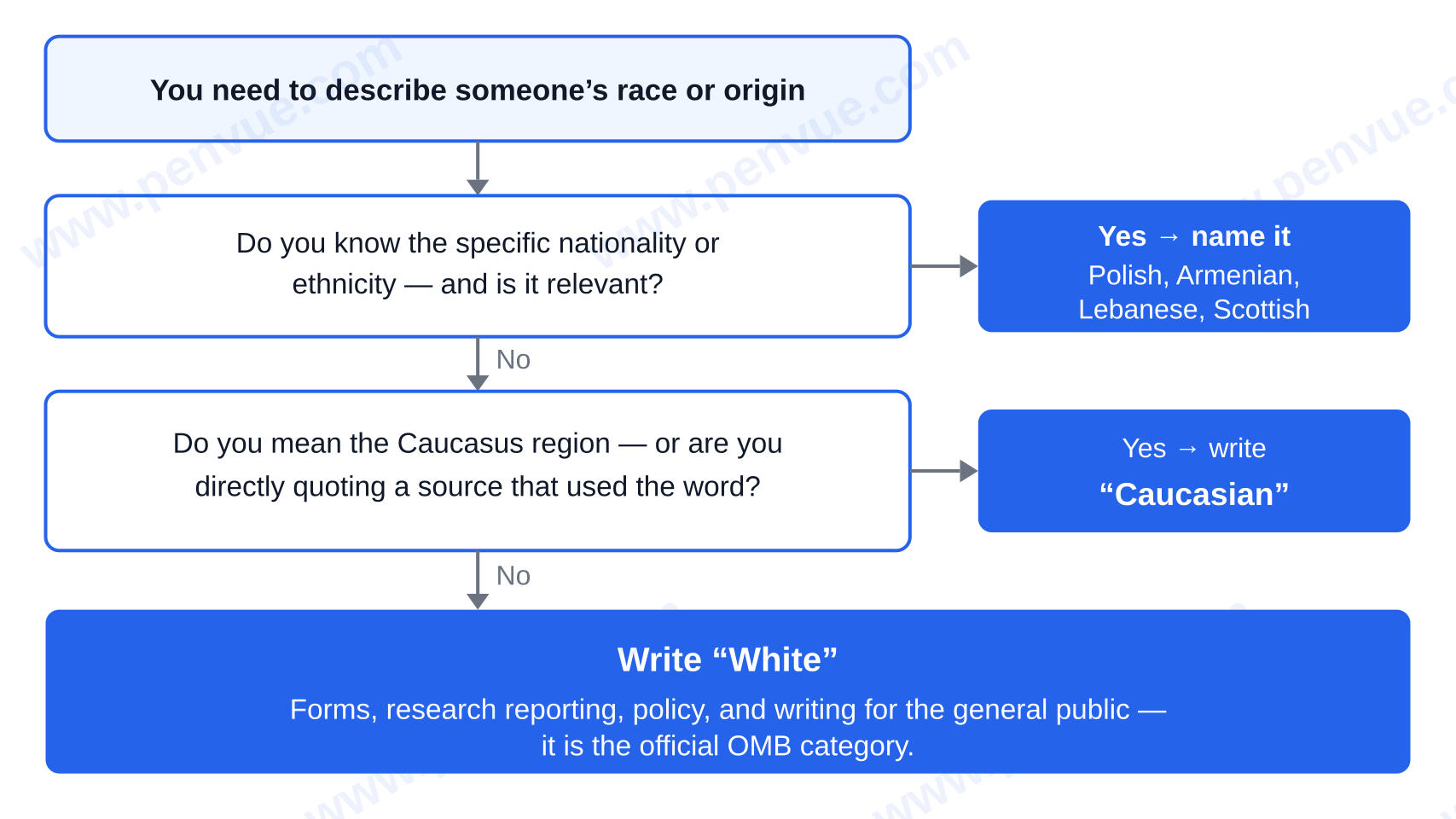
If you are filling out a form, writing a paper, or making policy, write “white”. It is the current category and the standard. You can use “Caucasian” to describe a person who is from the Caucasus region.
The two words are different. “White” is a social and political classification. The Office of Management and Budget directs the U.S. Census to collect this information. “Caucasian” is a scientific classification that is not used by any scientist. In regular, or informal speech, the two words overlap, but “Caucasian” is a discarded racial classification that is based on skull measurements.
Caucasian vs. White at a Glance
| Dimension | White | Caucasian |
|---|---|---|
| Who the term covers | People with origins in the original peoples of Europe | In anthropology: Europe, the Caucasus, Asia Minor, North Africa, the Horn of Africa, Western Asia, Central Asia and South Asia |
| Basis of the category | Social and political classification; self-identification | Skeletal morphology, chiefly skull shape |
| Status on U.S. federal forms | The official OMB category | Not a category; accepted only as a write-in that gets coded into White |
| Style-guide verdict | Preferred term | AP Stylebook advises avoiding it as a synonym for white |
| Scientifically valid? | Not a biological claim, so not in question | No — modern genetics finds no basis for discrete human races |
| When it is still correct | Racial categories, forms, research reporting | Describing someone from the Caucasus region. |
The Short Version: Which One to Write
Are all Caucasians white? No. The old Caucasoid classification covered populations that include North Africans, people from the Horn of Africa, and West and South Asians, which no one means when referring to the “white” race. That mismatch is the whole problem with treating the words as synonyms.
What Does “White” Mean on a Form Today?
Most explainers on this topic are out of date, and this is where they go wrong. Most describe “white” to include people of Middle Eastern and North African heritage. That’s no longer the federal standard as of 2024.
The 2024 OMB Definition, Verbatim
Under the revised OMB Statistical Policy Directive No. 15, the White category includes “Individuals with origins in any of the original peoples of Europe, including, for example, English, German, Irish, Italian, Polish, and Scottish.” That’s the current language. The revision was published in the Federal Register on March 29, 2024, effective March 28, 2024.
Why MENA Is No Longer Counted as White
That revision also created a separate Middle Eastern or North African category which includes Lebanese, Iranian, Egyptian, Syrian, Iraqi and Israeli origins, among others. That reverses the standard that’s been in place since 1977, which folded those origins into White. The U.S. Census Bureau’s explanation of the revised standards also indicates two other changes. The old format of a two-question race and ethnicity format has been replaced with a single combined question, “What is your race and/or ethnicity?” with instructions to select all that apply. Federal agencies also have five years — through March 2029 — to comply. Lastly, the Census Bureau will implement these standards for the American Community Survey and the 2030 Census.
An important point to keep in mind, “white” is a self-identified category, not a biological fact. The Census Bureau captures how people define themselves. The Bureau does not test anyone.
Where Does the Word “Caucasian” Come From?
The word is younger than most people assume, and the origin is worse than most people assume.
Meiners, Blumenbach and the Beautiful Skull
Christoph Meiners, a German philosopher, coined the term “Caucasian race” in 1785. He broke humanity into two races: the “Caucasian” (beautiful) and the “Mongolian” (ugly) races. Johann Friedrich Blumenbach built the five-race classification, and named the Caucasian category after the Caucasus Mountains, because he believed that the most beautiful skulls in his collection were from that region. The aesthetic ranking was there from the beginning. That’s the main reason the word is treated as offensive rather than imprecise.
Caucasoid Was Never a Skin-Color Category
This is the detail that collapses the synonym. For the Caucasoid category, the main focus was the shape of the skeleton, and especially the skull. Paying no attention to the color of the skin, people with dark brown complexions were classified as Caucasoid. Therefore, the term never meant what the Americans give it, even in its own terms. And as modern genetics shows no biological basis for discrete human races, the Caucasoid category is without anything to describe.
What Actually Happens If You Write “Caucasian” on a Form?
This is what most people are wanting to know when they look up “caucasian” vs. “white,” and nobody answers it. The mechanical answer is below.
On the Census and EEO Forms
Nothing breaks. “Caucasian” is tolerated as a write-in response and gets coded into the White category, alongside write-ins like Irish, German, and Italian. It is not the name of the category. When the standards were established for the collection of race and ethnicity data by the U.S. Office of Management and Budget (OMB), “Caucasian” was explicitly proposed as the label for that category, and that was ultimately rejected in favor of “White.” So if you write it in the box, you have supplied a non-standard synonym for an existing option. Your response still counts.
What Forms Designers Should Print Instead
There’s a practical rule that splits by role:
- HR and forms designers: The new and current OMB categories should be reflected in your options, including the new separate MENA option. If you leave MENA nested in White, and print “Caucasian” as a checkbox, your data will not map cleanly to federal reporting.
- Writers and researchers: The use of “Caucasian” adds imprecision. A reader cannot tell whether you mean European-descended, white-identified, or something broader.
Is It Offensive to Say Caucasian — and What Do Style Guides Say?
The use of that term is not considered a slur; it is simply incorrect. It imports a discredited taxonomy, implies a biological precision it does not have, and most white Americans have no ancestral connection to the Caucasus at all.
AP Stylebook and APA Style on “Caucasian”
According to AP Style, “Caucasian” should not be used as a synonym for “white.” The AP Stylebook’s entry is part of a larger style to use precise racial language, only using racial terminology when its relevance is clear and explicit. APA Style’s bias-free language guidelines push the same direction: use terms that groups prefer to call themselves, and drop obsolete pseudo-scientific classifications.
Over 1,500 Medical Papers Still Used It in 2023
Many articles say vaguely that “science has moved on.” Here’s a number. A 2025 commentary published in the medical literature did a PubMed search of articles published in 2023, and found over 1,500 articles that still printed the term “Caucasian”. The authors called on the medical community to adopt “White” instead, to standardize terminology guidelines across journals and funders, and to disclose data limitations when historical categories deviate from current reporting standards.
The term is dying slowly, not already dead. People still run into the term, despite it being outdated, and go looking for the difference.
When Is “Caucasian” Still the Right Word?
The basic advice, use “white,” does work, however, there are a few exceptions.
People Actually From the Caucasus
In the accurate, literal sense, someone from Georgia, Armenia, Azerbaijan, or parts of southern Russia is Caucasian. “White” may not be how they identify themselves at all. Be accurate when speaking about accurate places.
Forensic and Archival Exceptions
Terminology in forensic anthropology is slow to adapt, and skeletal-ancestry terminology including ‘Caucasian’ is still commonly used. While ‘White’ is becoming the most common term in its publications, terminology in old documents — a historical document, a legal ruling, an older dataset — should still be directly quoted, perhaps along with an explanation of the terminology, rather than silently rewritten.
What to Use Instead of Both
In the great majority of instances it is better to be more specific than to use either of these terms. Provide the person’s nationality, ethnicity, or ancestry when you know it and it matters. Examples are Polish, Armenian, Lebanese, or Scottish. It is better to use ‘white’ for racial categories and forms, and ‘Caucasian’ only for the Caucasus. Choose the specific nationality or ethnicity whenever precision is available and relevant.
The Decision Rule
Use ‘White’ when required to fill out a form, when reporting research data, when drafting policy, or when writing for the general public. It is the official OMB category, the term style guides and journals point to. It is the best choice as it does not incorporate a discarded 18th century taxonomy. Use ‘Caucasian’ only if you mean the Caucasus, or if you are directly quoting a source that used it. When you know the specific ancestry, and it is relevant, skip both and name it.
Next step: review any form, template, or dataset you maintain and check it against the revised OMB categories. Change ‘Caucasian’ to ‘White’ and add the separate Middle Eastern or North African option. There’s plenty more to dig into on Penvue.
Quick Answers
Does the U.S. Census use the term Caucasian?
Not formally. The official category is “White.” When the Office of Management and Budget developed the standards, “Caucasian” was offered as the label and was rejected in favor of “White.” It is still accepted as a write-in response and gets coded into the White category, but it is not printed as an option.
Are people from the Caucasus region considered white?
Under the current OMB definition, the White category covers people with origins in the original peoples of Europe. People of Georgia, Armenia, and Azerbaijan may or may not consider themselves as white — federal race data is self-reported, not a ruling. The citizens of the Caucasus region are, however, geographically “Caucasian,” and that is the accurate descriptor for them.
Is Caucasian a race or an ethnicity?
Neither, in current terms. “Caucasian” was at one time classified as a race in an 18th-century classification built by Christoph Meiners and Johann Friedrich Blumenbach, based on the shape of people’s skulls. According to modern genetics, there is no biological basis for discrete human races, so the category describes nothing. In the 2024 standards issued by the OMB, a single combined race and/or ethnicity question is used.
Why do doctors and medical studies still say Caucasian?
Inertia and legacy data sets. A commentary in 2025 reported that over 1,500 articles published in 2023 and indexed in PubMed still used the term “Caucasian,” and urged journals and funders to standardize on “White,” align terminology guidelines, and disclose data limitations when older categories differ from current reporting standards.
Author
