


To define umbrella insurance in a sentence: it is additional personal liability coverage that kicks in after the liability limits of your other personal policies (auto, home, renters or condo) are exhausted. It helps pay for lawsuits and property damage you cause others, legal defense costs, and claim types (like libel or slander) that are not covered in base policies. Limits start at $1,000,000.
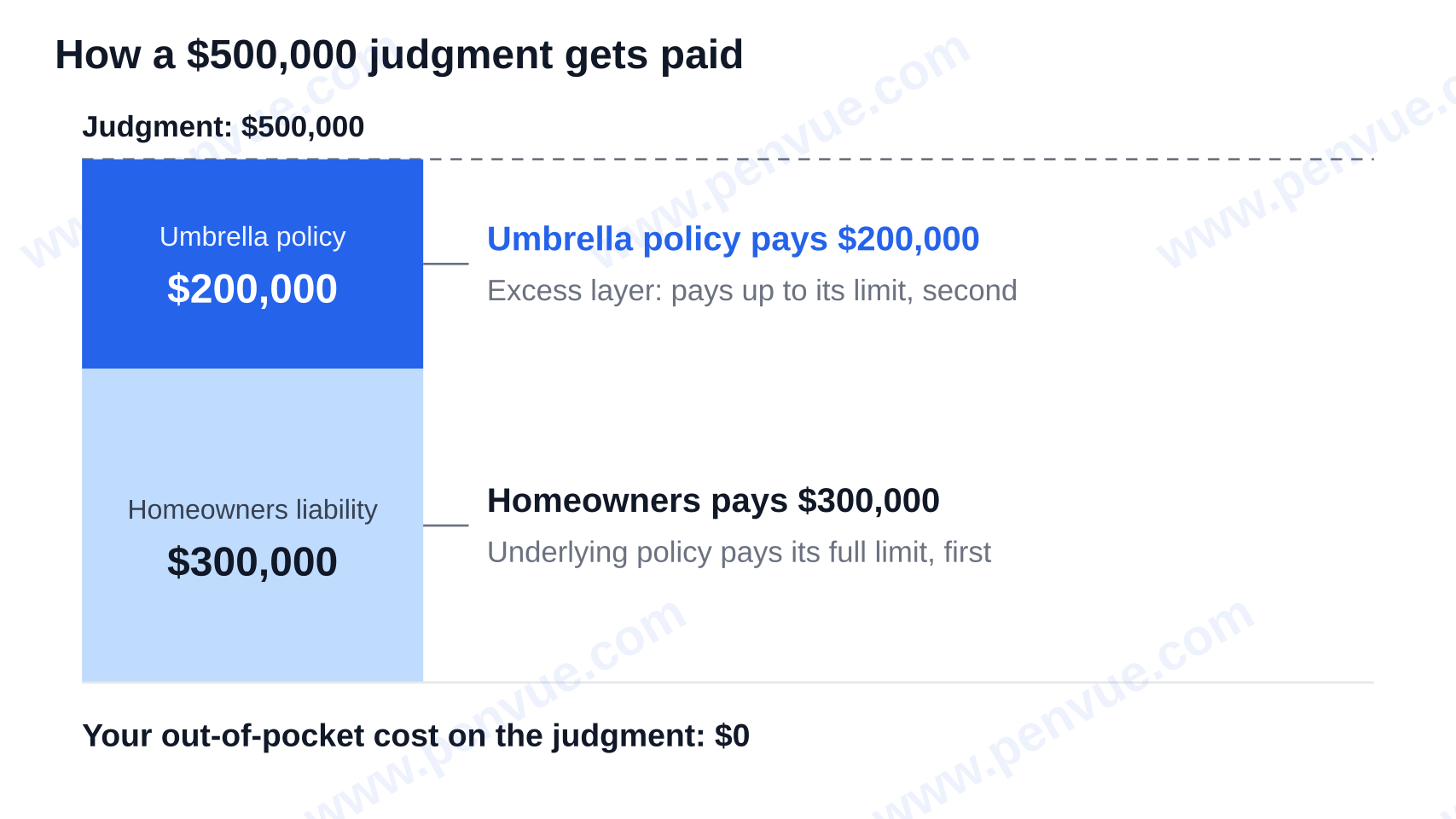
Now let’s talk dollars and cents. Assume there is a $500,000 court judgment against you and your homeowners’ policy only has $300,000 in personal liability coverage. The homeowners’ policy would pay its $300,000 limit and the umbrella policy would pay the remaining $200,000 (according to Forbes Advisor). Without the umbrella policy, you would be on the hook to pay the $200,000.
What does it mean to define umbrella insurance in plain English?
A personal umbrella policy (PUP) is additional personal liability coverage you purchase and add on top of your current personal liability coverage. A PUP does not replace coverage. It is excess coverage and adds additional limits and claim types.
The Insurance Information Institute (Triple-I) describes it as excess liability protection that kicks in when you reach the limit on the underlying liability coverage in an auto, homeowners, renters, or co-op/condo policy. That’s the neutral industry definition, not a carrier’s sales version — worth knowing, because carrier pages tend to describe only the policies they happen to sell you.
Why it’s called an “umbrella” policy
One policy sits over multiple policies. You can’t bolt it to just one. Raise the limit on your auto policy and all you’ve raised is your auto limits. Buy an umbrella policy and you’ve raised the limits on everything on its schedule.
What it is not: health insurance, auto insurance, or home insurance. It is liability insurance. It pays other people.
Personal umbrella policy (PUP) vs. excess liability insurance
Technically speaking, an excess liability policy only increases the limits of the policy it follows, while an umbrella policy can drop down and provide primary coverage for a loss the policy it follows doesn’t address. That second behavior — the “drop down” — matters later, because it’s the one scenario where you pay out of pocket.
Two terms carry the rest of this article. The underlying (or primary) policy is your auto, home, renters or condo policy that an umbrella covers. Liability limits are always written as a pair. For example, 250/500 means $250,000 of bodily injury coverage per person and $500,000 per accident.
How does an umbrella policy actually pay a claim?
An umbrella policy actually pays claims this way, from the bottom up. The underlying policy pays its full limit, and then the umbrella policy pays up to its limit. Nothing is shared or split.
A $500,000 lawsuit, step by step
- A guest is seriously injured on your property and sues.
- Judgment: $500,000
- Your homeowners’ personal liability limit is $300,000 and pays it in full.
- Your umbrella policy pays the remaining $200,000.
- Your out-of-pocket cost on the judgment: $0
The auto side works the same way and happens faster. One at-fault crash with two injured people in another car can exhaust your 250/500 bodily injury limits before the hospital bills are final, and everything above that is yours.
One thing the face number hides: legal defense costs are typically paid over and above the face amount of the policy, not carved out of it. A defense that drags on for two years doesn’t eat your $1 million.
How high can umbrella limits go?
Coverage starts at $1 million and rises in $1 million increments, commonly to $5 million and, per NerdWallet, up to about $10 million on a personal policy. The first million is the most expensive, because the underlying policies absorb the smaller losses and the higher layers are only hit for the larger, more catastrophic ones. For every million after the first, the price increases much less.
What umbrella insurance covers — and what it excludes
To define umbrella insurance accurately, you have to read both columns: the list of covered losses is wider than expected in one direction and narrower in the other.
| Typically covered | Not covered |
|---|---|
| Bodily injury you cause to other people | Your own bodily injury |
| Property damage you cause | Damage to your own property or vehicle |
| Medical bills for people you injured | Your family’s health care costs |
| Attorney fees and court costs | Intentional or criminal acts |
| Liability on rental property you own | Business or professional liability |
| Dog bites and swimming pool incidents | Employment-practices and workers’ comp-type exposures |
| Personal injury offenses: libel, slander, defamation, false arrest, malicious prosecution, invasion of privacy | Losses below your underlying policy’s limit (that’s the base policy’s job) |
The surprise is the personal injury line. Progressive lists coverage for slander, libel and defamation, false arrest and malicious prosecution among the claims an umbrella responds to. Those claim types are standard exclusions on personal auto and home insurance policies. If a post you wrote gets you sued, your homeowners’ policy probably is not the thing that answers.
Why a side business breaks a personal umbrella
Business and professional liability are excluded and that exclusion is broader than it may seem. Freelance work, a side business, or a short-term rental run as a business needs a commercial umbrella policy. A personal policy priced for a household is not going to cover a household that is also a business.
To answer the question directly: no, it will not cover damage to your own car or your own injuries.
The three things that decide whether your umbrella actually pays
Most pages that define umbrella insurance stop at the coverage list. In reality, that list is rarely the source of the frustration. These three things are where a paid-for umbrella policy may fail to respond.
1. The underlying-limit maintenance condition
Limit requirements are not something you clear to be able to purchase the policy. They are conditions of coverage that continue as long as the policy is in force.
You purchase an umbrella policy while carrying $500,000 of auto liability, reduce it to $300,000 the next renewal, and save premium dollars. But the umbrella policy does not slide down to fill the liability gap. You personally owe the $200,000 gap before the umbrella policy pays a dollar. Rough Notes walks the same example with a $1.5 million loss, where the insured is out the $200,000 purely because the scheduled underlying limit was reduced. If the underlying policy lapses entirely, you personally owe the full required underlying limit yourself.
The general rule is: never lower or cancel a scheduled underlying policy until the umbrella carrier has amended its schedule in writing.
2. It protects others from you — not you from an uninsured driver
Standard umbrella policies are third party liability policies. They pay the people you injure, and they offer no protection for the insured if they are struck by an uninsured/underinsured driver.
According to Independent Agent magazine, to obtain excess Uninsured/Underinsured Motorist Protection, an endorsement must be added to the policy, if the insurer and the state permit it. Some companies writing excess UM/UIM endorsements are Auto-Owners, State Farm, USAA, Chubb, Erie, and Travelers. It is not available everywhere. So the client who bought an umbrella to protect their family from an uninsured driver most likely did not buy what they think they bought. Ask your agent to endorse excess UM/UIM by name, rather than assuming your umbrella policy provides it.
3. The retained limit you pay when the umbrella drops down
When a claim falls outside the liability of the underlying policies, such as a claim for slander or a false arrest claim, and the umbrella liability coverage responds to the claim and indemnifies the insured, the umbrella policy acts as primary, and a self-insured retention (SIR) is applied. The structure of umbrella policy liability is illustrated in insurance-licensing material from RiskEducation.org. In this material, the SIR is illustrated from $250 up to $10,000, functioning similarly to a deductible. The insurance company pays claims above the SIR.
This clears up the confusion about the deductible. Effectively, there is no deductible when the umbrella policy stacks on top of a covered claim. However, in a drop-down situation, there is a true out-of-pocket retention.
Three things to do this week: obtain a copy of your declarations pages, confirm the scheduled underlying limits match what you actually carry today, and write to your carrier and ask what your retained limit is.
Who needs umbrella insurance, and what makes you higher risk?
Once you define umbrella insurance as lawsuit protection rather than a luxury product, the question changes. It is not about affluence. It is about how many ways you can be sued and how much a court can reach.
Risk triggers worth a quote
- Having a teen driver on your policy
- Having a swimming pool or trampoline
- Having a dog
- Owning rental property
- Having a boat, ATV, or other recreational vehicle
- Frequently entertaining, particularly if alcohol is served
- Being on a nonprofit or HOA board
- Coaching youth sports
- Maintaining a popular social media account, generating potential defamation claims
Liability increases with contact. More drivers, more guests, more property, more exposure. Triple-I’s own guidance on whether to purchase an umbrella liability policy frames it the same way, without a product to sell you.
Do you need it if you don’t have many assets?
Most of the time the answer is yes. A judgment that is above your liability limits can reach your savings, investments, home equity and future wages through a process called garnishment. Garnishment attaches to income and not to net worth, so people with a thin balance sheet often have a false sense of security. Legal defense alone can run into six figures before anyone rules on fault.
How much umbrella insurance should you buy — and what does it cost?
The standard rule of thumb is to buy limits at least equal to your net worth. It is a decent place to start and a bad place to finish.
Where the “match your net worth” rule breaks down
- The young high earner. A small net worth, but large garnishable future income. Size to lifetime earnings exposure, not today’s balance sheet — net worth badly understates what’s at risk.
- Wealth concentrated in a 401(k) or 403(b). ERISA-protected retirement assets are generally shielded from civil judgments and can reasonably be excluded from the calculation.
- A strong-homestead state like Florida. Equity in a person’s primary residence is largely shielded from forced sale by most creditors, and including it in the calculation overstates the true value at risk.
A better denominator is at-risk assets combined with future earnings exposure — not gross net worth.
Typical annual cost per million
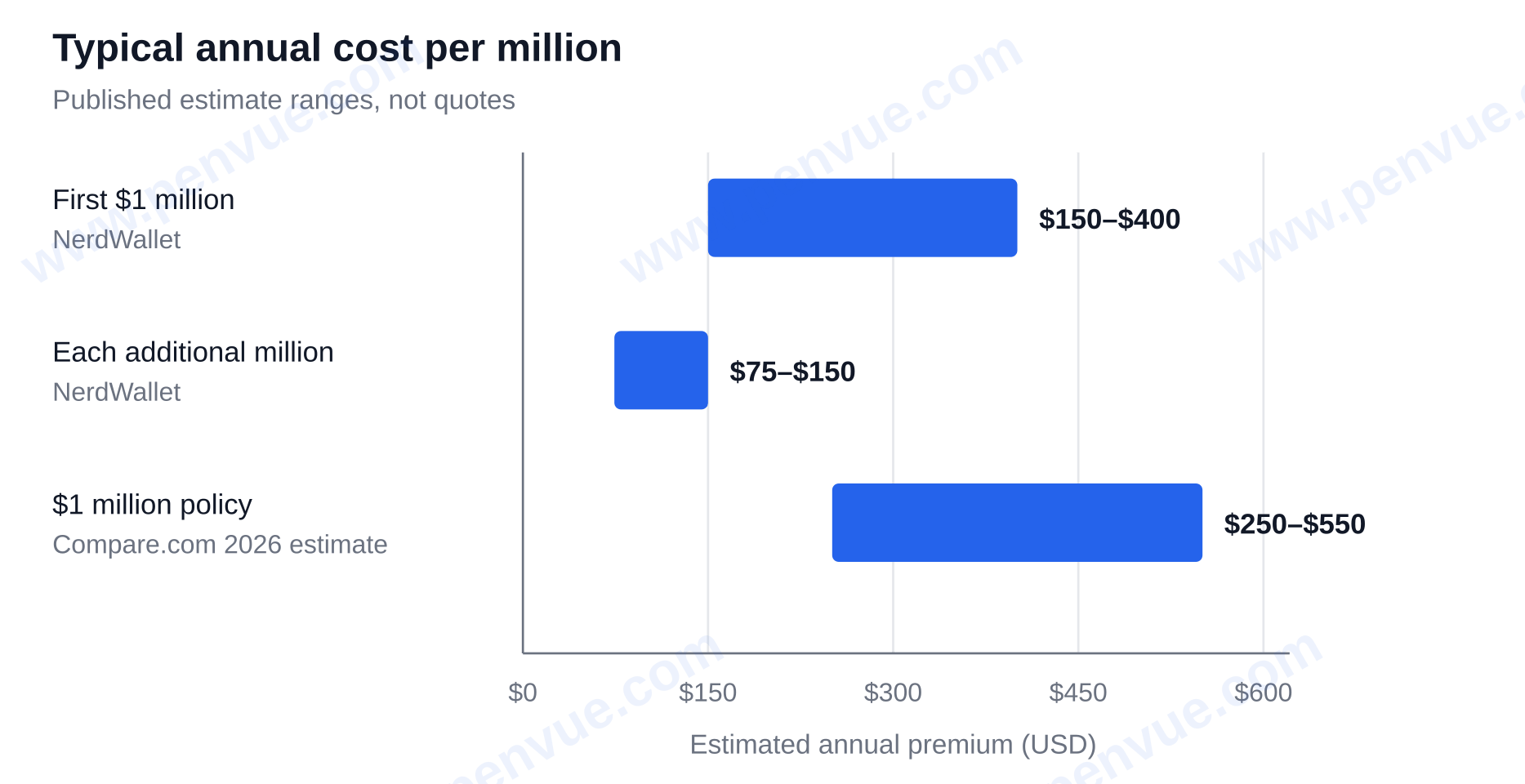
According to NerdWallet, the first $1 million costs roughly between $150 and $400 per year, and each million after that adds between $75 to $150. A 2026 Compare.com roundup estimates that a $1 million policy costs between $250 and $550 for households without teen drivers or high-risk features. Keep in mind that these are just estimates from brokers and publishers, so treat them as ranges and get a real quote.
Either way, the marginal million is cheap, for the structural reason described earlier: the first layer absorbs most of the claim frequency, so moving from $1 million to $3 million costs nowhere near three times as much. What actually increases the cost of your liability insurance is the number and age of your drivers, past claims, rental properties, swimming pools, dogs, and how many underlying policies are scheduled.
What you need before a carrier will sell you a policy
Before a carrier will sell you the layer above, you need enough liability coverage underneath it.
Required underlying liability limits
| Coverage | Triple-I baseline | Common carrier practice |
|---|---|---|
| Auto liability | About $250,000 | Often 250/500 — $250,000 per person / $500,000 per accident |
| Homeowners personal liability | About $300,000 | Some carriers require $500,000 |
| Renters or condo/co-op liability | Counts as a valid underlying policy | Typically at least $300,000 of personal liability |
The Triple-I gives the baseline — roughly $250,000 in auto liability and $300,000 in homeowners liability before an insurer will sell you an umbrella policy. According to Atesa Risk Advisors, the current standard is often stricter. Many carriers will ask for 250/500 auto bodily injury, and some want $500,000 in homeowner’s personal liability. The cost of the umbrella policy and the cost of increasing the liability on the underlying policies are often priced together.
Can renters and people without a car buy one?
Yes. Triple-I’s definition names renters and condo/co-op policies as valid underlying policies, and most carrier pages skip those entirely. The path is through a renters’ policy carrying at least $300,000 of personal liability as your underlying layer, and a non-owner auto liability policy if you don’t own a vehicle, to meet the auto requirement. Having no house and no car is not a disqualifier.
How to get a quote
Generally, start with the carrier that also writes your home and auto, since most prefer to bundle (or at the very least have every underlying policy scheduled). Have your current declarations pages, all drivers and their age, all vehicles, all property (owned or rented out), all pets, pools or trampolines, boats, and any board or volunteer positions. Also, confirm every policy you own is scheduled, and ask if excess UM/UIM is available in your state, before you sign.
If you had to define umbrella insurance by one practical fact, it is this: an umbrella is the least expensive liability layer you can buy, and the main way it fails is letting the policies under it drift below the limits your carrier scheduled. That’s also what’s shifting — the underlying bar — from the old $250,000/$300,000 baseline toward 250/500 auto and $500,000 home liability, so watch your renewal notices. A limit change you make to save $40 a month, or one a carrier makes for you, is the thing most likely to turn a $1 million policy into a $200,000 bill. You’ll find related pieces under Lifestyle.
Quick Answers
Does an umbrella policy have a deductible?
Effectively no when it’s stacking on top of a covered claim — the underlying policy pays to its limit and the umbrella picks up from there with nothing out of pocket from you. The exception is the drop-down situation, where the umbrella acts as primary for a loss your base policy excluded (a slander or false-arrest claim, for example). Then a self-insured retention applies. Insurance-licensing material on umbrella policy structure says the commonly selected retention is between $250 and $10,000. Write to your carrier and ask what yours is.
Is umbrella insurance worth it if I already have high auto and home liability limits?
In general, yes, for two reasons. First, a major multi-injury auto claim or a large judgement against you for a claim that happens on your property can exceed even 250/500 limits, and the amount above your limit comes from savings, investments, home equity, and garnished wages. Second, an umbrella adds claim types high base limits don’t touch at all — libel, slander, defamation, false arrest, malicious prosecution, invasion of privacy — which standard home and auto policies typically exclude. Per NerdWallet, each additional million runs roughly $75 to $150 a year, so the extra height is cheap relative to the exposure.
Does umbrella insurance cover me while driving a rental car or someone else’s vehicle?
It’s complicated. Basically, an umbrella policy extends the liability limits of the underlying policies rather than standing on its own. If your auto policy covers you driving a rental or borrowed car, then the umbrella generally sits above that coverage. If, however, your primary policy doesn’t respond, there’s no underlying limit for the umbrella to stack on. Confirm the specifics with your carrier before a trip rather than assuming, and remember the umbrella covers liability to others, not damage to the rental itself.
Can I buy umbrella insurance from a different company than my auto and home insurer?
You could, but it is the riskier setup. Many carriers require you to bundle, and all of them require every underlying policy to be scheduled on the umbrella. When the umbrella and the primary policies sit at different companies, nobody is watching the limits for you — and as Rough Notes documents, a reduced or lapsed underlying limit leaves you personally liable for the gap. If you do split coverage, treat any change to an underlying policy as a change to the umbrella and get the carrier’s amended schedule in writing first.
Does an umbrella policy cover my adult child at college or a family member living with me?
In general, the policy covers the named insured and relatives residing in the household, which usually includes an individual who is a student away at school but still a household member. Definitions vary among carriers, and the exact wording is what controls. You should request the definition of the term “insured” in writing, and make sure a young driver’s vehicle and auto policy are scheduled on the umbrella. Adding a teen or young driver is also one of the biggest factors that moves your premium.
What happens to my umbrella coverage if I sell my car or move into a rental?
In general, if there are changes to your underlying schedule, your umbrella has to change with it. If you sold the car and dropped auto liability, you no longer satisfy the auto underlying requirement — a non-owner auto liability policy is the usual fix. If you moved from a house to an apartment, a renters’ policy with at least $300,000 of personal liability can serve as the underlying layer, since the Insurance Information Institute (Triple-I) counts renters and condo/co-op policies as valid underlying policies. Notify the umbrella carrier before the change and get the amended schedule in writing.

