

US fluid ounces are equal to liters at a rate of 0.0295735. One US fluid ounce equals 0.0295735 liters, and one liter equals 33.814 US fluid ounces. Therefore, a 16 ounce bottle is equal to 0.473 L, a 32 ounce bottle is equal to 0.946 L, and 33.814 ounces is equal to 1 liter.
Now that you know the conversion, the question is, which fluid ounce is printed on the bottle in your hand? The U.S. has 3 legally defined ounces, and they don’t always agree. This article will show you the formula, the 3 ounces, the error you take on by guessing, a full container chart, the bottle count answers, the fluid vs. weight problem, and which factor to use for cooking, hydration, and paperwork.
How do you convert oz to liters?
You just need to memorize one multiplication.
The formula, both ways
- Ounces to liters: liters = fluid ounces × 0.0295735
- Liters to ounces: fluid ounces = liters × 33.814 (same as dividing by 0.0295735)
Inch Calculator publishes the working factor as 0.029574, which is the same number rounded one place further. The difference is not noticeable for everyday conversions.
A worked example: 16 oz to liters
We will use a 16 oz bottle for this example. 16 × 0.0295735 = 0.4732, so the bottle holds 0.473 L, or 473 mL. Run it backwards to check a 2 L bottle. 2 × 33.814 = 67.63, so a 2 L bottle is equal to about 68 oz.
Converting through milliliters instead
A decimal with four leading zeros is hard for most people to hold in their head. Use the milliliter conversion instead. One US fluid ounce is 29.5735 mL, so multiply your ounces by 29.5735 to get milliliters, then move the decimal three spaces to the left to get liters. Same answer. One less chance to misplace a zero.
A ballpark figure for the shelf, multiply ounces by 3, move the decimal two spaces: 64 × 3 = 192, so roughly 1.92 L. That shortcut uses a 30 mL ounce, not the true 29.5735 mL ounce. That’s fine when comparing two bottles, but not when scaling anything up. More on exactly how much that costs you below.
Which fluid ounce is on your container? There are three, not two
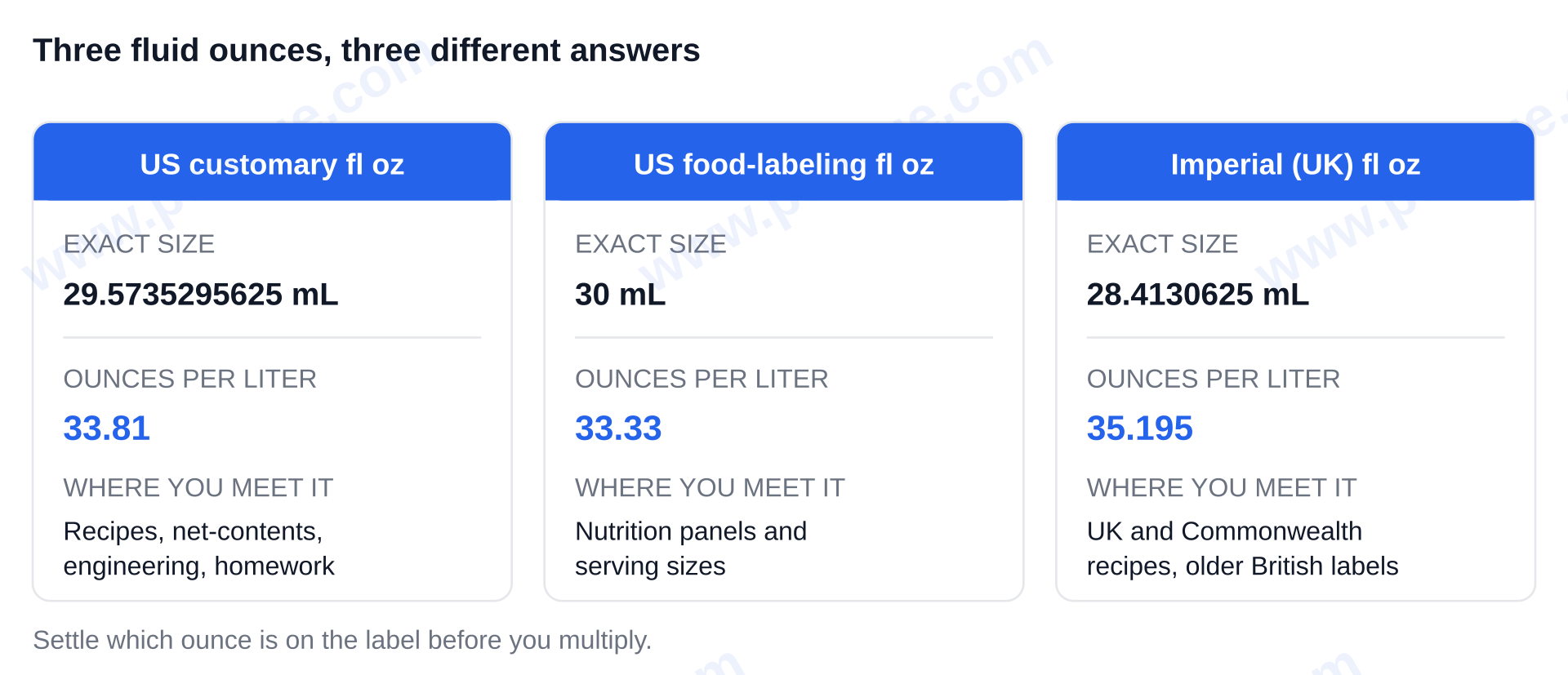
Every converter webpage skips this step. Before you multiply, settle which ounce the number on the label actually is. Wikipedia’s article on the fluid ounce describes all three as distinct, defined units with exact values.
US customary vs US food-label vs imperial fluid ounce
| Unit | Exact size | Ounces per liter | Where you meet it |
|---|---|---|---|
| US customary fluid ounce | 29.5735295625 mL | 33.81 | Recipes, net-contents lines, engineering, homework |
| US food-labeling fluid ounce | 30 mL | 33.33 | Nutrition panels and serving sizes |
| Imperial (UK) fluid ounce | 28.4130625 mL | 35.195 | UK and Commonwealth recipes, older British labels |
The ounce on the label is not sloppiness by the manufacturer. The FDA’s nutrition labeling rule at 21 CFR 101.9 defines 1 cup as 240 mL and sets the reference amount for beverages at 240 mL, labeled as 8 fl oz. By regulation, ounces on a nutrition panel are 30 mL.
How to read the label and pick the right factor
In order of importance:
- A nutrition panel number, or a dual label like “8 fl oz (240 mL),” states label ounces. Treat them as 30 mL.
- A net-contents line stating “16.9 FL OZ (500 mL),” gives a metric container in customary ounces. Trust the metric figure; the ounce figure is the derived one.
- A British cookbook or a pre-metric UK tin is imperial. Those ounces are smaller, and there are 20 of them to the imperial pint, instead of 16.
In practice, for one glass of water, any of the three is close enough that no one will notice. It’s only when you start multiplying — batch baking, a month of intake totals, dosing, a shipping declaration — that things really start to compound, in one direction every single time. There are fixed legal definitions for these measurements; any page that claims a different value is just rounding.
How much error does the “1 oz = 30 mL” shortcut cost you?
About 1.44%, always on the high side. 1.44% is roughly how much a label ounce of 30 mL overstates the customary ounce of 29.5735295625 mL.
When 1 fl oz ≈ 30 mL is good enough
Just one drink? Maybe. What about salad dressings? Or what about a recipe for a weeknight meal? Probably. No one will notice 1.44% in a glass of water.
When you need the exact factor
Here’s the gap made concrete. The exact factor makes 64 oz convert to 1.893 L, and the label factor makes it convert to 1.920 L — a difference of 27 mL, roughly a shot glass. Invisible once. Now track 64 oz a day for a month using the wrong factor and you are off by around 0.8 L, close to a full extra large bottle you never drank.
The decision rule, in one line: For a single serving, use 30 mL. For anything you multiply, use 29.5735295625 mL. Everything on the other side of the rule is things like batch recipes, dosing of medications and supplements, lab work, and net-contents declarations.
Watch the output, too. 0.473 L and 473 mL are the same number, and writing 0.4732 L on a recipe is a false sense of precision — you can’t pour to a tenth of a milliliter in a home kitchen.
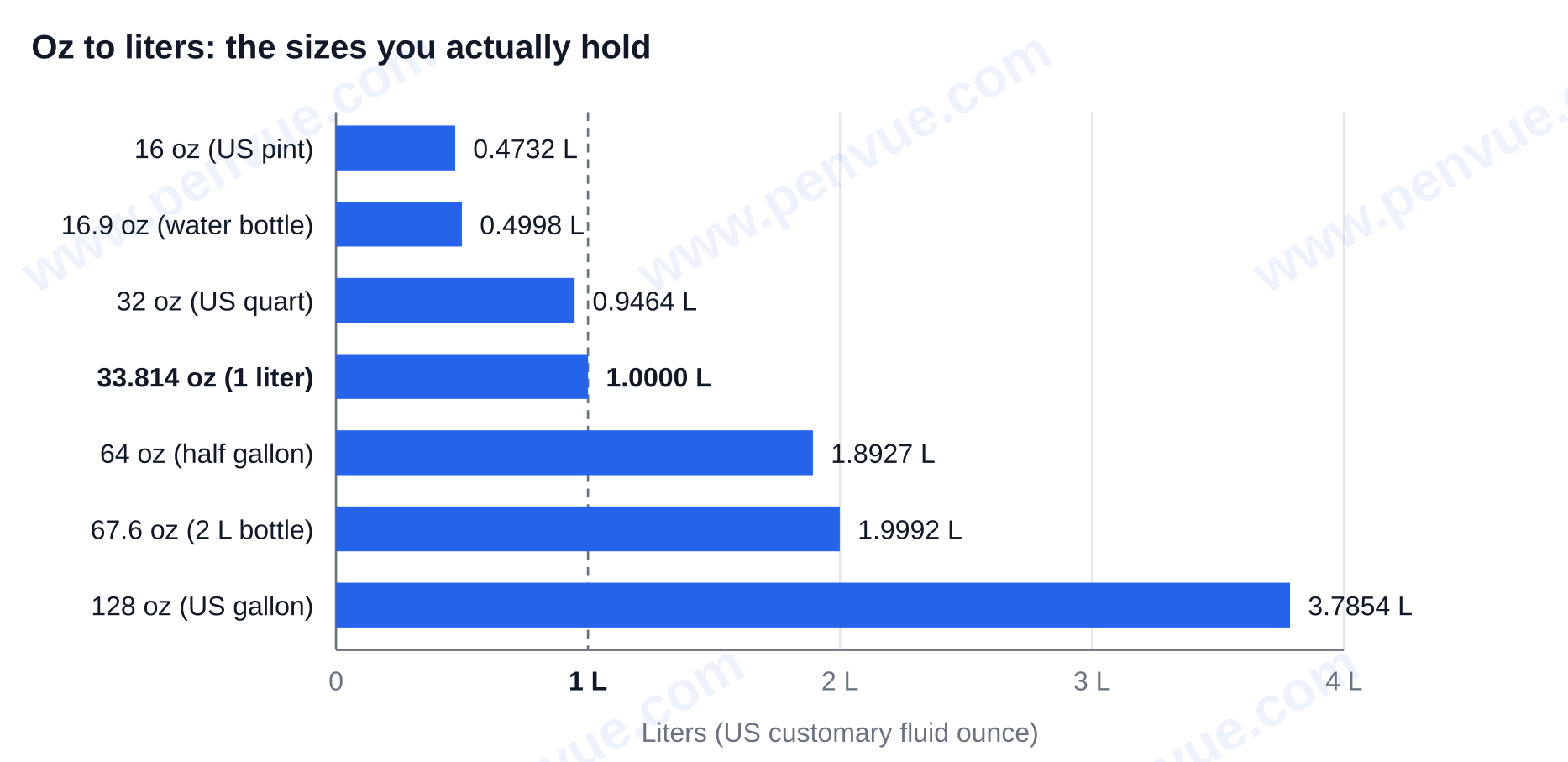
Oz to liters conversion chart for the sizes you actually hold
Columns two and three answer different questions. Use the US column if your number came off of an American container, and use the imperial column if your number came off of a British container.
| Fluid ounces | Liters (US customary) | Liters (imperial) | What it usually is |
|---|---|---|---|
| 1 oz | 0.0296 L | 0.0284 L | A single ounce |
| 2 oz | 0.0591 L | 0.0568 L | Sauce cup |
| 4 oz | 0.1183 L | 0.1137 L | Small juice box |
| 6 oz | 0.1774 L | 0.1705 L | Small coffee cup |
| 8 oz | 0.2366 L | 0.2273 L | One US cup |
| 12 oz | 0.3549 L | 0.3410 L | Soda can |
| 16 oz | 0.4732 L | 0.4546 L | US liquid pint |
| 16.9 oz | 0.4998 L | 0.4802 L | The standard water bottle — a 500 mL bottle labeled in ounces |
| 20 oz | 0.5915 L | 0.5683 L | Large soda bottle |
| 24 oz | 0.7098 L | 0.6819 L | Gym bottle |
| 25.4 oz | 0.7512 L | 0.7217 L | TTB’s ounce figure for the 750 mL wine or spirits bottle |
| 32 oz | 0.9464 L | 0.9092 L | US quart, 32 oz Nalgene — just under a liter |
| 33.814 oz | 1.0000 L | 0.9608 L | Exactly one liter |
| 40 oz | 1.1829 L | 1.1365 L | The big tumbler |
| 48 oz | 1.4195 L | 1.3638 L | Three US pints |
| 64 oz | 1.8927 L | 1.8184 L | Half a US gallon |
| 67.6 oz | 1.9992 L | 1.9207 L | The two-liter bottle (a true 2 L is 67.63 oz) |
| 100 oz | 2.9574 L | 2.8413 L | Large dispenser jug |
| 128 oz | 3.7854 L | 3.6369 L | One US gallon |
Common bottle and jug sizes in liters
Three rows carry the most traffic. 32 oz is slightly less than 1 liter, not equal to one. 33.814 oz is exactly 1 liter. 67.63 oz is exactly 2 liters. So, 2 liter bottles get called “about 68 ounces.”
Why wine and water bottles show odd ounce numbers
16.9 and 25.4 look strange because bottles are manufactured to metric sizes first, then translated afterwards. A 500 mL bottle is about 16.91 US fluid ounces. A 750 mL bottle is 25.36 US fluid ounces, and TTB’s conversion tables authorize 750 mL as a standard of fill equal to 25.4 fluid ounces. The ounces are the translation. The metric figure is the original.
You will see other odd numbers. The TTB’s final rule T.D. TTB-200, published in the Federal Register on January 10, 2025, added 13 new standards of fill for wine and 15 for distilled spirits. Authorized wine sizes now include 3 L, 1.5 L, 1 L, 750 mL, 500 mL, 375 mL, 355 mL, 250 mL, 200 mL, 187 mL, and 100 mL, with spirits running from 50 mL up to 1.8 L.
How many ounces are in a liter, and how many bottles is that?
One liter is 33.814 US fluid ounces, 35.195 imperial fluid ounces, or 33.33 label ounces. In reverse: 500 mL is 16.91 US fl oz, 750 mL is 25.36 US fl oz, 1.5 L is 50.72 oz, 2 L is 67.63 oz, and 3 L is 101.4 oz.
How many 16.9 oz bottles make a liter — and 2 liters?
This is the division you were actually doing in your head, so here it is finished:
- A 16.9 oz bottle is 0.4998 L, so two of them make essentially exactly 1 liter.
- A 2 L daily target is 67.63 oz — four 16.9 oz bottles plus a swallow, or about two 32 oz Nalgenes plus 3.6 oz.
- A 40 oz tumbler is 1.183 L, so two fills is already past 2.3 L, which is above the goal for most people.
- A 1 L bottle beats a 32 oz Nalgene by about 1.8 oz. “A liter” and “a quart” are not the same brag.
- Eight 8 oz glasses is 64 oz, or 1.893 L, which is not 2 L, though these get confused a lot.
Is a fluid ounce the same as an ounce on a scale?
No, and this is where the multiplication fails outright. A fluid ounce measures volume. An avoirdupois ounce measures mass. The oz to liters conversion only works on the first kind.
Volume vs weight ounces in practice
There’s no single factor for weight ounces because you’d need the substance’s density first, so the answer changes with what is in the container. With that being said, let’s assume water is the substance in the container. Even with the friendliest case, there’s still a discrepancy. Inch Calculator puts 1 fl oz of water at about 1.043 weight ounces, and 1 weight ounce of water at about 0.96 fl oz. That’s roughly a 4% gap. Now think of how hard honey, oil and flour break the assumption. A recipe written by weight can definitely not be saved with a volume factor.
How to tell which ounce you have
Figure out the source of the number. For example, if the number came off a liquid container’s net-contents line, it’s a fluid ounce and it can be converted. If the number came off a kitchen scale or a dry-ingredient line, stop and look up the density. When it is genuinely mass, the path is: convert the ounces to grams, divide by the density in grams per milliliter to get milliliters, then divide by 1,000 for liters.
What exactly are a fluid ounce and a liter?
Knowing where each unit comes from explains the ugly decimal.
The fluid ounce’s place in pints, quarts, and gallons
The US fluid ounce is defined by division: 1 US fluid ounce = 1/16 of a US liquid pint, 1/32 of a quart, 1/128 of a US gallon. Since the US gallon is fixed at exactly 3.785411784 L, then 1 US fluid ounce = 29.5735295625 mL. The long decimal is because of the precision and not because it’s sloppy.
A U.K. imperial ounce is smaller than a U.S. ounce. One imperial ounce is 1/20 of an imperial pint and 1/160 of an imperial gallon, a legacy of the 1824 imperial gallon definition. That different denominator — not a different philosophy of measurement — is the entire source of the roughly 4% gap between UK and US ounces.
What a liter is in SI terms
The liter is the metric volume unit accepted for use with SI: 1 L = 1,000 mL = 1 cubic decimeter, a cube 10 cm on a side. It is defined by length. The fluid ounce is defined by subdividing a gallon. The two systems meet only through one fixed conversion, which is why that conversion never resolves into a clean number — and why technical documents following NIST conventions happily print both liters and cubic meters.
Which conversion should you use for cooking, hydration, or shipping?
It depends on what breaks if you are 1.44% off.
Recipes: US vs UK ounces
Cooking a U.S. recipe in a metric kitchen? Use the customary conversion factor, and then round to the nearest 5 mL. 8 oz becomes 240 mL on a jug and nothing suffers. Cooking from a UK or Australian book? Check for imperial ounces first. Treating 10 imperial oz as US oz puts you about 12 mL heavy on every measure — enough to loosen a batter across a full recipe.
Intake tracking, shipping, and schoolwork
For hydration, just pick one factor and keep it for the whole month, so that your weekly totals are comparable to each other. For shipping, customs and net-contents declarations, use the exact 29.5735295625 mL definition, and let the form handle the rounding. The stated figure must match what is in the container. For schoolwork, state the formula using 0.0295735 and explain your rounding — graders want the method, not twelve decimal places. Behind a bar, think in 750 mL and 1 L, because the metric standards of fill are the actual sizes, and convert to ounces only if a customer asks.
The one number to save
Converting oz to liters can be determined with one multiplication — ounces × 0.0295735 — but the number you input matters more than the multiplication. Settle which of the three fluid ounces is shown on the container first, then multiply: 29.5735295625 mL if you are scaling up, 30 mL for a serving on a nutrition fact panel, and 28.4130625 mL for imperial.
What changes next is the shelf, not the math. The definitions don’t change, but TTB’s 2025 standards-of-fill expansion means more metric bottle sizes are arriving in US stores, and each one lands as another odd ounce figure on a label. For now, look at the net-contents line on the bottle in front of you, and match it to a row in the chart above, and save that single figure. That number is the only conversion you will reach for again. For more on this, see our Lifestyle coverage.
Quick Answers
Is 32 oz the same as 1 liter?
No. 32 US fluid ounces is 0.946 L, slightly less than a liter. You need 33.814 oz to make exactly one liter, so a 1 L bottle holds about 1.8 oz more than a 32 oz Nalgene.
How many ozs is 2 liters of water?
2 liters is 67.63 US fluid ounces, usually quoted as 67.6 oz. That is four 16.9 oz water bottles plus a swallow, or about two 32 oz bottles plus 3.6 oz. In imperial ounces, 2 liters are about 70.4.
Is 16 oz half a liter?
Close, but no. 16 oz is 0.473 L, about 27 mL short of half a liter. A true half liter is 16.91 US fl oz, which is why bottled water is labeled 16.9 fl oz rather than 16.
Are US and UK fluid ounces the same?
No. A U.S. customary fluid ounce is exactly 29.5735295625 mL and an imperial fluid ounce is exactly 28.4130625 mL. A liter contains 33.814 U.S. fluid ounces and about 35.195 imperial fluid ounces. So, there is a gap of roughly 4%.
Why does my water bottle say 16.9 fl oz instead of a round number?
Because the bottle was designed as a 500 mL metric container and the ounce figure is just the translation. 500 mL works out to 16.91 US fluid ounces. The same principle applies when looking at wine: a 750 mL bottle is 25.36 oz, which TTB authorizes as 25.4 fl oz.

