

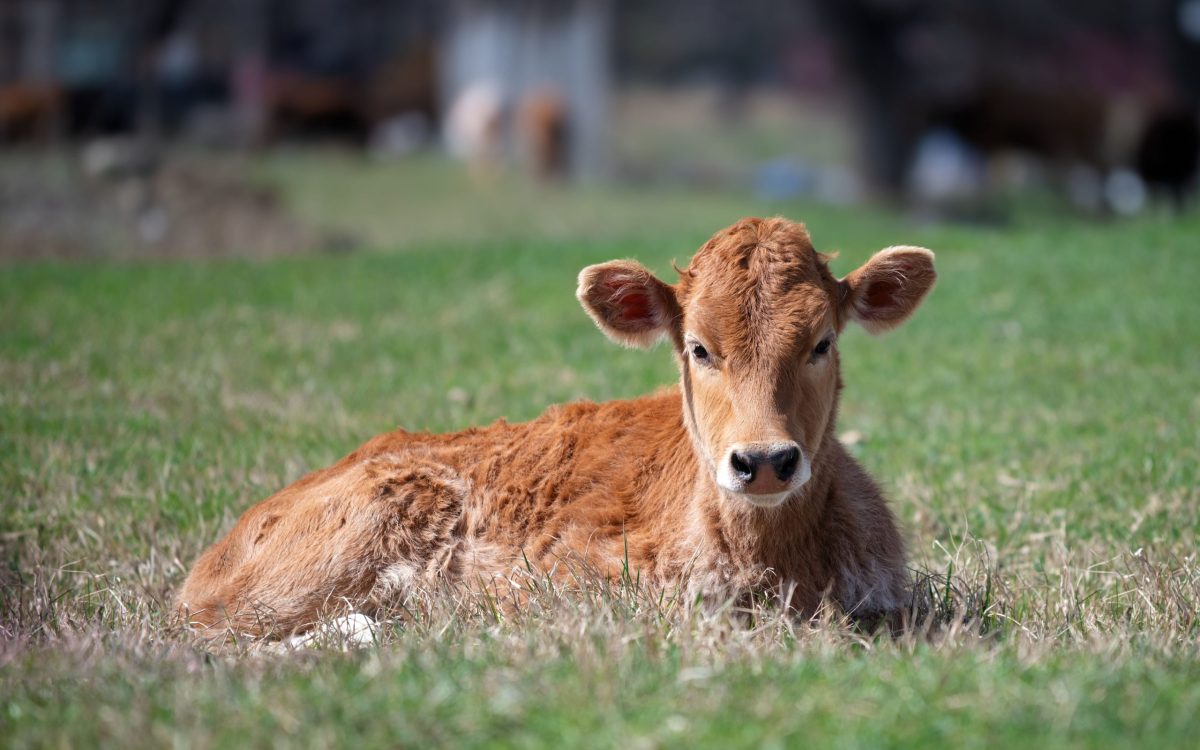
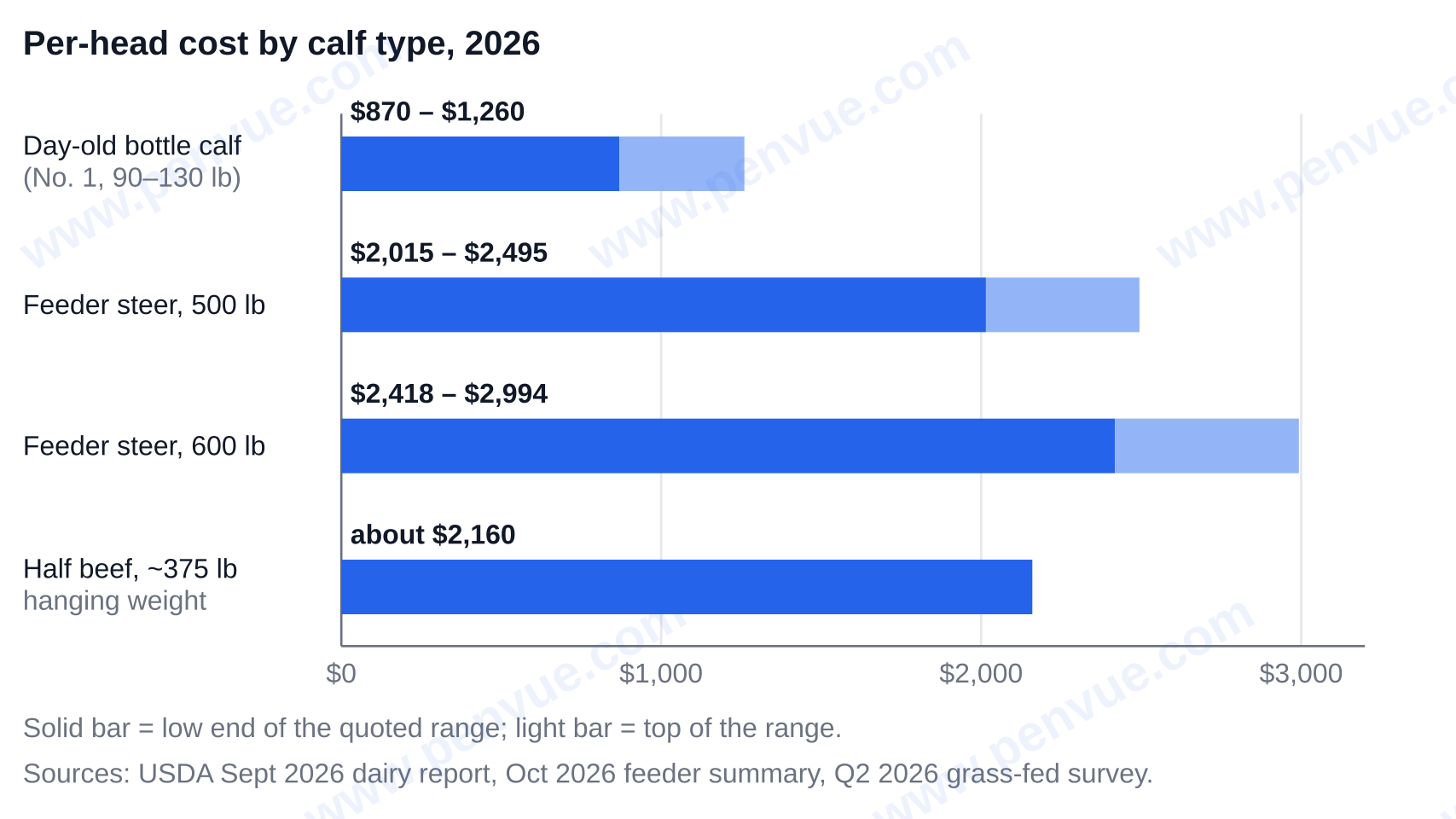
If you’ve read that day-old calves go for $40 to $50, toss that number out. What’s the cost of a calf in 2026? A newborn dairy bull calf is about $870 to $1,260 a head, and a weaned feeder calf, a 500 to 600-lb steer is about $2,015 to $2,994 a head, going by USDA price reports for September and October 2026.
The $40 figure still sits at the top of many search results. Current auction sheets price those same calves by the pound, not dollars per head. The following guide covers all 4 animals that are referred to as "a calf", the bottle calf, weaned feeder calf, bred replacement female, and the half-beef order that is not a live animal at all. You will also learn the one-line formula to convert any live market quote to the price of the calf that’s in front of you.
How much is a calf right now, by type?
Four different purchases go by the same word, "a calf." Each purchase is also quoted in a different unit, which leads to the conflicting price guides. The following provides a conversion table.
| What you actually mean | How it is priced | Current quote | Works out to |
|---|---|---|---|
| Day-old bottle calf (wet calf, 0–14 days) | Per head or per pound, at the dairy or the sale barn | No. 1 grade dairy bull calves, 90–130 lbs, averaged $970.01 per cwt in USDA’s September 2026 National Dairy Comprehensive Report; No. 2 grade bulls at 85–120 lbs averaged $825.09 per cwt | About $870 to $1,260 a head at the No. 1 average, depending on where the calf falls in that weight band |
| Weaned feeder or stocker calf (500-600 lb) | Per hundredweight (cwt) of liveweight | $403.00 to $499.00 per cwt for medium and large frame steers in the October 2026 USDA National Daily Feeder and Stocker Cattle Summary | $2,015 to $2,495 for a 500 lb steer; $2,418 to $2,994 for a 600 lb steer |
| Bred heifer or replacement female | Per head, at dispersal sales and private treaty | No national daily quote exists; she prices off what her calf crop is worth, and calf money is at records | A multiple of feeder-calf money, because you are buying this year’s calf and next year’s with her |
| "Half a calf" of freezer beef | Per pound of hanging weight, plus processing | Halves averaged $5.76 per pound hanging weight and quarters $6.23 per pound in the USDA AMS grass-fed survey for Q2 2026 | About $2,160 for a half at roughly 375 lb hanging, which yields in the region of 225 lb of packaged meat |
The price ranges provided above are a snapshot. The next section will teach you to price a calf yourself on any given day, which is way more valuable than memorizing price ranges that go out-of-date in less than a month.
Why a day-old calf and a weaned calf have such different price tags
There is a reason there is a big difference in price between day-old calves and weaned calves. A newborn is a bet. Many things can go wrong; calves can get scours, or not receive enough colostrum, and he has not been through weaning. The buyer carries every pound of gain and takes on all of that risk between day one and the calf reaching 500 lbs. Weaned, bunk-broke calves are more desirable because they have already survived the two riskiest months of their life, and the price reflects that. A day-old calf can sell for a higher price pound-for-pound than a weaned calf. In Edgewood Livestock’s September 29, 2026 sale, a 95 lb Holstein bull calf topped the sale at $13.00 per pound, which is $1,300 per cwt. Feeders quote at $403 to $499 per cwt. The day-old calf’s cheque per head is far smaller all the same.
If you meant half a beef, not a live animal
There are many people looking for calf prices that do not want to purchase a live calf. Many people want a freezer full of beef and hear the phrase "buying half a calf." That is a meat order, priced per pound of hanging weight, and the live-animal numbers on this page do not apply to it. Jump to the last section before you price a live calf for that job — the arithmetic usually points the other way.
How do you work out the price of the specific calf in front of you?
Calculate the price for the calf you’re looking at like this:
(weight in lb × price per cwt) ÷ 100 = price per head
Work it with the current quote. A 500 lb steer at $403 per cwt is (500 × 403) ÷ 100 = $2,015. The same calf at the top of the reported range, $499 per cwt, is $2,495. Step up to 600 lbs and the same quotes give you $2,418 and $2,994. That spread — nearly a thousand dollars on one weight class — is why a static price range is close to useless and the formula is not.
What cwt means and how to convert it to a price per head
Hundredweight means 100 pounds. And remember, a quote of $450 per cwt means $4.50 per pound of liveweight. This is also why heavier calves carry a lower per-cwt number but a bigger total: the market pays less per pound as the pounds pile on because the easy, cheap gain is behind the animal. A 350 lb calf will quote a much better price than a 700 lb calf per hundredweight and still cost less to take home.
Day-old calves are the exception to this. The dairy and the sale barn usually quote them per pound or per head. So, when comparing prices, make the needed conversions. A $9.00 per pound bottle calf would cost $900 per cwt — put that next to the $403 to $499 per cwt a feeder brings and you’ll see what you are really paying for weight you have not yet put on.
Pulling today’s number from the USDA report
No subscription needed for this info. For feeders and stockers, check the USDA AMS National Daily Feeder and Stocker Cattle Summary for per-cwt ranges by weight class, sex, and frame and muscle score. The monthly National Dairy Comprehensive Report gives grades and weights for day old dairy calves. For the direction of travel rather than today’s cash prices, look at the CME Feeder Cattle Index and feeder cattle futures.
In practice, the sequence at a sale barn is the same every time. Locate your weight class on the report. Locate your sex (steers and heifers are quoted separately). Locate your frame and muscle score. Then run the formula on the weight the auctioneer actually calls, not the weight you guessed standing in the alley.
Treat it as a ceiling, not a target. Commission, yardage, freight, and a shrink allowance all sit on top of that. The quote doesn’t account for transport costs or loss. A calf bought at the quote and hauled 200 miles is costlier than the quote.
What moves a calf’s price up or down?
As stated previously, weight class plays the biggest role. After that, these are the levers that separate two calves of identical weight on the same day.
Sex. Steers typically command a higher price than heifers of the same weight. Bull calves are discounted against steers, as the buyer takes on the cost as well as the setback of castration.
Breed and genetics. English and English cross beef calves bring top dollars in the quoted range. Straight Holstein bull calves sit at the bottom.
Health and management. A weaned, bunk broke, and twice vaccinated calf that is part of a documented preconditioning program will sell for a premium when compared to an unweaned and unvaccinated calf of the same weight. A discount on a recently weaned calf is not sentiment. It is the buyer factoring in death loss.
Frame, muscling, and fill. USDA frame and muscling scores will place which end of the quote you are against. It is also important to consider fill. A gaunt, tucked up calf will weigh differently from a filled calf of the same animal.
Season and volume. Spring and fall calving runs will push the most calves through the ring in October and November, and heavy volume softens price.
Region and lot size. Freight distance to the feedyards shifts the number, and so does whether your calf sells as a single head or inside a uniform load lot. The method of sale (ring or private treaty) can also move the same calf several hundred dollars.
Why dairy calves and beef calves price so differently
Straight Holstein bull calves will never hang a beef carcass. Holsteins grow tall and lean, convert feed differently, and yield a carcass the packer pays less for. A beef-bred calf is built for the job from birth. This is why Holsteins and beef calves are at opposite ends of the same report.
Beef-on-dairy crossbreds and the premium they earn
Dairy cows bred by beef bulls result in calves with the drinking habits of a dairy calf but the finishing ability of a beef animal. Those crossbred calves bring a real premium over straight Holsteins of the same age and weight. That premium has been the most drastic change to the day-old calf market in recent years. If you buy bottle calves for beef, this is the important distinction to know before price.
Where should you buy, and what does each option cost you?
Livestock auction or sale barn. You get the largest selection and the truest market price, because the price is set in front of you. There you will find commingled calves of unknown health history. It is also the most risky for the first 2 weeks for contracting respiratory diseases.
Dairy farm direct. The cheapest route to a day-old calf. Here you can actually see the person face to face and ask if the calf received colostrum. The answer will be more important than the price.
Private treaty from a cow-calf producer or neighbour. It will cost you a premium over sale barn money, but you will have the security of knowing the genetics and vaccination status, and the calf will not have been hauled and mixed.
Online listings. Classifieds, Facebook groups, and online video auctions are convenient and sometimes cheap. There is no recourse, and it is the most common venue for moving a sick or bottle-failed calf.
What to check before you hand over money
- Navel: dry and clean. If thick or wet, it’s bad. It should not smell.
- Eyes and nose: bright eyes and nose with no discharge. Ears should be up.
- Manure and hydration: firm manure, no scour staining down the back legs. When pinched, the skin should snap back.
- Suck reflex on a baby: a baby that will not suck your finger will not take a bottle.
- Movement: calf should get up on its own and be walking on its own.
- Paperwork: vaccination record, and some account of the dam.
Walk away from a droopy-eared newborn with a wet navel, from any calf priced at a premium with no vaccination record, and from a seller that will not talk about the dam. Plan the haul and what you will do for the first 48 hours before you buy, not after. That is when most bought calves are lost.
What does the calf cost after you buy it?
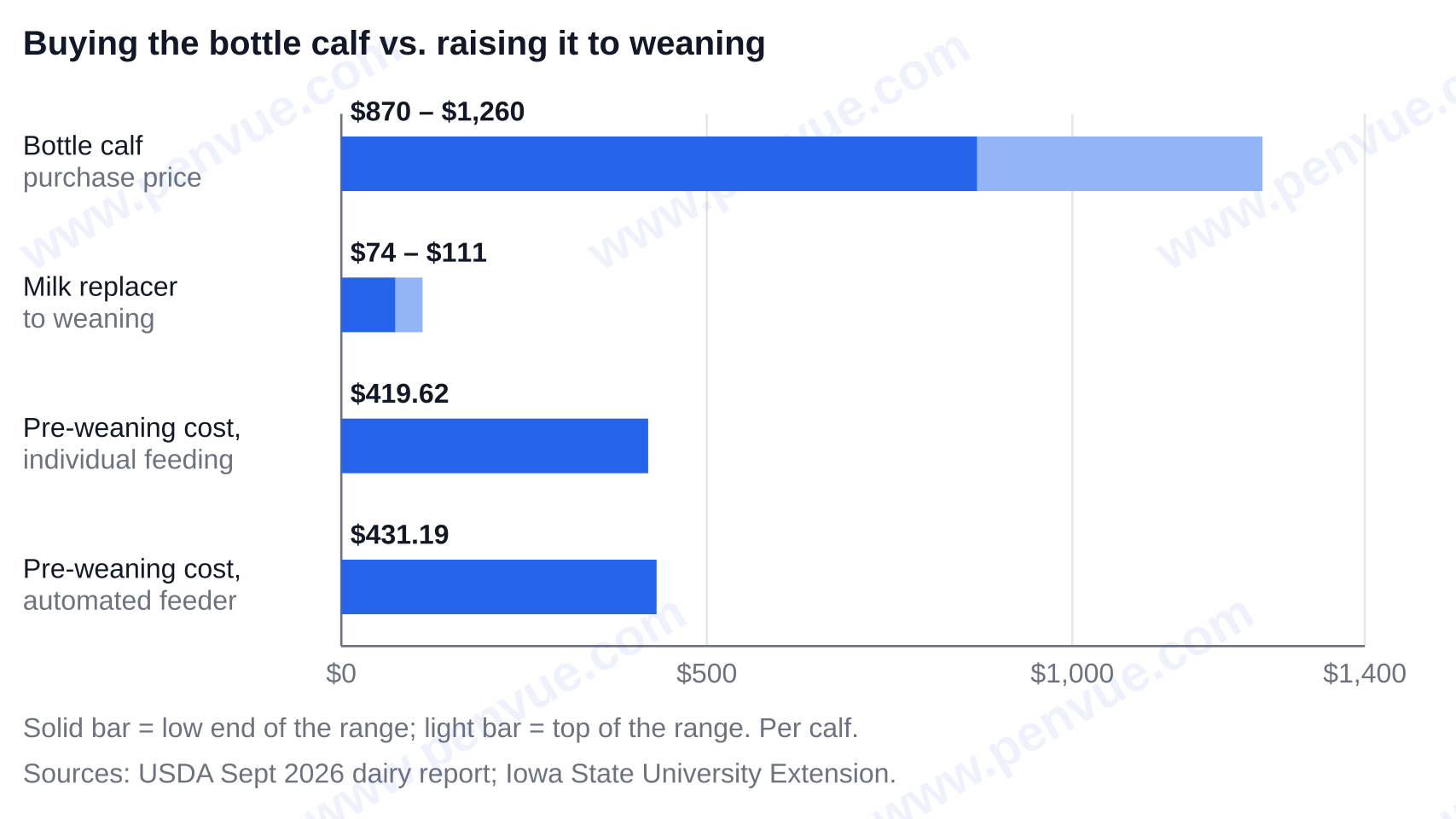
Here is the number almost no price guide attaches: the purchase price is often the smaller half of the first year’s cost. Milk replacer alone is between $74 and $111 per calf to weaning, and Iowa State University Extension puts total pre-weaning rearing cost near $419.62 per calf in individual feeding systems and $431.19 per calf in automated feeder systems.
Read that against a bottle calf bought for $870 to $1,260. The cost of the first eight weeks of a bottle calf can approach half again the cost of the animal and it hasn’t eaten its first morsel of grass. New bottle calf buyers usually lose money with the first bottle calf and that is why an inexpensive calf is usually an expensive calf.
What it costs to get a bottle calf to weaning
The costs change shape rather than stop after a calf has been weaned. Expenses for hay, grain or creep, and free-choice mineral are scaled to the weight you want to add. Anticipate the cost of initial vaccinations and boosters, deworming, castration, and dehorning if they are still ahead of you. Have a realistic estimate for scours and pneumonia rather than hoping for no vet bills.
Infrastructure has to exist before the calf arrives. You will want fencing that holds a calf, water he can reach, shelter from the elements, and handling facilities you can catch and work the calf in alone. On land, the working rule of thumb is that one to two acres of decent pasture supports one animal unit and more on thin ground — check your county extension’s stocking rate for your soil before you count on grass. If the end point is the freezer, add the haul and the processing: a kill fee plus cut-and-wrap charged per pound of hanging weight.
Why are calf prices so high, and does buying one still pay?
Supply. The U.S. herd has been contracting since a decline that began in 2015. As of January 2026, USDA’s Cattle Inventory put the U.S. herd at 86.2 million head. That’s down from 86.5 million the previous year. Fewer cows mean a smaller calf crop, and feedyards bidding against each other for that shrinking crop is what sits underneath every figure on this page. USDA expects 750-800 lb feeder cattle to average $364 per cwt in 2026. That’s about 13% above the 2025 average of $322 per cwt.
From the producer’s point of view, the market looks good. In a spring-calving budget published February 27, 2026 by the University of Kentucky, 2026 calf prices were projected between $3.50 to $4.00 per pound on a 550 lb weaning weight — roughly $1,925 to $2,200 per head. Against about $667 per cow in specified cash expenses, the budget projected around $846 per cow in return to land and labour.
Calf, bred heifer, or just buy the beef?
That same market is exactly why the typical advice — start cheap, buy a calf instead of a cow — fails for some buyers now. If all you want is a freezer full of beef, asking how much a calf is answers the wrong question. Raising a calf for beef means you would be buying a record-priced animal and then paying a year of feed, health, and processing to convert him. Paying for a half of finished beef at $5.76 per pound hanging weight runs about $2,160 for roughly 225 lb of packaged meat. That comes with no fencing, no scours, and no death loss. For that buyer, the half wins.
The calf route pays for a different person: someone with grass already standing, who intends to keep producing rather than fill one freezer, and who can absorb a death loss without the year going underwater. If that is you, and you plan to stay in, price a bred female or a cow-calf pair alongside the calf and see if that changes the equation. She costs far more up front and comes with a calf crop, which changes the arithmetic entirely.
Three things to carry out of this guide. First, the $40 bottle calf is gone — the same animal averaged $970.01 per cwt in USDA’s September 2026 dairy report. Second, there is no single answer to how much a calf is, only the one you calculate: (weight × $/cwt) ÷ 100. Third, pull today’s USDA National Daily Feeder and Stocker Cattle Summary, find your weight class and sex, and run that number before you raise your hand at the ring. There’s plenty more to dig into on Penvue.
People Also Ask
How much does a bottle calf cost in 2026?
Anywhere from $870 to $1,260 a head. No. 1 grade dairy bull calves, aged 0–14 days and weighing 90–130 lbs, were reported by the USDA in their September 2026 National Dairy Comprehensive Report at an average of $970.01 per cwt. No. 2 grade bulls at 85–120 lbs averaged $825.09 per cwt. Sale barns quote the same calves per pound: on September 29, 2026, dairy bull calves trended $5.25 to $12.00 per pound at Edgewood Livestock, and a top 95 lb Holstein bull calf sold that day for $13.00 per pound. The widely repeated $40 to $50 figure is years out of date.
How much is a 500 lb calf worth?
Between $2,015 and $2,495. According to the October 2026 USDA National Daily Feeder and Stocker Cattle Summary, medium and large frame feeder steers weighing 500–600 lbs were quoted at $403.00 to $499.00 per cwt. Do the math yourself: (500 × 403) ÷ 100 = $2,015 at the bottom of the range, and (500 × 499) ÷ 100 = $2,495 at the top. Heifers of the same weight usually fetch less than steers, and freight, commission, and shrink sit on top of whatever you calculate.
Is it cheaper to buy a calf or a bred cow?
A calf is cheaper to buy and more expensive to own. The University of Kentucky’s February 2026 spring-calving budget assumes 2026 calves at $3.50 to $4.00 per pound on a 550 lb weaning weight, which is approximately $1,925 to $2,200 per head, against roughly $667 per cow in specified cash expenses and a projected $846 per cow return to land and labour. A bred female costs far more up front but arrives carrying a calf crop, so if you intend to keep producing, her higher price buys you income rather than just an animal.
How much land do you need per calf?
A good rule of thumb is one to two acres of decent pasture per animal unit, and more on thin or dry ground. Variability in rainfall, soil, and forage species makes the stocking rate extremely site specific, so check your county extension service’s published rate for your area before you count on grass carrying the animal. If you are short on acreage, budget for hay and grain year-round rather than assuming pasture will cover the gap.