

A Political Action Committee (PAC) collects voluntary contributions from many people and spends it to support or oppose candidates, parties, ballot measures or legislation. The full answer to what is a political action committee adds three legal facts: a federal PAC registers with the Federal Election Commission, discloses its donors, and gives to candidates only in capped amounts.
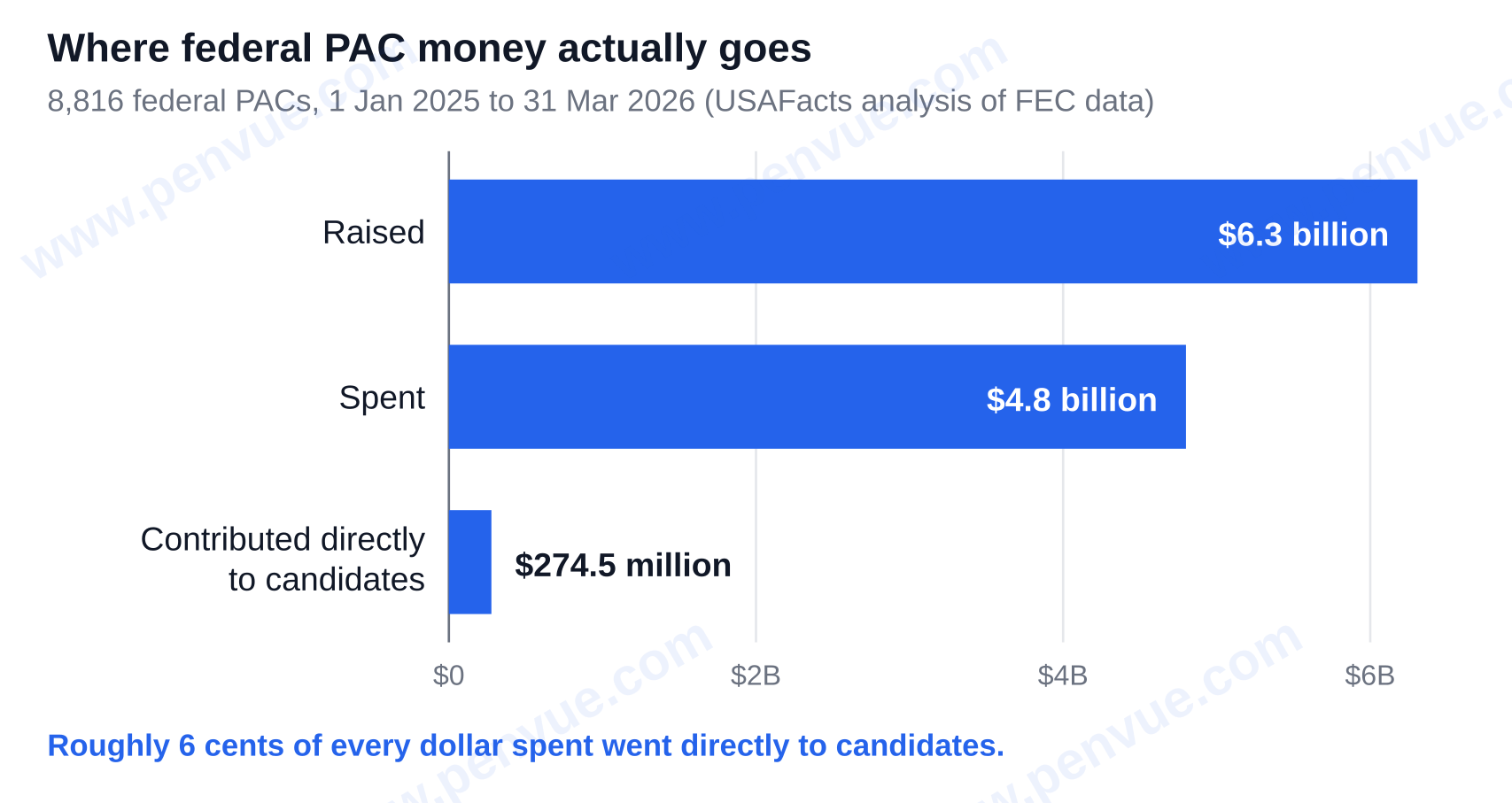
The number that puts the whole topic in proportion. USAFacts’ analysis of FEC data reports that, for the reporting period of 1 January 2025 to 31 March 2026, there were 8,816 federal PACs. During that time, they raised $6.3 billion, spent $4.8 billion, and contributed $274.5 million directly to candidates. That means, of the total amount spent, PACs contributed roughly 6 cents of every dollar to candidates. Hold onto that figure; it explains more about PACs than any definition does.
What is a political action committee, in one sentence?
It is a middleman for political money. A lot of people give small or mid-size contributions to a committee, and the committee decides where the money goes.
The two words “pools” and “disburses” explain the concept the best. “Pools” means a lot of people give money to a PAC, and “disburses” means the PAC gives the money to candidates or spends it on advertisements or other expenses. It is rarely the final destination.
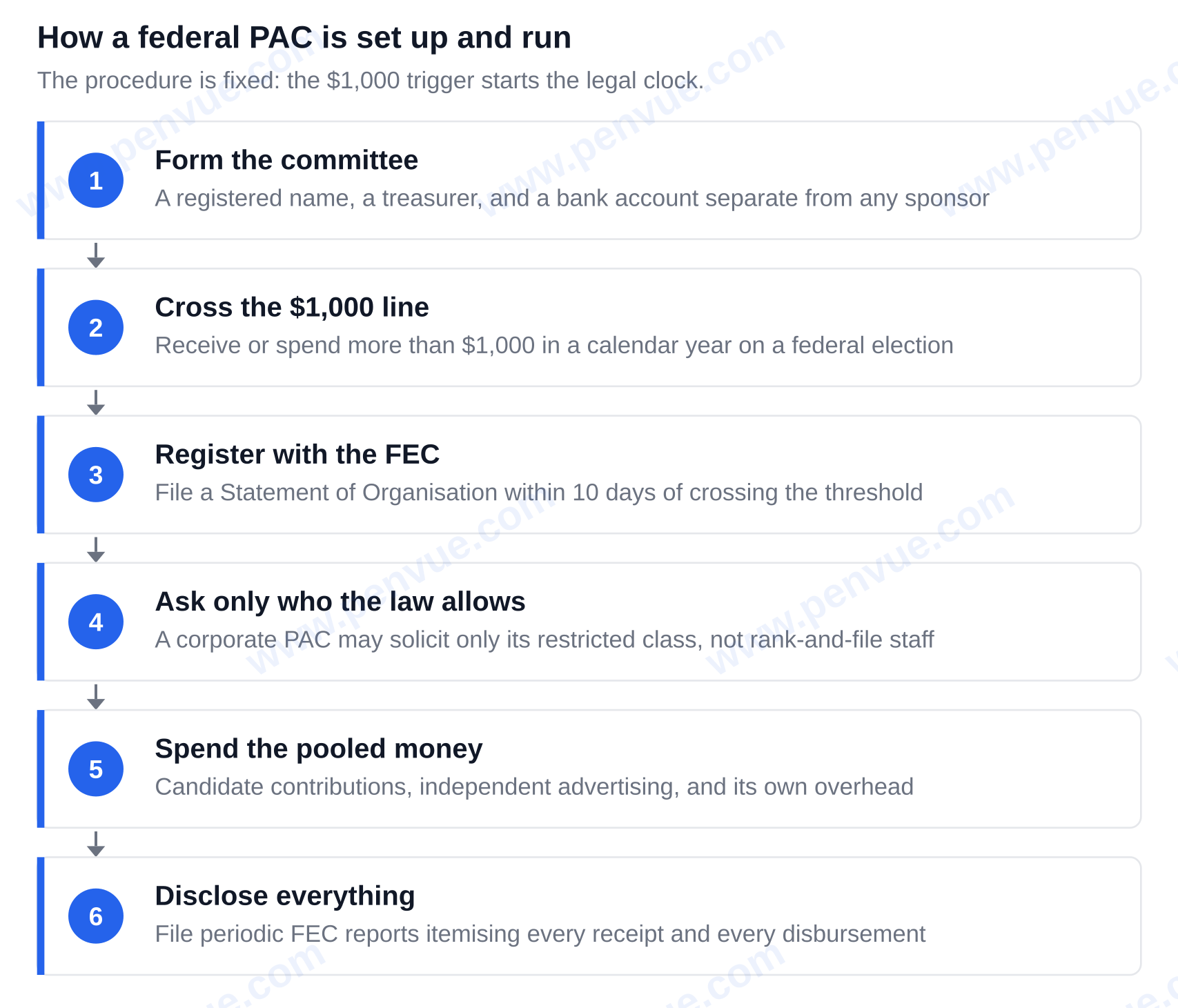
There are three parts to every federal PAC: a registered name, a treasurer who is personally responsible for the filings, and a bank account kept separate from any sponsoring organisation. A federal PAC is a 527 organization for tax purposes. A 527 organization is not a charity, and contributions to it are not tax-deductible.
PAC vs. campaign vs. lobbying group — three things people mix up
- A campaign committee is tied to one candidate and spends money to help that candidate get elected. A PAC is not tied to a candidate (except for leadership PACs, described below).
- A lobbying firm charges clients to make arguments to lawmakers. A PAC gives money; it does not bill clients for advocacy.
- A 501(c)(4) advocacy group can do advocacy and run political ads without disclosing its donors. A PAC has to disclose its donors. The two can be aligned, which is why they are confused.
Where the term “PAC” came from, and why it was invented
The first PAC was the CIO-PAC, formed in July 1943 under Congress of Industrial Organisations president Philip Murray and headed by Sidney Hillman, to back Franklin D. Roosevelt’s 1944 re-election.
It was formed because of a ban. The Smith–Connally Act of 1943 barred unions from funding federal candidates with their treasury money, so the CIO collected small voluntary contributions from individual members and spent it. The PAC was created as a compliance structure — a legal way to raise capped, disclosed, member-funded money. It was not created as a loophole for large donors.
The modern framework began taking shape in 1971 with the passage of the Federal Election Campaign Act. This legislation established the basic disclosure and contribution limits that the Federal Election Commission enforces. The years to memorize are 1943 (first PAC), 1971 (FECA), 2010 (super PACs).
How a PAC works, and who it may legally ask for money
The procedure is fixed. A group of people decides to form a committee, names a treasurer, opens a dedicated bank account, asks for money from people it may legally ask for money from, and spends that money on federal candidate contributions, independent advertising, and/or its own overhead.
The $1,000 trigger and the 10-day registration window
There is a bright line. Once an organization receives or spends more than $1,000 in a calendar year to influence a federal election, it is a PAC and has to register with the FEC by filing a Statement of Organisation within 10 days. After that, it must file periodic reports with the FEC that disclose every penny it spent and every dime it received, which is why you can look up a PAC’s contributors yourself in the FEC’s filings database.
There are three absolute prohibitions: (1) no money from foreign nationals; (2) no contributions given in someone else’s name; and (3) no corporate or union treasury money in the account used for candidate contributions.
The restricted class, which trips almost everyone up
The usual shorthand — “a PAC raises money from like-minded people” — is wrong for the most common type. The most common type is a corporate-connected PAC, formally a separate segregated fund, which is only allowed to solicit its restricted class: salaried management, professional and supervisory employees who have policymaking responsibility, plus shareholders, plus the families of both. Hourly and rank-and-file staff may not be solicited by the company PAC at all, and every solicitation must explain that giving is voluntary and that refusing carries no consequence of work.
Practically speaking, that’s why the PAC of a large employer has never asked most of its own workforce for a cent.
The main types of PAC
There is not a single uniform structure behind the acronym, so what a political action committee is depends on the type being discussed.
- Connected PAC (separate segregated fund) — established by a corporation, union, trade association or membership group, and is restricted to soliciting its own restricted class. These PACs can give directly to candidates, within the limitations.
- Non-connected PAC — an ideological or single-issue PAC and the fastest growing segment. These PACs can solicit the general public. The FEC classes as non-connected anything that is not a party committee, a candidate’s authorised committee, or an SSF.
- Leadership PAC — established by a sitting elected official to support colleagues, and build or maintain influence. These contributed nearly $69 million to federal candidates in the 2024 cycle.
- Super PAC (independent expenditure-only committee) — allows unlimited funds from individuals, corporations, and unions. Cannot give money to political candidates or to political parties. Cannot work with political candidates.
- Hybrid, or Carey, PAC — has two accounts. A limited account for candidate contributions and an unlimited account for independent expenditures only.
Super PACs were made possible because of the two 2010 decisions Citizens United v. FEC and SpeechNow.org v. FEC. Together, these cases allowed for unlimited, independent political spending. The Campaign Legal Center’s guide to election spending vehicles states that super PACs do report their donors. Dark money, in the eyes of the public, is usually associated with 501(c)(4) groups that do not disclose their donors.
How much a PAC can give and receive
Most explainers state this as a lump sum, stating “$5,000 per election”. This is inaccurate for newly formed committees. There are two tiers, and the FEC’s contribution limits chart distinguishes them on every row.
| 2025–2026 federal cycle | Multicandidate PAC | PAC not yet qualified |
|---|---|---|
| To a federal candidate, per election | $5,000 | $3,500 (indexed) |
| Practical ceiling per cycle (primary + general) | $10,000 | $7,000 |
| To a national party committee, per year | $15,000 | $44,300 (indexed) |
| From an individual into the PAC, per year | $5,000 | $5,000 |
Indexed numbers are adjusted for inflation every odd-numbered year. Therefore, both the $3,500 and $44,300 figures on the chart are subject to change. The chart should be consulted before the figures are relied upon.
Qualifying as a multicandidate committee under the FEC includes registration with the commission for at least 6 months, 51 or more unique contributors, and contributing to at least 5 different federal candidates.
Are PAC donations tax-deductible?
PAC donations are not tax-deductible. Contributions and payments to political organisations — candidates, parties, campaign committees and PACs alike — are not deductible for individuals, and businesses cannot deduct political contributions either. Every competing explainer leaves that loop open; the answer is simply no.
The word has drifted — and the money mostly doesn’t reach candidates
Here is the argument this page makes that the ranking pages do not. “PAC” was coined in 1943 for a capped, fully disclosed, small-dollar committee. The structure of modern PACs, which allow for unlimited money and no direct giving, only became possible 67 years later in 2010. So, PACs as formed in 1943, and the structure of PACs made possible in 2010 are almost opposites — and they share a name.
The split is measurable. Out of the 8,816 federal PACs documented by USAFacts, 2,236 were super PACs. So, about a quarter of all federal committees are the unlimited-money kind and the other three-quarters are the capped kind that writes cheques to candidates — and most people asking what is a political action committee are picturing the quarter, not the three-quarters.
There is also the six-cent ratio: $4.8 billion spent and $274.5 million contributed by PACs to candidates. In the modern PAC system, the money raised is overwhelmingly spent on media buys, consultants, fundraising costs, polling and staff rather than used to give money directly to campaign accounts. This means that when a headline states that a PAC spent $10 million to support a candidate, it almost never means the candidate’s campaign received $10 million. The two facts imply very different things about influence.
Stated fairly, both sides of the debate can frame that number the way they want. Critics of PACs argue that PAC money purchases access, not votes, and that disclosure is undercut by non-disclosing affiliates. Defenders of PACs argue that pooled giving is protected association, and that disclosure is the true safeguard. Six cents cuts both ways: less direct money to candidates, far more persuasion spending that no one votes on.
Always remember, a political action committee is a pooled-money vehicle, and the word PAC now covers two structures that work in opposite directions. So make sure you understand which structure a story is referring to. What changes next is the arithmetic. Those indexed limits reset in odd-numbered years, so the non-qualified and party figures will shift again for the 2027–2028 cycle. Pick any committee name you have seen in the news, do a search for it in the FEC’s filings database, and you’ll see who funded it, what it spent, and how little of that went to a campaign. You’ll find similar guides across Penvue.
People Also Ask
Who regulates PACs, and are they legal?
Federal PACs are entirely legal and are regulated by the FEC under the Federal Election Campaign Act of 1971. A PAC is required to file a Statement of Organization, name a treasurer, and maintain a dedicated bank account. A PAC is also required to file periodic reports itemising what it received and what it spent. State-level committees are regulated separately by the state’s election authorities.
Can a foreign company or foreign national give money to a PAC?
No. It is illegal for foreign nationals to contribute in connection with any US election, and that ban applies to PACs and super PACs alike. It is also illegal to make a contribution in another person’s name, which closes the obvious workaround. These are among the strictest prohibitions in federal campaign-finance law.
How do you start a political action committee?
The trigger is financial, not formal: once you receive or spend more than $1,000 in a calendar year to influence a federal election, you have become a PAC and must register with the FEC within 10 days by filing a Statement of Organization. Before reaching this threshold, you need a committee name, a treasurer who accepts personal responsibility for the reporting, and a bank account separate from any sponsoring organization.
Can a candidate control or coordinate with a super PAC that supports them?
A candidate cannot control or coordinate with a super PAC. A super PAC is an independent expenditure-only committee. That means it may spend unlimited amounts of money to advocate for or against a candidate, but it is not permitted to coordinate that spending with the candidate or the candidate’s campaign, and it may not contribute to a candidate or party committee at all. That independence requirement is the trade-off for being allowed to raise unlimited money from individuals, corporations, and unions.
Do PACs have to say where their money came from?
Yes. Both traditional PACs and super PACs must report their receipts and disbursements to the FEC (Federal Election Commission), and the FEC has a searchable database of filings on their website. The gap people notice is elsewhere: 501(c)(4) advocacy groups can run comparable political advertising without disclosing donors, and the “dark money” most people are referring to is that funding by 501(c)(4)s — not PACs themselves.

