


The Oedipus family tree is short, royal, and folded once in the middle: Oedipus was the son of King Laius and Queen Jocasta of Thebes, raised in Corinth by Polybus and Merope, and he unknowingly married Jocasta. Their four children — Eteocles, Polynices, Antigone, and Ismene — are at once his children and his maternal half-siblings.
That single fold is the whole story. This guide walks the line from Cadmus down to Oedipus’s grandson, tabulates every double label in one place, fixes the kinship term most study guides get wrong, and shows you where the ancient sources disagree about who the mother of those four children really was.
What does the Oedipus family tree actually look like?
Read it top to bottom as five generations of Theban kings, with one short Corinthian branch off to the side. Only one edge in the whole diagram is unusual — and it generates every strange label underneath it.
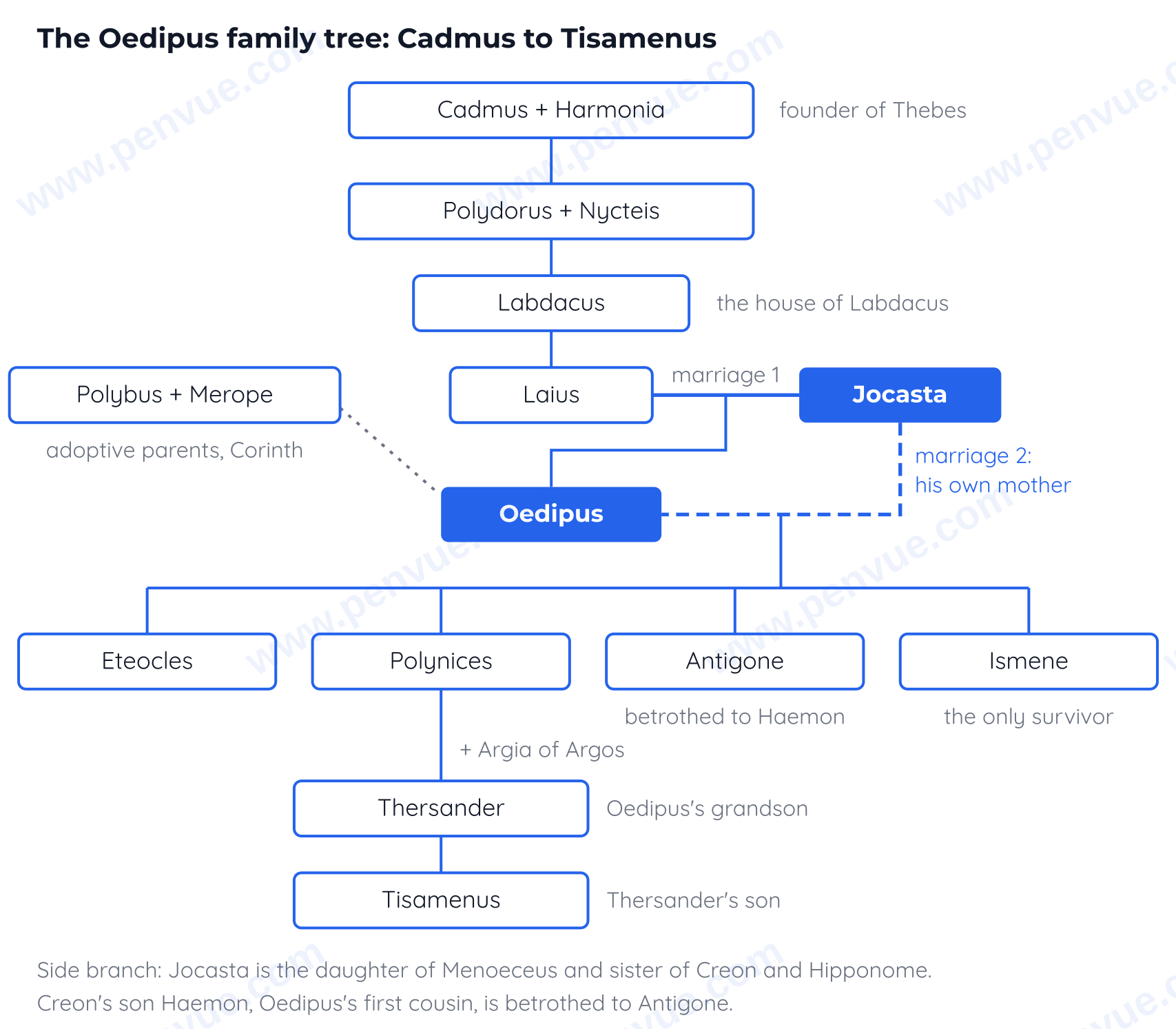
The diagram in text form (copy this into your notes)
- Cadmus + Harmonia — founder of Thebes and his wife
- Polydorus + Nycteis
- Labdacus — his descendants are the Labdacids, “the house of Labdacus”
- Laius + Jocasta (marriage line 1)
- Oedipus — exposed as an infant, raised in Corinth by Polybus + Merope
- Oedipus + Jocasta (marriage line 2 — his own mother)
- Eteocles
- Polynices + Argia of Argos
- Thersander
- Tisamenus
- Thersander
- Antigone — betrothed to Haemon
- Ismene
- Oedipus + Jocasta (marriage line 2 — his own mother)
- Oedipus — exposed as an infant, raised in Corinth by Polybus + Merope
- Laius + Jocasta (marriage line 1)
- Labdacus — his descendants are the Labdacids, “the house of Labdacus”
- Polydorus + Nycteis
And the side branch that supplies the uncle, the regent, and the fiancé:
- Menoeceus, a descendant of Cadmus
- Jocasta — marries Laius, then Oedipus
- Creon + Eurydice
- Haemon — betrothed to Antigone
- Hipponome
How to read the two marriage lines
If you are drawing this out, mark the two marriages differently — that is the trick that makes the chart legible.
- Marriage line 1: Laius + Jocasta, producing Oedipus. Ordinary parent-child descent.
- Marriage line 2: Oedipus + Jocasta, one generation lower. Draw this one dashed or in a second colour. Jocasta now sits in two places on the same vertical: above Oedipus as his mother, beside him as his wife.
- The Corinthian branch: Polybus and Merope sit off to the side with a dotted line, not a descent line. They had no biological children of their own, which is exactly why they raised Oedipus as their heir — and why he is no blood relation to them at all.
- The generation almost every chart cuts: Polynices and Argia, daughter of Adrastus of Argos, had a son — Thersander, Oedipus’s grandson. Most diagrams stop one row too early.
Three lines of orientation if you skimmed the diagram: one mother is shared across two generations; one brother-in-law is also an uncle; one cousin is also a fiancé. Everything below is the consequence of those three facts.
Who is who twice over? The double-label lookup table
Here is the table you have been building in your head while reading every other family-tree page. Each person’s first relationship to Oedipus, their second simultaneous relationship, and where you will meet them in Sophocles’ Theban plays.
| Person | First relationship to Oedipus | Second, simultaneous relationship | Appears in |
|---|---|---|---|
| Jocasta | Mother | Wife — and grandmother to her own children | Oedipus Rex (dead before Oedipus at Colonus) |
| Antigone | Daughter | Maternal half-sister | All three plays |
| Ismene | Daughter | Maternal half-sister | All three plays — the only child who survives |
| Eteocles | Son | Maternal half-brother | Named in Oedipus at Colonus; dead before Antigone opens |
| Polynices | Son | Maternal half-brother | Oedipus at Colonus; his unburied corpse drives Antigone |
| Creon | Maternal uncle (Jocasta’s brother) | Brother-in-law, by Oedipus’s marriage to Jocasta | All three plays |
| Haemon | First cousin (Creon’s son) | Nephew — and both first and second cousin to Oedipus’s four children | Antigone |
| Eurydice | Aunt by marriage | Prospective mother-in-law to Antigone, who is also her husband’s great-niece | Antigone |
| Polybus and Merope | Adoptive parents | None — the only clean relationship on the page | Referred to in Oedipus Rex |
Why one person can hold two labels at once
One rule generates every row above. Because Jocasta occupies two positions in the tree — once as Oedipus’s mother, once as his wife — every person below her has two routes to the same relative. Trace Antigone up through her father and you reach Laius; trace her up through her mother and you reach Jocasta, who is also Oedipus’s mother. Same with Creon: he is Jocasta’s brother by blood and Oedipus’s brother-in-law by marriage, and both are true simultaneously. Timeless Myths notes the Haemon case in the same way — first and second cousin to Oedipus’s children at the same time, by the two separate paths.
Half-sister or sister? The exact kinship term students get wrong
Antigone is Oedipus’s daughter and his maternal half-sister — not his full sister. In practice, this is the single correction worth the most marks on a Theban-plays essay, because the loose version is everywhere.
The arithmetic is simple, and it is the step most summaries skip:
- Full siblings share both parents.
- Oedipus’s father is Laius. Antigone’s father is Oedipus.
- They share one parent only — Jocasta.
- One shared parent out of two means half-sibling. The prefix is not optional.
The same fix applies across the set. Eteocles and Polynices are Oedipus’s sons and his maternal half-brothers — not his nephews, which is a common slip because Creon stands in the uncle role and readers transfer it downward. Haemon’s double cousinship works by the same logic from the other direction: he is Oedipus’s first cousin through Menoeceus, the father Creon and Jocasta share, and a nephew a second time over through Oedipus’s marriage into that same sibling group.
How to write the relationship in an essay
Write it as one sentence that names both labels and the parent they run through: “Antigone is both Oedipus’s daughter and, through Jocasta, his half-sister.” That shows you understand the mechanism rather than repeating a label.
Be aware that you are contradicting the majority here. Most study guides and AI-generated summaries say simply “brother and sister,” and Sophocles’ own text leans on the horror rather than the genealogical vocabulary — which is why the loose phrasing spread so widely. The precise term is still the defensible one, and it is the one that survives a marker asking you which parent they share.
Who are Oedipus’s parents, and who actually raised him?
Two sets, and only one of them is blood.
Laius and Jocasta: the Theban parents
Laius was king of Thebes and the last of the direct Labdacids. Jocasta was the daughter of Menoeceus, a descendant of Cadmus, with two siblings — Creon and Hipponome. Expect her name to shift between editions: she appears as Iocaste in Latinised texts and as Epicaste in Homer’s Odyssey. Oedipus himself is addressed with the patronymic Laiades, “son of Laius,” which is a small irony the play plants long before he knows it.
Polybus and Merope: the Corinthian parents
Polybus and Merope were king and queen of Corinth, and childless. They raised Oedipus as their own heir, which is the hinge of the entire plot: believing the oracle pointed at them, Oedipus fled Corinth to protect them — and walked straight toward Thebes, his father, and his mother.
The curse before the prophecy: Laius and Chrysippus
Most family-tree pages present the prophecy as arbitrary. It was not. Laius abducted and raped Chrysippus, son of Pelops, and Pelops cursed him to die childless or be killed by his own son. Only afterwards did the Delphic oracle warn Laius that any son born to him and Jocasta would kill him and marry her.
The rest is mechanism. The infant was exposed on the mountainside, rescued by a shepherd, and handed to Corinth — so Oedipus grew up with no way to recognise either parent when he met them. The curse did not manufacture the coincidence. The attempt to dodge it did.
Where does the family come from, and what happens to each member?
You need the ancestry for one practical reason: Sophocles’ choruses call this family “the house of Labdacus,” and that phrase only means something once you can point to Labdacus on the chart.
The Theban line above Laius: Cadmus to the Labdacids
- Cadmus, founder of Thebes, married to Harmonia.
- Pentheus, the famously ill-fated Theban king in the same generation group.
- Polydorus, married to Nycteis.
- Labdacus — from here the family are the Labdacids.
- Amphion and Zethus, who rule Thebes as an interruption to the direct line.
- Laius, then Oedipus, then Eteocles and Polynices. The Wikipedia list of Theban kings lays out the full sequence, including Creon’s regencies between reigns.
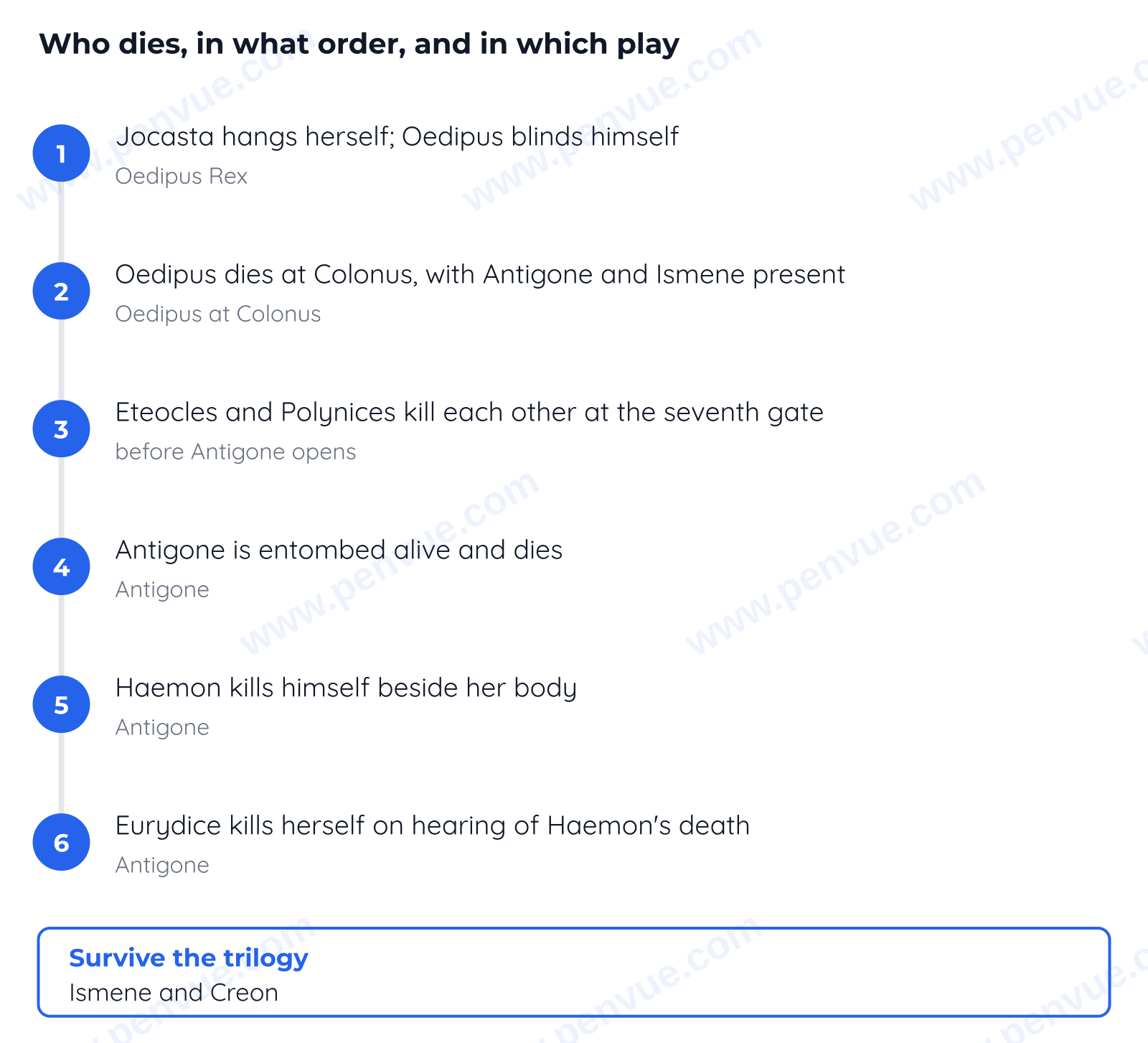
Who dies, in what order, and in which play
- Jocasta hangs herself; Oedipus blinds himself — Oedipus Rex.
- Oedipus dies at Colonus, with Antigone and Ismene present — Oedipus at Colonus.
- Eteocles and Polynices kill each other at the seventh gate, before Antigone begins.
- Antigone is entombed alive and dies — Antigone.
- Haemon kills himself beside her body.
- Eurydice kills herself on hearing of Haemon’s death.
Who survives
Two people: Ismene and Creon. Creon ends the trilogy ruling a house he has emptied — which is the shape GradeSaver’s study-guide version of the tree stops at, and it is a fair place to stop if your assignment is only the play.
If you have been assigned a single text, here is who you actually need: Oedipus Rex — Oedipus, Jocasta, Creon. Oedipus at Colonus — Oedipus, Antigone, Ismene, Polynices, Creon. Antigone — Antigone, Ismene, Creon, Haemon, Eurydice.
Did the Theban royal line end with Oedipus’s children?
No — and this is where nearly every Oedipus family tree page stops short. Polynices married Argia, daughter of Adrastus of Argos, and they had a son: Thersander.
Thersander and the Epigoni: Oedipus’s grandson on the throne
Thersander was one of the Epigoni, the sons of the Seven who had died attacking Thebes. The Epigoni captured the city roughly ten years after their fathers failed, and Thersander became king. He was succeeded by his own son, Tisamenus. So Oedipus’s bloodline holds the Theban throne for two further generations, and the king-lists run on well past the last line of Antigone.
The gap in the coverage is easy to explain. Sophocles ends the story at the household’s destruction, so study guides inherit that ending and conclude the family died out. The wider mythological tradition does not stop there.
The Euryganeia variant: was Jocasta really their mother?
Here is the one no family-tree page folds in. Ancient sources disagree about whether Jocasta bore those four children at all. Pausanias argued that Homer’s Odyssey — where the gods expose the incestuous marriage almost immediately — leaves no time for Epicaste to bear Oedipus four children, and he cited the lost epic the Oedipodea naming Euryganeia, daughter of Hyperphas, as the mother of Eteocles, Polynices, Antigone, and Ismene. Wikipedia’s genealogy box for Oedipus also lists Astymedusa among his variant consorts.
What to do with that in an assignment: cite the Sophoclean tree as the one your play uses, then note the Euryganeia tradition as evidence that this chart is a reconstruction stitched from competing sources, not a single surviving document. That is a stronger paragraph than another retelling of the prophecy.
The one rule to carry with you
The whole tree reduces to a single rule: Jocasta occupies two positions in it, so everyone below her carries two labels. Keep the double-label table open while you read, and use the precise terms — daughter and maternal half-sister, son and maternal half-brother, uncle and brother-in-law.
Then do one thing with it. Pick the relationship your assignment actually turns on, and write it out as a single sentence that names both labels and the parent they run through. That is the mechanism rather than the name — and as more summaries of this material get generated rather than written, the mechanism is the part that will keep separating a correct answer from a confident one. There’s more to read under Lifestyle.