
The oz to quart conversion comes down to one number: 32. One US liquid quart equals 32 US fluid ounces. To convert, divide fluid ounces by 32 (quarts = fl oz ÷ 32), or multiply quarts by 32 to go the other way. So 16 fl oz is half a quart, 48 fl oz is 1.5 quarts, and 64 fl oz is exactly 2 quarts.
It answers the question. The rest of this guide covers the part the charts leave out: the formulas in both directions, the full conversion tables, the three different quarts in use, the fluid-ounce vs. weight-ounce confusion, why the ounces used in a carton labeled “32 fl oz” are not the same ounces in your measuring cup, and the one case where 32 ounces is definitely not the answer.
How do you convert oz to quarts?
Two lines of math cover almost every case. Inch Calculator states the same rule you will see on every conversion page: to go from ounces to quarts, divide by 32; to go from quarts to ounces, multiply by 32.
The formula in both directions
Quarts = fluid ounces ÷ 32. Fluid ounces = quarts × 32. One US fluid ounce is 0.03125 quart, which is just 1 ÷ 32 written as a decimal.
A clean example first: 48 fl oz ÷ 32 = 1.5 quarts. Reversing it, 2.5 qt × 32 = 80 fl oz. Both directions use the same single number, so there is nothing extra to memorise once you know 32.
A worked example with an odd number of ounces
Awkward numbers are where people assume they have made a mistake. Take 5 fl oz: 5 ÷ 32 = 0.15625 quart, roughly one sixth of a quart. That long decimal is correct, not an error. Because 32 is a power of two, quantities that are not multiples of 2, 4, 8 or 16 produce decimals that run on, and rounding to 0.16 qt is fine for cooking.
Most cooks skip the calculator. A quart is 4 cups, so 32 ounces halves to 16 ounces (2 cups, half a quart) and quarters to 8 ounces (1 cup, a quarter quart). Working down from 4 cups is faster than dividing.
Before the conversion charts: all of this assumes US fluid ounces and a US liquid quart. If either assumption breaks (and it breaks more than you would think) the number changes. The next two sections cover this.
Ounces to quarts and quarts to ounces: the full conversion charts
Here is a chart showing both ounces to quarts and quarts to ounces, with fractions and decimals shown for ease of reading based on your preference.
Fluid ounces to quarts chart (1–128 oz)
| US fluid ounces | Quarts (fraction) | Quarts (decimal) |
|---|---|---|
| 1 fl oz | 1/32 qt | 0.03125 qt |
| 2 fl oz | 1/16 qt | 0.0625 qt |
| 4 fl oz | 1/8 qt | 0.125 qt |
| 8 fl oz | 1/4 qt | 0.25 qt |
| 12 fl oz | 3/8 qt | 0.375 qt |
| 16 fl oz | 1/2 qt | 0.5 qt |
| 20 fl oz | 5/8 qt | 0.625 qt |
| 24 fl oz | 3/4 qt | 0.75 qt |
| 32 fl oz | 1 qt | 1 qt |
| 40 fl oz | 1 1/4 qt | 1.25 qt |
| 48 fl oz | 1 1/2 qt | 1.5 qt |
| 64 fl oz | 2 qt | 2 qt |
| 96 fl oz | 3 qt | 3 qt |
| 128 fl oz | 4 qt | 4 qt |
Quarts to fluid ounces chart (1–8 qt)
| Quarts | US fluid ounces | Also equals |
|---|---|---|
| 1/4 qt | 8 fl oz | 1 cup |
| 1/2 qt | 16 fl oz | 2 cups, 1 pint |
| 3/4 qt | 24 fl oz | 3 cups |
| 1 qt | 32 fl oz | 4 cups, 2 pints |
| 1.5 qt | 48 fl oz | 6 cups |
| 2 qt | 64 fl oz | 8 cups, half a gallon |
| 2.5 qt | 80 fl oz | 10 cups |
| 3 qt | 96 fl oz | 12 cups |
| 4 qt | 128 fl oz | 16 cups, 1 US gallon |
| 5 qt | 160 fl oz | 20 cups |
| 6 qt | 192 fl oz | 24 cups |
| 7 qt | 224 fl oz | 28 cups |
| 8 qt | 256 fl oz | 32 cups, 2 US gallons |
Quart landmarks include: 16 oz = 1/2 quart; 32 oz = 1 quart; 64 oz = 2 quarts; 128 oz = 4 quarts = 1 US gallon. Remember those, and you can deduce the rest.
Both charts only use US liquid measures. Swap out a dry quart or a British Imperial quart, and everything changes.
Which quart and which ounce are you actually holding?
In the real world, this is where things go wrong. Nearly every page gives you 32 and stops. But what about the case where a recipe doesn’t specify ounces, and just says “quart?” Whose quart do they mean? And what if they just say “ounce” (is it a fluid ounce measuring volume, or a weight ounce?) Those create a lot more mistakes than arithmetic ever will.
All three quarts, converted to US fluid ounces
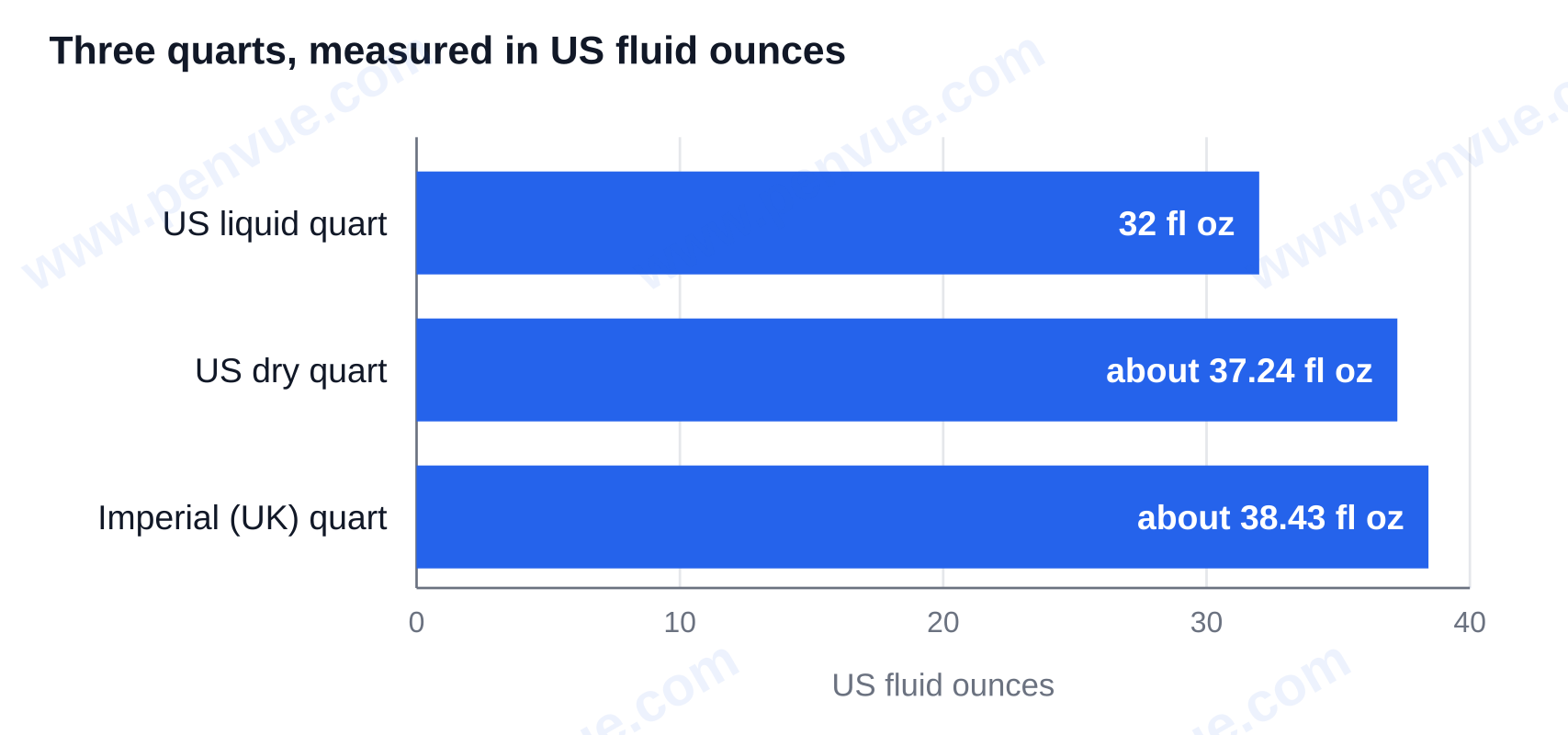
The figures for the three quarts are often given in random units (some in cubic inches, some in liters, some in imperial ounces, etc.), which makes them hard to compare. If you convert them all to US fluid ounces, they are as follows. Volumes are taken from Wikipedia’s reference figures for the quart and divided by the US fluid ounce (29.5735295625 mL, which equals 1.8046875 cubic inches).
| Quart | Defined volume | In US fluid ounces |
|---|---|---|
| US liquid quart | 57.75 cubic inches / 0.946352946 L | 32 US fl oz |
| US dry quart | 67.200625 cubic inches / 1.101220942715 L | about 37.24 US fl oz |
| Imperial (UK) quart | 1.1365225 L / 40 imperial fl oz | about 38.43 US fl oz |
The only rule that falls out of the table is imperial quart > dry quart > US liquid quart. A British quart is about 20% larger than an American quart, 40 imperial fluid ounces versus 32 US fluid ounces, and the imperial fluid ounce is also the smaller ounce at 28.4130625 mL versus the US at 29.5735295625 mL, making the US fluid ounce about 4.084% larger. Smaller ounces, more of them, larger quart.
The odd 37.24 is not arbitrary either. The two US quarts descend from two different parent units: the liquid quart is a quarter of the 231-cubic-inch US gallon (231 ÷ 4 = 57.75), while the dry quart is a thirty-second of the 2150.42-cubic-inch US bushel (2150.42 ÷ 32 = 67.200625). Two parents, two quarts. It is also why there is no such thing as a “dry fluid ounce” — the dry quart was never subdivided that way. Both definitions sit in NIST Handbook 44, Appendix C (2024 edition), and NIST Handbook 133 Appendix E, updated for the 2026 edition, still carries 57.75 and 67.2006 cubic inches unchanged. These numbers are not drifting.
Fluid ounces vs weight ounces — and what a quart of water really weighs
A fluid ounce measures volume. The ounce on your kitchen scale is an avoirdupois ounce, 28.3495 grams, and measures weight. They share a name and nothing else, so 32 ounces on a scale is not a quart of anything.
Here is the loop almost no page closes: a quart of water does not weigh 32 ounces. One US liquid quart is 0.946352946 L, so about 946 g of water, which works out to roughly 33.4 avoirdupois ounces (946 ÷ 28.3495). That is about 1.4 oz heavier than the volume figure implies. Milk, being denser than water, weighs more still. If you have ever poured a quart of water onto a scale and thought the chart was wrong, it wasn’t — you were reading two different units.
Why the “32 fl oz” on a carton doesn’t match your measuring cup
There is also a second fluid ounce in circulation, and it is printed on your groceries. For nutrition-label serving sizes, a fluid ounce is defined by US regulations to be exactly 30 mL under 21 CFR §101.9(b)(5)(viii), as documented on Wikipedia’s fluid ounce entry, not the 29.5735295625 mL ounce behind every conversion chart above.
Do the math. A container labeled 32 fl. oz. implies 960 mL on label arithmetic. A true measured US quart is 946.35 mL. The difference is approximately 14 mL, around half a tablespoon.
For pouring a drink, that is noise. It becomes important when you’re trying to scale a recipe by the carton — four of them and you are off by a couple of tablespoons. It also happens when you’re trying to convert a metric recipe to an American one, or vice versa, and the millilitres refuse to agree. The practical rule: trust the chart when you are measuring, trust the label when you are shopping, and don’t try to force the two to match to the millilitre.
Where quarts sit in the kitchen — cups, pints, gallons and the produce exception
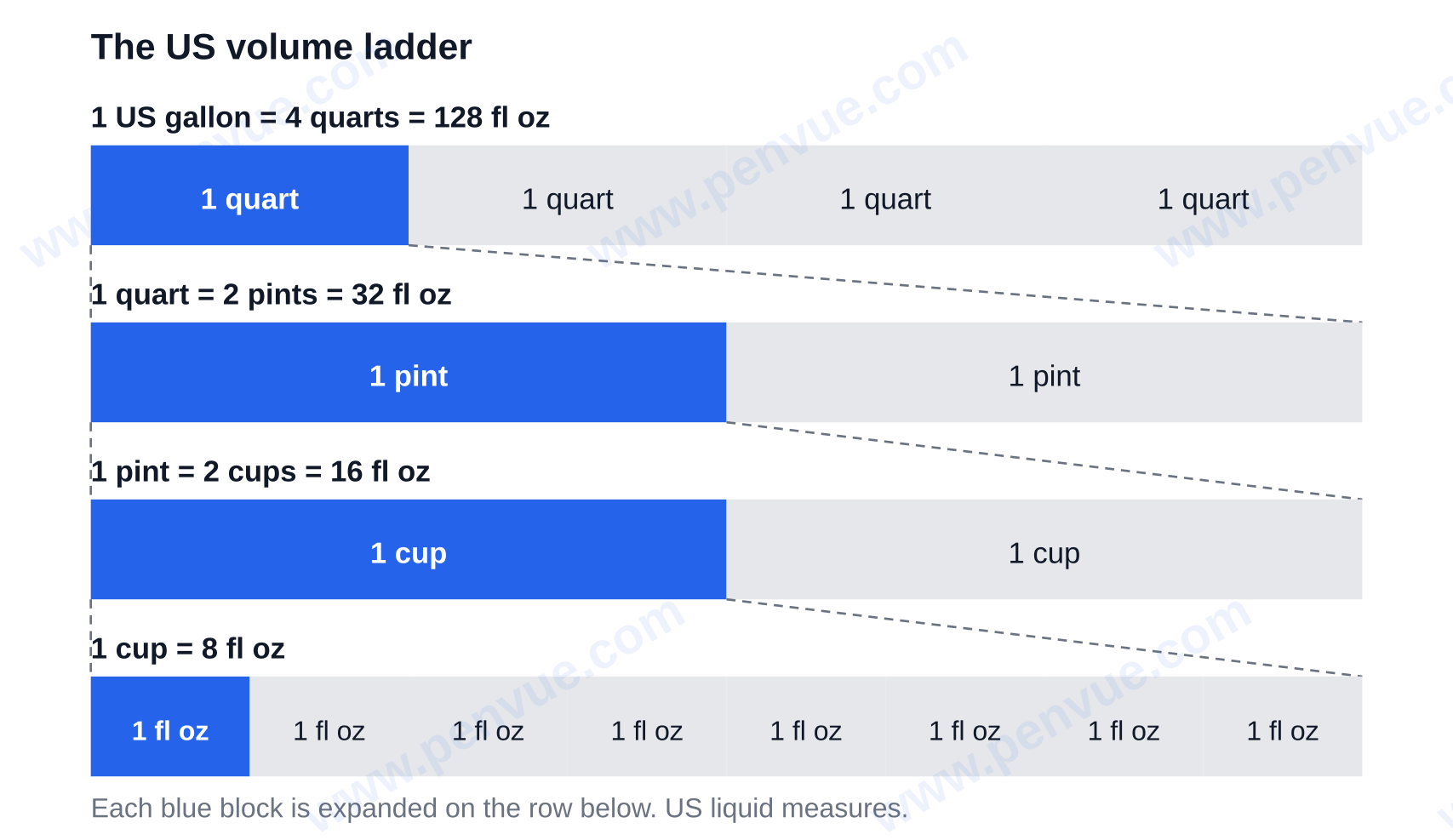
Any oz to quart figure is easier to sanity-check once you can see the whole US volume ladder at once. Quarts, pints and cups can all easily be converted to ounces:
- 1 fl oz = 1/8 cup = 1/16 pint
- 1 cup = 8 fl oz
- 1 pint = 2 cups = 16 fl oz
- 1 quart = 2 pints = 4 cups = 32 fl oz
- 1 US gallon = 4 quarts = 8 pints = 128 fl oz
A quart of water, milk and flour
1 quart of water or milk measures cleanly. Simply fill to the quart line and you have 32 fl oz. Flour on the other hand, is different. A quart of flour is a dry volume, and there are a lot of variables with how exactly you’ll get 1 quart of it. If you scooped, spooned, or even shook the container, you’ll get a different measurement, because loose flour compacts and you can’t really control it. That’s why serious baking recipes are normally given in grams rather than quarts or cups.
A quart of strawberries and why the number floats
Produce is where the 32-ounce answer fails outright, especially with berries. A quart of strawberries is a dry-quart basket, or a container size, not a conversion. Also, the weight of a quart of strawberries varies depending on the size of the strawberries, whether they have their hulls, and how they are packed in the basket. A retail quart of whole strawberries usually weighs about 20–24 ounces. A dry quart is actually 37.24 fluid ounces, and one is a weight and the other is a volume, so neither is equivalent to 32 ounces. If a recipe calls for a quart of berries, buy the basket. There is no exact figure to guess, and trying to figure it out wastes time.
Liquid cup, dry cup or scale?
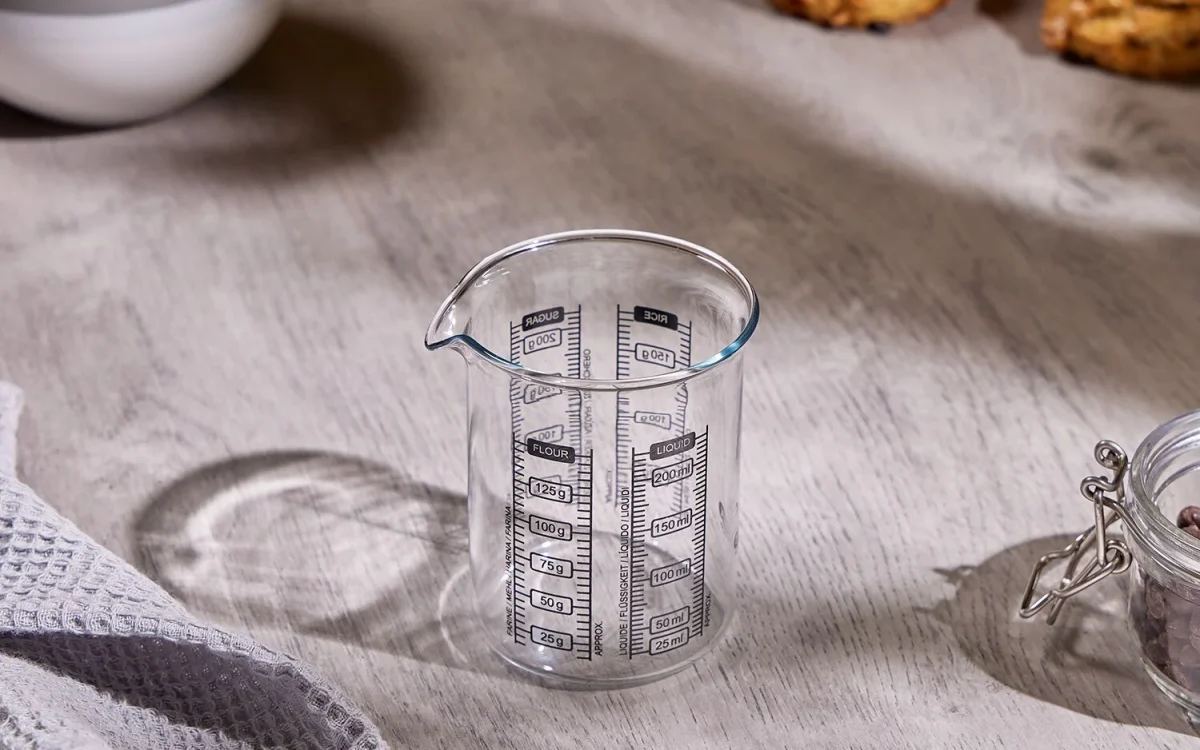
Use a graduated liquid measuring cup for anything that you can pour, read at eye level, with headroom above the top line so you are not fighting the meniscus at the rim. Use a dry measuring cup, filled and levelled flat with a straight edge, for things like flour and sugar. Use a kitchen scale when you want to be exact, especially for things like breads or pastries that you want to repeat. Using a dry measuring cup for liquids is where the most measuring errors occur, long before anyone divides by 32.
The short version, and the one check before you measure
There are 32 US fluid ounces in a US liquid quart. Going one way, divide ounces by 32. Going the other way, multiply quarts by 32. Easy. This conversion handles water, milk, stock, juice and every other pourable ingredient in a recipe.
Now the caveat that earns this page its keep: confirm you are measuring volume rather than weight. Also confirm the recipe is calling for a US liquid quart rather than a dry or Imperial quart. The next step is to bookmark or print the two conversion charts above. If you frequently cook from British recipes or regularly weigh your ingredients, then you may want the three quart comparison chart available as well so that a 20% error never ends up in your recipe. There’s more to read under Lifestyle.