

Hearing the word humility may conjure up thoughts of people who seem weak or ‘not good enough’ to you. In fact, someone described as ‘humble’ is not criticizing themself, but accurately evaluating themself — holding an accurate view of yourself, strengths and limits both, without needing to rank yourself above other people. Merriam-Webster claims humility is simply the quality or state of being humble. Modern psychology adds one correction: accuracy, not self-criticism, is the point.
Here is what that looks like in practice. You ship something, it breaks, and you say “that was my call and it was wrong” — full stop, no three-clause explanation trailing after it. You have not lowered your estimate of your own ability. You have just reported the facts without shading them in your favour. That is the whole move.
What is humility, in one sentence?
What do people mean when they say that someone is humble? A humble person does not have an inflated sense of worth or belief that they are superior to others. Cambridge Dictionary provides a definition that adds a lot of context to what I’m trying to get across: It is not being proud, and not believing that you are better than other people.
Humility in plain English
You can be excellent at something and humble. Humility is more of a ruling power over how you hold the judgement, not how high the judgement is. A surgeon who knows she is the best in her hospital is not being arrogant — she is being correct. Arrogance occurs when she stops listening to the nurse who has seen this complication twice, and stops holding judgement.
Researchers consistently find two components: an accurate self-evaluation, and an other-oriented stance that acknowledges other people’s worth and ideas. People rarely hold both in the same thought; however the second aspect (consideration for others) is what most of the benefit is tied to.
What humility is not, in one line
It is not a low opinion of yourself — though for a very long time, the accepted definition of humility was that it is an inferior opinion of yourself, and that is reflected in the historic definitions of the word. That quiet flip is why so many explanations of humility contradict each other.
Where does the word humility come from?
Humility comes from the Latin humilitas, from the adjective humilis, which comes from humus, the word for earth or soil. Humility is literally groundedness: closeness to the soil.
The root is more important than it seems. The original image is positional, not emotional. To be humble is to be ‘low to the ground’ and not to have a bad opinion of yourself. Modern usage keeps losing that distinction, and most of the confusion downstream starts there. With time, the definition grew to incorporate more of a ‘right relations’ and ‘lowliness’ to God in the Christian faith and practice, which carried the word into English. That is where the flavour of “lowliness” entered.
The ‘umbles’ theory and why it sticks
A commonly cited false etymology is that the word ‘humble’ came to be from umbles, the lesser cuts of meats given to the lowly folk in feudal England, hence “eating humble pie.” As the Wikipedia entry on humility notes, it is a coincidence of sound rather than a shared root. But it persists, partly, due to the strong association of the word humility to lowly status.
How the definition of humility quietly flipped
The quiet change in the definition, put side by side with dates, will resolve most of the confusion surrounding humility today.
- 1998, Oxford Dictionary: humility is having a “low opinion of oneself.”
- Contemporary psychology: humility is knowing yourself accurately, expressing yourself modestly, and maintaining goal direction, openness and broad-mindedness.
Look at the quote everyone likes: “humility isn’t thinking less of yourself, it’s thinking of yourself less.” This isn’t a timeless truism. It is a correction of a real, documented, dated definition. It has been repeated hundreds of times, without ever showing what it is correcting. That leaves the advice floating. Researchers use the accuracy framing now. Anything in self-help literature that relies on the low opinion frame is arguing against a definition its own field already abandoned.
Why nobody can reliably measure humility
This is the second big problem, and one the field isn’t as willing to admit. Researchers still do not have an agreed upon way to measure humility. Genuinely humble people end up modestly under-reporting their humility on self-report measures, and narcissists inflate their score. Because of this, the two groups can end up indistinguishable on the same questionnaire. That’s why researchers have shifted toward informant ratings and observer-based measures.
Be clear about what that costs you as a reader. This means that when you see “signs you’re humble” or trait lists, like the ones further down this page, you can be certain they use the one method the literature treats as structurally unreliable. Instead of viewing them as a way to score yourself, see them as reflective prompts.
When humility backfires: inward vs outward
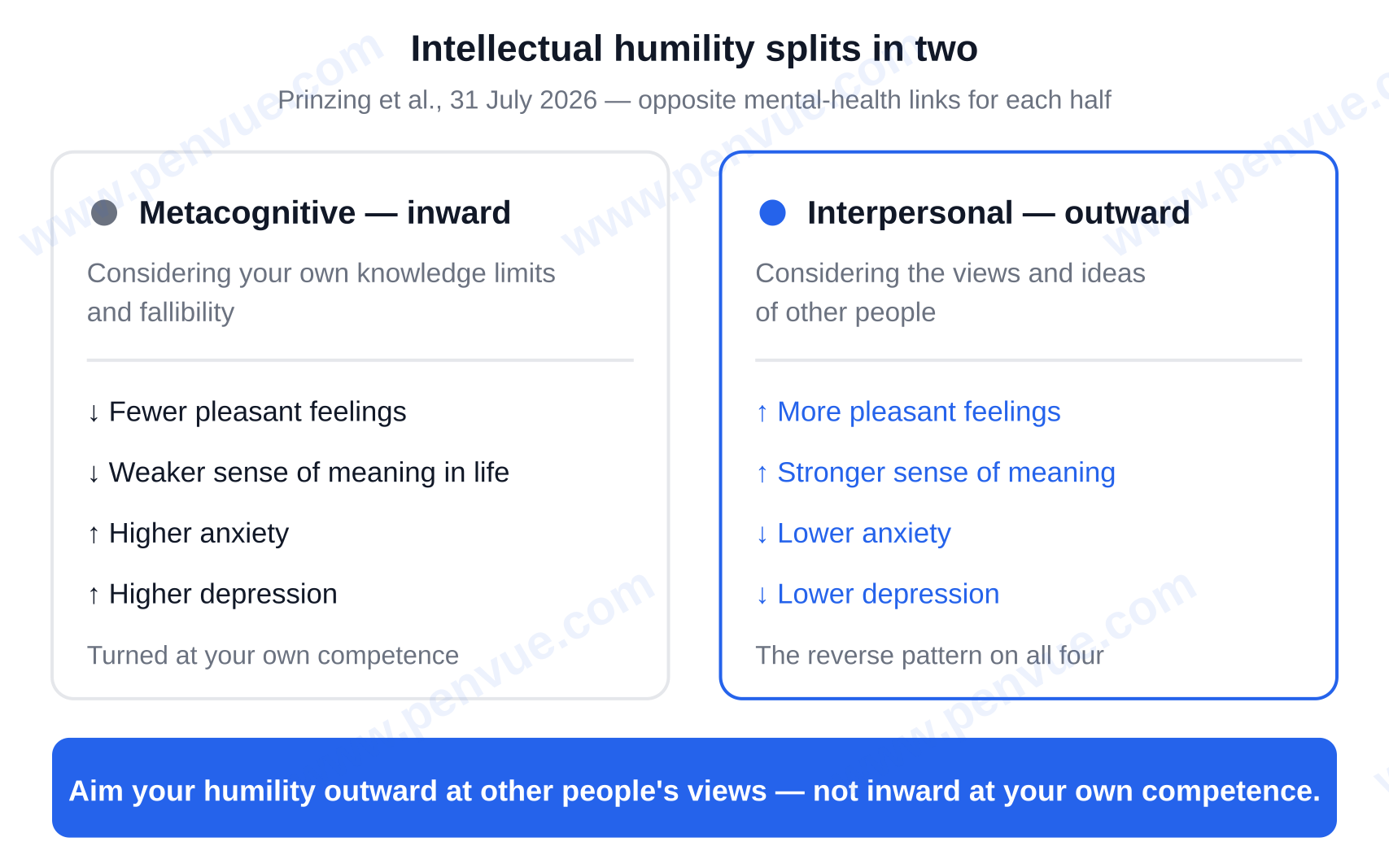
The third seam is the most recent and abandons what every other explainer assumes: that humility is always good for you. A study published in Personality and Social Psychology Bulletin on 31 July 2026 by Michael M. Prinzing, Shauna M. Bowes, Karen Melton, Perry Glanzer and Sarah Schnitker split intellectual humility into two categories and found opposite mental-health links:
- Metacognitive — considering your own knowledge limits and fallibility — tracked with fewer pleasant feelings, a weaker sense of meaning in life, and higher anxiety and depression.
- Interpersonal — considering the views and ideas of others — tracked with the reverse pattern.
The sample sizes are important so you can assess them: 596 college students and 527 adults cross-sectionally, 400 US adults in the main study, and 2,526 students across 14 universities tracked over two years.
The rule of thumb fits in one line. Aim your humility outward to the views and ideas of others, not inward at your own competence.
Humility vs modesty, meekness, and low self-esteem
Most dictionaries say synonyms of humility are modesty, meekness, lowliness and diffidence. Flattening five genuinely different things into one is a major source of reader confusion on this topic. Below are the differences:
| Term | What it actually governs | The distinguishing test |
|---|---|---|
| Humility | Inward — how accurately you see yourself | Is your self-estimate correct, strengths included? |
| Meekness | Outward — gentleness and restraint toward others | Do you hold back when you could overpower someone? |
| Modesty | Presentation — how you talk about achievements | What do you say when you win? |
| Low self-esteem | A distorted downward view, not an accurate one | Is your self-estimate wrong in a specific direction? |
| Diffidence | Confidence in acting — which humility does not require | Do you hesitate to act at all? |
| Honesty-Humility (HEXACO) | A measurable personality dimension | Scores on sincerity, fairness, greed-avoidance, modesty |
Honesty-Humility: the measurable version
There is some weight to that last row. Honesty-Humility is the sixth factor of the HEXACO model, developed by Kibeom Lee and Michael Ashton in the early 2000s and built from four facets: sincerity, fairness, greed-avoidance and modesty. It predicts counterproductive work behaviour, unethical decisions and exploitation better than any Big Five trait. So the trait is not unmeasurable in every form — it is unmeasurable when you ask people to rate their own humility directly.
Why humility and confidence are not opposites
Humility and confidence are not opposites. Humility is not shy, weak, or self-deprecating, nor does it mean letting people walk all over you. Humility and assertiveness are complementary of one another — the accuracy definition actually requires it, since underselling a real strength is just as inaccurate as overselling one. The real opposite of humility is narcissism and habitual self-enhancement. It was never confidence.
What does humility look like in everyday life?
So, what does humility look like in the real world? It involves the behaviors people can observe, not internal states — which is the only way anyone else can see it:
- Saying “I don’t know” in a meeting instead of improvising something plausible.
- Giving credit where credit is due, by name, to the person who actually did the work.
- Accepting criticism without justifying or defending yourself on the spot.
- Recognizing when you’re out of your element and letting the expert take charge, even when it is your project.
- Asking for help, and not punting until the last second, before the cost of the mistake compounds.
Convert those into traits and you get what people are usually searching for: realistic self-assessment, genuine listening, teachability, willingness to be corrected, and no need to self-promote.
The humblebrag problem
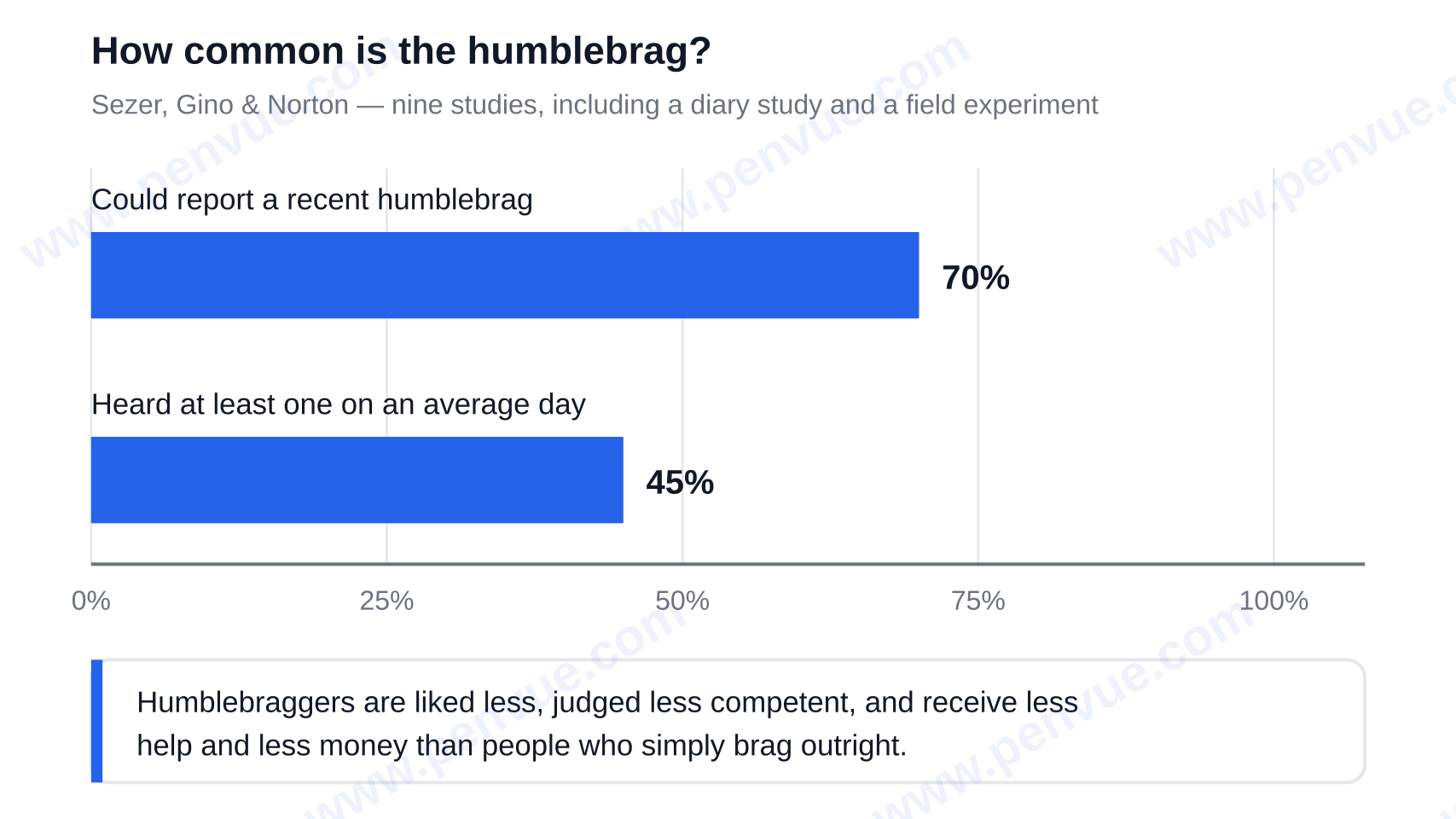
The following counters the claim with data. Ovul Sezer, Francesca Gino and Michael Norton conducted nine studies on humblebragging, including a week-long diary study and a field experiment. Seventy percent of respondents were able to report a recent humblebrag. Forty-five percent of respondents said they had heard at least one humblebrag on an average day.
The surprising result of the study is people who humblebrag are liked less, judged less competent, and receive less help and less money than people who simply brag outright. Fake humility is seen as insincerity, and insincerity costs more than open self-promotion. If you are going to boast, boast.
Additionally, you’ll find that people sort humility by domain, rather than by intensity. Intellectual humility is the notion of your ideas, your knowledge, and your limits. Cultural humility is other people’s cultures, backgrounds, and your blind spots. Relational humility is how you are experienced by one specific individual — which, notably, only they can report.
Why does humility matter at work and in relationships?
Start with the findings that hold up. Intellectual humility is reliably associated with more constructive and less destructive responses to conflict, and people high in intellectual humility are also better liked than those low in it. There is also a trust effect worth knowing: simply describing a scientist as high in intellectual humility increased perceived trustworthiness, belief in their research, intentions to follow their recommendations, and information-seeking behaviour. Humility is perceived as credibility — not as doubt.
The standard business reference is Jim Collins’ Level 5 leader, from Good to Great and Harvard Business Review: a paradoxical blend of personal humility and fierce professional will. Such leaders own mistakes first and take credit for success last.
The structurally interesting part is that credit-and-blame asymmetry is a behaviour, which means other people can observe it — which is exactly why self-report cannot capture humility and observers can. You do not get to claim humility. It gets read off what you do.
Humility in religious and philosophical traditions
Readers arrive here from several traditions, and there is a convergence of them more than you would expect. For example, in Christianity, humility is right relation to God and neighbour, not self-hatred. In Stoicism, humility is accurate judgement of what is and is not in your control. In Buddhism, it is detachment to self. All three converge toward the modern accuracy definition.
And all three traditions point in the same direction as the 2026 finding: the major benefits are outward-facing, humility toward others and respect for other views. Keep the respect for other perspectives. Drop the rumination about your own inadequacy.
How can you become humbler?
These habits are aimed outward — at other people’s ideas, not at your own self-worth. That distinction is the whole point.
- Ask one genuine question before you state your view.
- Say “I don’t know” out loud once a week, in front of someone whose opinion you care about.
- Give credit to others by naming the person whose work made your result possible.
- Most of us need a day to sit with critical feedback before we can reply constructively.
- Find one person who knows more than you do about something you consider a strength.
- Ask two people who work closely with you what you are like to disagree with.
That last one follows directly from the measurement problem. Instead of rating yourself in terms of humility — the unreliable method — collect the third-party observational data researchers actually trust.
The mistake to avoid
Cataloguing your deficits to practice humility is metacognitive humility: the form the Prinzing study links to higher anxiety and depression. It has gone wrong if it is making you smaller rather than more curious. Turn it outward.
There is an added discomfort with this practice. People close to you will notice progress before you do. That is uncomfortable, and it is also the point.
The three-point recap
- Humility is accuracy, not lowness. It means holding a correct view of yourself — strengths included — without needing to rank above anyone. The root of humility comes from the Latin word humus meaning ground, not shame.
- The definition flipped, and most pages missed it. “Low opinion of oneself” was the 1998 Oxford framing; “accurate opinion of oneself” is what researchers use now. Also: nobody can measure it by asking, so treating every self-checklist as a prompt rather than a score will provide better direction.
- Direction decides whether it helps. Outward humility is about other people’s ideas, and it tracks with better conflict, better relationships and better mental health. Inward humility focuses on yourself and your limits, and tracks with the opposite.
Pick one conversation this week where you would normally defend your position, and ask the other person a real question first instead. For more on this, see our Lifestyle coverage.
FAQ
What is the simplest definition of humility?
One definition is freedom from pride or arrogance. Humility is seeing yourself accurately, with a clear perception of your strengths and limits. This does not require you to place yourself below others. Merriam-Webster defines it as the quality or state of being humble. “Accurately” is an important word here. In the field of modern psychology, humility is treated as a correct self-estimate, not a low one, so being genuinely good at something and still being humble is possible.
What is the difference between humility and modesty?
Humility is inward — it is about seeing yourself accurately. Modesty is presentational — it is about how you talk about your achievements. You can be modest in public while privately overrating yourself, and you can be accurate about your own ability while stating it plainly. Humility and modesty are not the same, and people misinterpreting them is understandable, given that dictionaries have listed them as synonyms, but they govern different things. Meekness is again something different: it’s having gentleness and restraint in how you relate to and treat others.
Is humility a weakness?
No. Rather, the evidence runs in the opposite direction. Jim Collins’ research on Level 5 leaders found the executives who took their companies from good to great combined personal humility with fierce professional will, owning mistakes first and taking credit last. Describing a scientist as intellectually humble has also been shown to increase their perceived trustworthiness and people’s willingness to follow their recommendations. The opposite of humility is not confidence, it is narcissism and habitual self-enhancement.
What does the Bible say humility means?
Christian teaching frames humility as right relation to God and neighbour rather than self-hatred — the creature’s accurate position before the creator, which is where the “lowliness” flavour of the English word originated. That usage carried the Latin humilitas into English, and it sits closer to the modern accuracy definition than to the “low opinion of yourself” framing dictionaries used as recently as 1998.