
How do you compare a 40 oz. tumbler to a 1 L bottle? In this case, the 40 oz to liters conversion wins. A 40 oz. measurement converts to 1.1829 L, or about 1.18 L, or 1,182.94 mL. The difference to a liter is about 18% more because in the US fluid ounces’ system, 1 oz. = 29.5735295625 mL.
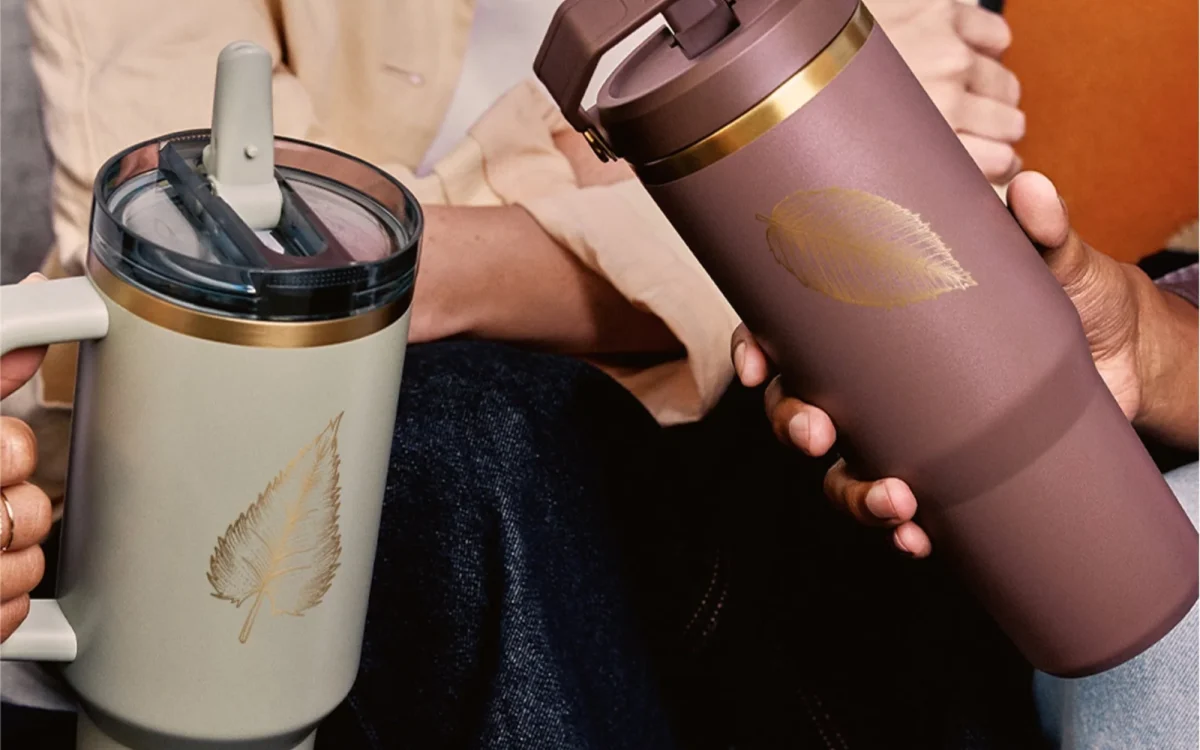
For a real world example, the 40 fl oz. Stanley Quencher H2.0 FlowState Tumbler sold by REI has a listed liquid capacity of 1.18 L. Same number, printed on a product you can hold.
If using the Imperial system, 40 fl oz. = 1.1365 L = 1 Imperial quart.
How many liters is 40 oz?
Pick the precision that fits the job:
- 1.1829411825 L — the exact answer
- 1.1829 L — a rounding value for calculations
- 1.18 L — everyday usage, labels, recipes
- 1.2 L — rounded for tracking and talking
- 1,182.94 mL — if working in milliliters
All of these assume US customary fluid ounces, which is what most things are printed in, sold and cooked in across the United States.
Is 40 oz the same as 1 liter?
No. In the US customary fluid ounce system, 1 L = 33.814 oz, meaning 40 oz is about 18% more than 1 L — a difference of roughly 183 mL, which is about a cup. If a recipe or a bottle swap treats the two as equal, you are off by nearly a cup.
What is the formula for converting fluid ounces to liters?
Two factors cover everything, both from CheckYourMath’s US fl oz to litre reference:
- litres = US fl oz × 0.0295735296
- US fl oz = litres × 33.81402266
Step-by-step: 40 × 0.0295735296
40 × 0.0295735296 = 1.18294118 L. Multiply by 1,000 and you get 1,182.94 mL. That is the whole 40 oz to liters calculation — one multiplication, no lookup needed.
The same arithmetic works on any bottle. A 24 oz bottle: 24 × 0.0295735296 = 0.71 L. A 64 oz jug: 64 × 0.0295735296 = 1.893 L. Swap in your own number and the factor never changes.
Converting liters back to fluid ounces
Going the other way, a 1.5 L bottle is 1.5 × 33.81402266 = 50.7 US fl oz. For mental maths, divide ounces by 34: 40 ÷ 34 gives 1.1765, which lands within about half a percent of the true figure.
Why 40 oz means two different volumes in the US and the UK
Most conversion web pages skip this section. The same “40 oz” is two different volumes depending on which ounce it was written in.
| Unit | Size of one fl oz | 40 fl oz equals | What 40 oz is called |
|---|---|---|---|
| US customary fluid ounce | 29.5735295625 mL (exact) | 1.18294 L / 1,182.94 mL | 1.25 US quarts — not a quart |
| Imperial (UK) fluid ounce | 28.413 mL | ~1.1365 L / 1,136.52 mL | Exactly 1 Imperial quart |
| Difference | US unit ~4.1% larger | ~46 mL per bottle | About a fifth of a US cup |
Is 40 oz a quart or half a gallon?
Both can say “a quart” and mean different things. In the UK system 40 Imperial fl oz is a quart. In the US system a quart is 32 fl oz, so 40 US fl oz is a quart and a quarter — see the breakdown of how fluid ounces map onto quarts if you need the other sizes. So half a gallon is 64 fl oz, and 40 fl oz is just under a third of a gallon.
The split is historical. As the ANSI Blog explains, the Imperial ounce is based on the volume of an ounce of water, while the American one is based on the volume of an ounce of wine, resulting in the American ounce being about 4% larger. In practice, that 4% compounds. It’s not noticeable on a single glass, but it is a fifth of a cup in a 40 ounce bottle, and it stacks when you scale a recipe or batch a drink, and it compounds even further when you fill multiple bottles in a row. Which measurement to use depends on where the container or recipe was written, not where you are.
What is 40 oz in mL, cups, pints, quarts and gallons?
The full equivalence set in one place, so you are not hopping between single-unit converter pages:
| Unit | 40 US fl oz equals | Exact or decimal? |
|---|---|---|
| Millilitres | 1,182.94 mL | Decimal |
| Litres | 1.1829 L | Decimal |
| US cups | 5 cups | Exact |
| US pints | 2.5 pints | Exact |
| US quarts | 1.25 quarts | Exact |
| US gallons | 0.3125 gallons | Exact |
| Imperial quarts | ~1.1365 L = 1 Imperial quart | Exact (UK system) |
Notice which values land clean. A US cup is 8 fl oz and a quart is 32 fl oz, so 40 oz is exactly 5 cups and exactly 1.25 quarts. That is why 40 oz halves and scales neatly in a kitchen, even though its liter value is an awkward decimal. Measure in cups and convert at the end.
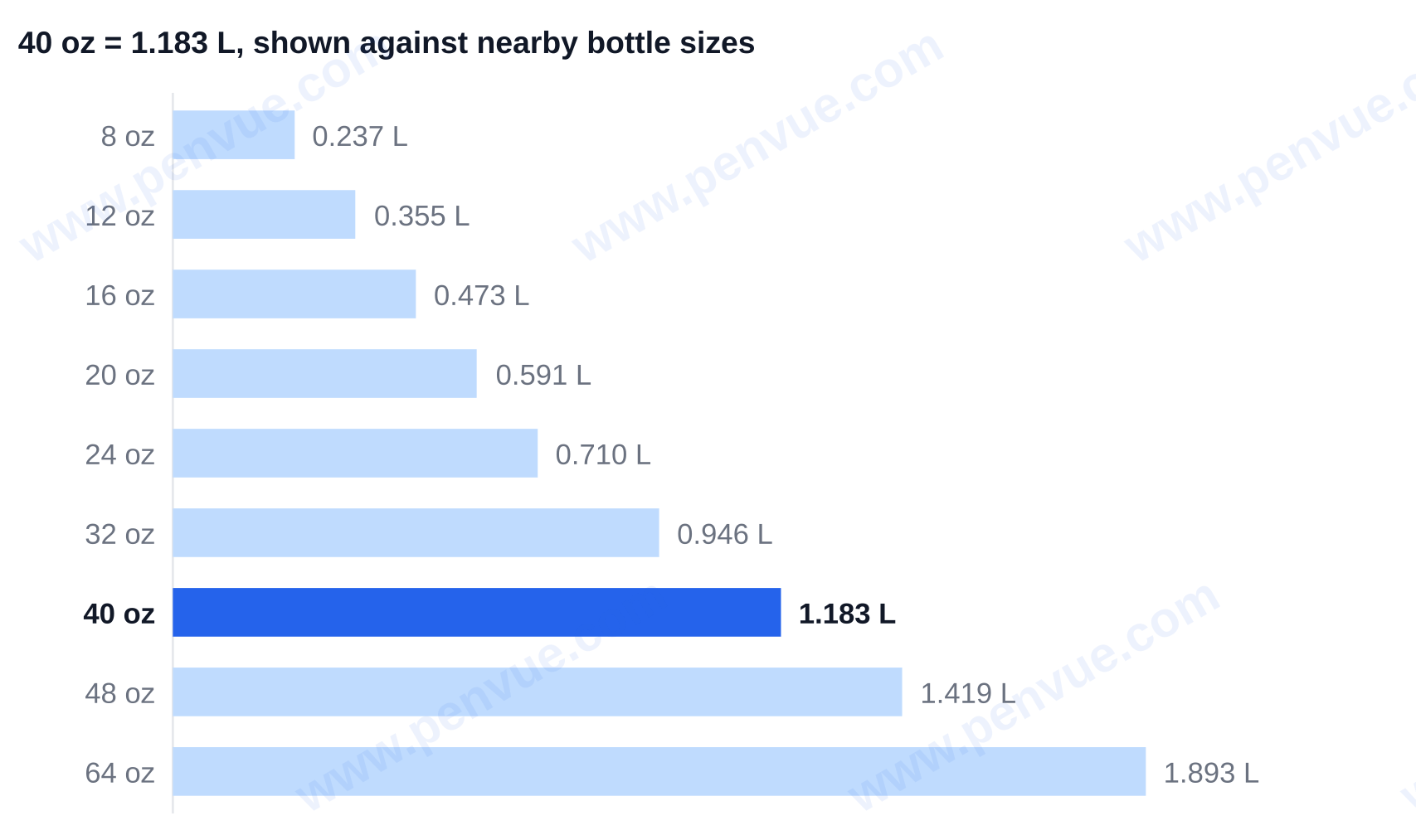
Conversion chart: 40 oz to liters and nearby bottle sizes
Every value below uses the same 0.0295735296 factor, so the pattern holds for any size not listed. For the full range, our ounces to liters conversion guide covers the sizes between these steps.
- 8 oz = 0.237 L
- 12 oz = 0.355 L
- 16 oz = 0.473 L
- 20 oz = 0.591 L
- 24 oz = 0.710 L
- 32 oz = 0.946 L
- 40 oz = 1.183 L
- 48 oz = 1.419 L
- 64 oz = 1.893 L
Memorize these three anchors: 16 oz is just under half a litre, 32 oz is just under a litre, 64 oz is just under two. If you have these down, estimating sizes of water bottles on a shelf is easy — no calculator needed.
When to round to 1.2 L and when the exact millilitres matter
Answers are often rounded to a single number, but the right level of precision depends on the context.
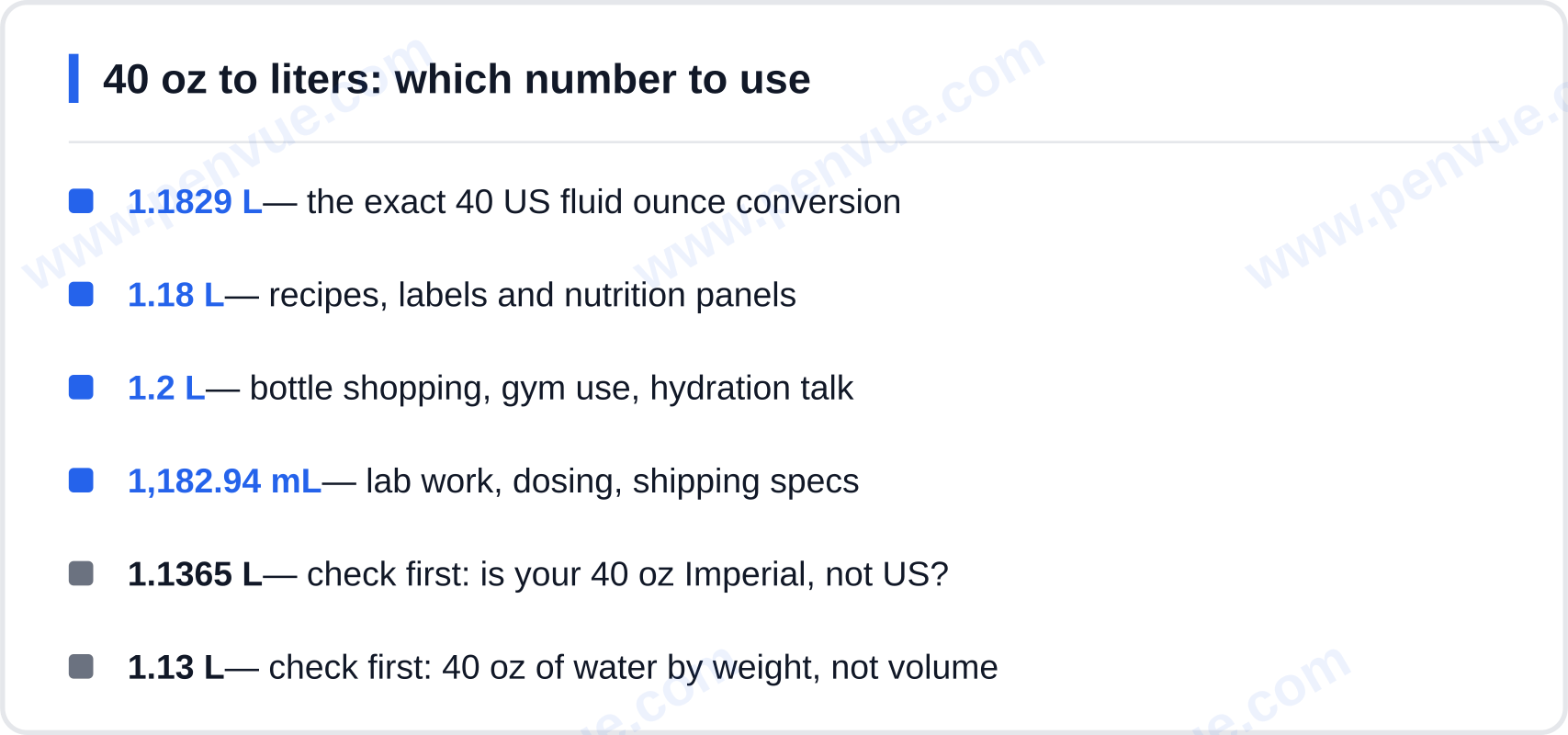
- 1.2 L — For bottle shopping, gym use and approximate hydration tracking, this level of imprecision (about 17 mL, under 1.5% error) is just fine.
- 1.18 L — this precision is necessary for ingredient measurements in recipes, and is the right level for nutrition panels and anything printed on packaging.
- 1,182.94 mL — use the unrounded figure only where it is required: lab work, drug dosing, and shipping specs.
Worth knowing: the underlying number is not a measurement. Per Wikipedia’s entry on the fluid ounce, the US fluid ounce has been exactly 29.5735295625 mL since the 1959 adoption of the international inch. So 1.1829411825 L is an exact legal value and the full precision is available any time it’s required.
How big is a 40 oz bottle or tumbler in liters?
In real containers, 1.18 L is the large-but-carryable size. The 1.18 L capacity of large insulated sports bottles is the same as the classic 40 oz beverage bottle. The Stanley Quencher 40 fl oz has a listed capacity of 1.18 L, and this is the most common container people are holding when performing this calculation.
Again, using metric sizes, 1.18 L is a little over a standard 1 L bottle and noticeably under a 1.5 L bottle. Something to note though, the size listed on the bottle is the capacity measured to the brim. Leaving headroom for a lid leaves less room for actual liquid, and with ice, you end up with even less. So in reality, the volume you actually drink from a 40 oz tumbler is comfortably below 1.18 L.
How many 40 oz bottles of water should you drink a day?
Here is the arithmetic the hydration posts leave unfinished. According to Mayo Clinic guidance, for men the adequate daily fluid intake is approximately 3.7 litres, and 2.7 litres for women. Divide by 1.18294 L and that equates to roughly 3.1 fills a day for men and 2.3 for women.
Is a 40 oz water bottle enough for a day?
On its own, no — a single 40 oz fill only covers about a third of the men’s figure and under half the women’s. But carry the caveat that makes those numbers usable: Mayo’s targets count all beverages plus water-rich foods, not plain water alone. Coffee, tea, milk and food all count, so your actual plain-water fills will be fewer. In reality, many factors influence the true target, such as how active you are, heat, altitude, illness and body size. Treat the fill count as a baseline, not a rule.
When 40 oz does not convert to 1.18 liters at all
If your 40 oz is a weight, every figure above is wrong for you. Ounces of mass have no fixed litre equivalent, because volume depends on density. The formula that applies instead is: litres = ounces ÷ (35.274 × density in g/mL).
If run on water at 1 g/mL, 40 ounces by weight comes to about 1.13 L. Run it on something less dense like protein powder or flour and notice how much more space it takes up. A litre of honey and a litre of flour take up the same space but weigh very different amounts, and that is the issue in a nutshell.
How to tell which you have: if something is packaged in a liquid form and states “fl oz” then it is measured by volume. A net weight on a dry good, powder or shipped parcel means mass.
The one thing to remember
40 US fluid ounces equals 1.1829 litres — 1.18 L for recipes and labels, 1.2 L for general hydration talk, and 1,182.94 mL only when precision is required. Before you trust any of those, check two things: whether your 40 oz is US or Imperial, and whether it is fluid ounces or ounces by weight.
The conversion factor itself is not going to move; it has been fixed by law since 1959. What has changed is the packaging around it. Retailers have started printing 1.18 L next to 40 fl oz on the same product page, so the conversion increasingly arrives pre-done. Until every label catches up, take the size of your bottle in fl oz, multiply by 0.0295735296 to get its litre capacity, then divide your daily fluid target by that number to figure out how many refills your day actually requires.
FAQ
How many ml is 40 oz of water?
40 US fluid ounces is 1,182.94 mL, rounded to 1,183 mL for everyday use. The exact figure is 1,182.9411825 mL, because one US fluid ounce is defined as exactly 29.5735295625 mL. If your 40 oz is Imperial, the answer is 1,136.52 mL instead.
How many cups is 40 oz?
Exactly 5 US cups. A US customary cup is 8 fl oz, so 40 ÷ 8 = 5 with nothing left over. That is also 2.5 US pints and 1.25 US quarts — all exact figures, which is why 40 oz scales and halves cleanly in a recipe even though 1.1829 L does not.
Is 40 oz bigger than 1 liter?
Yes. 40 US fluid ounces is 1.1829 L, roughly 18% more than a litre. One litre holds 33.814 US fl oz, so you would need about 33.8 oz to fill a 1 L bottle — 40 oz overshoots it by around 183 mL, close to a full cup.
What is 40 oz in liters in the UK?
About 1.1365 L. The Imperial fluid ounce is 28.413 mL against the US unit’s 29.5735295625 mL, so 40 Imperial fl oz comes to 1,136.52 mL — around 46 mL less than the US answer. In the UK system that volume is exactly one Imperial quart.
How many 40 oz bottles make a gallon?
3.2 bottles. A US gallon is 128 fl oz, and 128 ÷ 40 = 3.2, so three full 40 oz fills plus about a fifth of a fourth. Put another way, 40 oz is 0.3125 of a US gallon — just under a third, and well short of the 64 oz that makes half a gallon.
What is the difference between a US fluid ounce and a UK fluid ounce?
The US fluid ounce is 29.5735295625 mL and the Imperial one is 28.413 mL, making the US unit about 4.1% larger. The ANSI Blog traces the split to their origins: the Imperial ounce was based on the volume of an ounce of water, the American one on an ounce of wine. The gap is trivial on one glass but adds up fast when scaling a recipe or batching drinks.