


It’s late, you’ve typed and deleted the same message three times, and now you’re searching for someone else’s words instead. Pain loneliness quotes are short, attributed lines that label the pain of being alone – unseen, unheard and disconnected – as opposed to addressing it. One of the most famous comes from theologian Paul Tillich, where he states that language “created the word loneliness to express the pain of being alone,” and “solitude to express the glory of being alone.”
Most collections sort these lines by emotional flavor and leave you sifting through hundreds to find the one that fits. Every quote on this list is fully attributed, organized by what you’re about to do with the line, with primary sources where they exist, and with the WHO’s 2025 loneliness figures attached to the health claim these lists usually make without evidence.
Which Quote Do You Actually Need? Pick by Occasion, Not by Mood
Sort pain loneliness quotes by use, not by feeling. A line that works as a 2 a.m. journal entry is the wrong line to text a friend who has stopped replying, and wrong again under a photo. Mood-sorting assumes you want to browse. In practice you want one line, for one place, in the next two minutes.
The four occasions pain loneliness quotes actually get used for
| What you’re doing | Go to | Tone to avoid |
|---|---|---|
| Posting a caption, status or bio | Short lines | Anything over two lines, or darker than you’d say out loud |
| Checking in on someone isolating | Lines that make a person feel seen | Diagnosis language; advice they didn’t ask for |
| Journalling when you can’t name it | The unseen / disconnected register | Tidy resolutions — you’re describing, not closing |
| Speaking to someone after a loss or breakup | Grief and heartbreak lines | Uplift reframes and silver linings |
Why this list is short and fully attributed
How do you handle the length versus attribution trade-off? Long collections buy their size by dropping names — the biggest ones list line after line as “Unknown,” or credit nobody at all. A short list can be sourced, and that is the trade made here. So if a primary source exists, it’s given: book, publisher, year, chapter, so you can verify a line before citing it.
What Are the Most Quoted Pain Loneliness Quotes?
These are the canonical ones, with provenance. These are the lines everyone knows, quotes, and that get reduced to a last name.
Paul Tillich on loneliness and solitude — the full passage and where it comes from
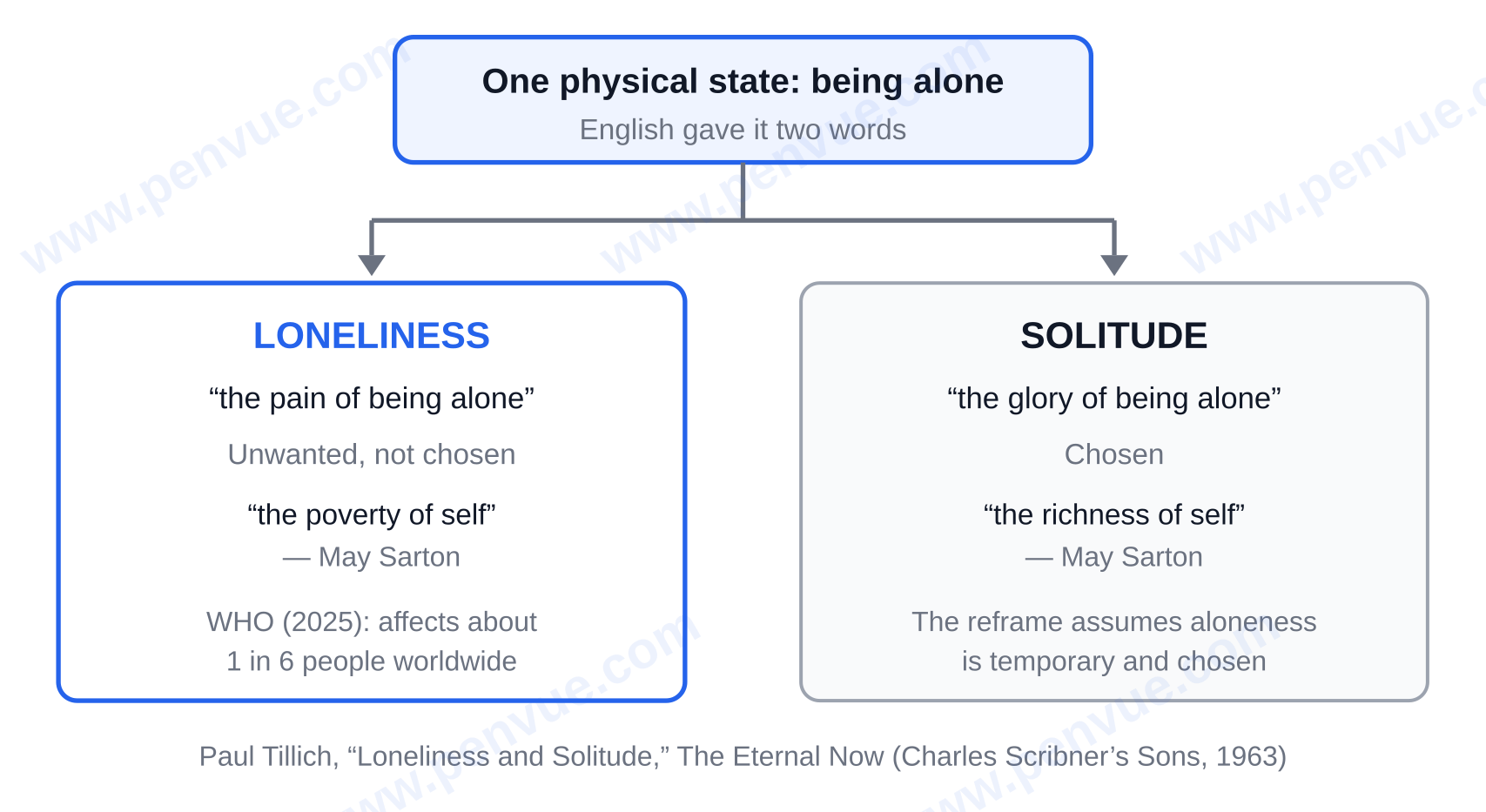
The full quote: “Our language has wisely sensed these two sides of man’s being alone. It has created the word loneliness to express the pain of being alone. And it has created the word solitude to express the glory of being alone.” It is from the sermon “Loneliness and Solitude,” the opening chapter of The Eternal Now (New York: Charles Scribner’s Sons, 1963). It is the most famous quote about loneliness because it gave English two words for one physical state.
What Carl Jung actually said about loneliness
“Loneliness does not come from having no people about one, but from being unable to communicate the things that seem important to oneself, or from holding certain views which others find inadmissible.” From Memories, Dreams, Reflections (1962), translated by Richard and Clara Winston, in the final chapter, “Retrospect.” Jung said loneliness derives from a lack of communication of deeper feelings, rather than from physical isolation.
The other members of the core set:
- Mother Teresa: “The most terrible poverty is loneliness, and the feeling of being unloved.” Loneliness as deprivation, not mood.
- Charles Bukowski: “I’ve never been lonely. I’ve been in a room — I’ve felt suicidal…” A useful counterweight to the tidier lines around it.
- Dag Hammarskjöld: “Friendship needs no words — it is solitude delivered from the anguish of loneliness.”
- May Sarton: “Loneliness is the poverty of self; solitude is the richness of self.” The second, less-used version of the split Tillich made famous.
Short Loneliness Quotes to Post as a Caption or Status
One breath, no context needed. For a story, a bio, a WhatsApp status, the pain loneliness quotes that work are under fifteen words with a name attached — something succinct and to the point, such as Tillich’s condensed version: “Loneliness expresses the pain of being alone and solitude expresses the glory of being alone.” Sarton’s “Loneliness is the poverty of self; solitude is the richness of self” is the next shortest that still says something, and Hammarskjöld’s quote would also be apt for a post about a friend rather than about you.
When quoting, put the author in the caption, not the comments — unattributed quote posts are where misattribution starts. And one honest warning for this occasion: a status is read by everyone who follows you, including people who will worry. If the line is darker than anything you’d say to a friend’s face, you already know.
Which Quotes Describe Feeling Unseen, Unheard, or Emotionally Disconnected?
This is loneliness amongst people, not loneliness from a lack of people. Emotional disconnect, not physical distance. Jung’s line belongs here as much as in the famous block — “unable to communicate the things that seem important to oneself” is the most accurate description of being unseen anyone has written. The register touches on invisibility, feelings of being surrounded by people and still feeling utterly alone, and the gap between how you look and how you feel.
Quotes for loneliness that overlaps with depression
When the two meet, the lines describe flatness, withdrawal, and the notion that reaching out drains more than it returns. A clear boundary, plainly: these quotes describe depression’s loneliness, but do not evaluate it. If this section reads like your past few months rather than your past few days, that’s information about your health, not your writing.
The best use of this section isn’t collecting lines. Write one at the top of a page and answer it.
Can You Feel Lonely in a Relationship or a Marriage?
Yes, and it’s a specific kind of loneliness — the kind that happens in proximity. The other person is present and the connection isn’t. Absence of people explains itself, but absence of connection while sharing the same bed doesn’t, so most people assume the fault is with them.
That’s the register behind the much-repeated idea that the worst loneliness is being with people who make you feel alone. Jung’s description fits it exactly: a marriage can hold two people who can’t communicate the things that are of utmost importance to them. Use the distinction deliberately. These lines can be written down or can be conveyed to a person directly. They work badly as a public status about a partner who hasn’t been told yet.
What Can You Say to Someone Who Is Lonely, Grieving, or Pulling Away?
Pick a quote which describes the emotion and doesn’t try to prescribe a solution. This is the most difficult of all four occasions as the wrong quote can land as a lecture. For someone who has gone quiet, choose something that names the feeling without asking them to explain it.
Quotes to send after a loss or a breakup
Hammarskjöld’s “friendship needs no words” can be used to represent and describe the emotion felt after the death of a loved one as the quote doesn’t try to explain away the grief. Mother Teresa’s line about the feeling of being unloved can be used for the loneliness felt after heartbreak as it’s sharp, acute and new, and attached to one specific absence — it tends to land there better than anything about strength.
Bible and faith quotes on not being alone
Some scriptural lines about not being deserted provide great comfort to many, while to others they are an unwanted intrusion. Know which camp your audience is in before sending them.
The practical answer: a quote is an opening line, not the message. It names a feeling. Pair it with an invitation to change the feeling. The invitation must be concrete, low cost, and actionable, like offering to make a call or take a walk — a named day you’ll actually keep. What not to send: anything which frames loneliness in a positive way as a source of personal development.
Why Does Loneliness Hurt This Much — and Is It Bad for Your Health?
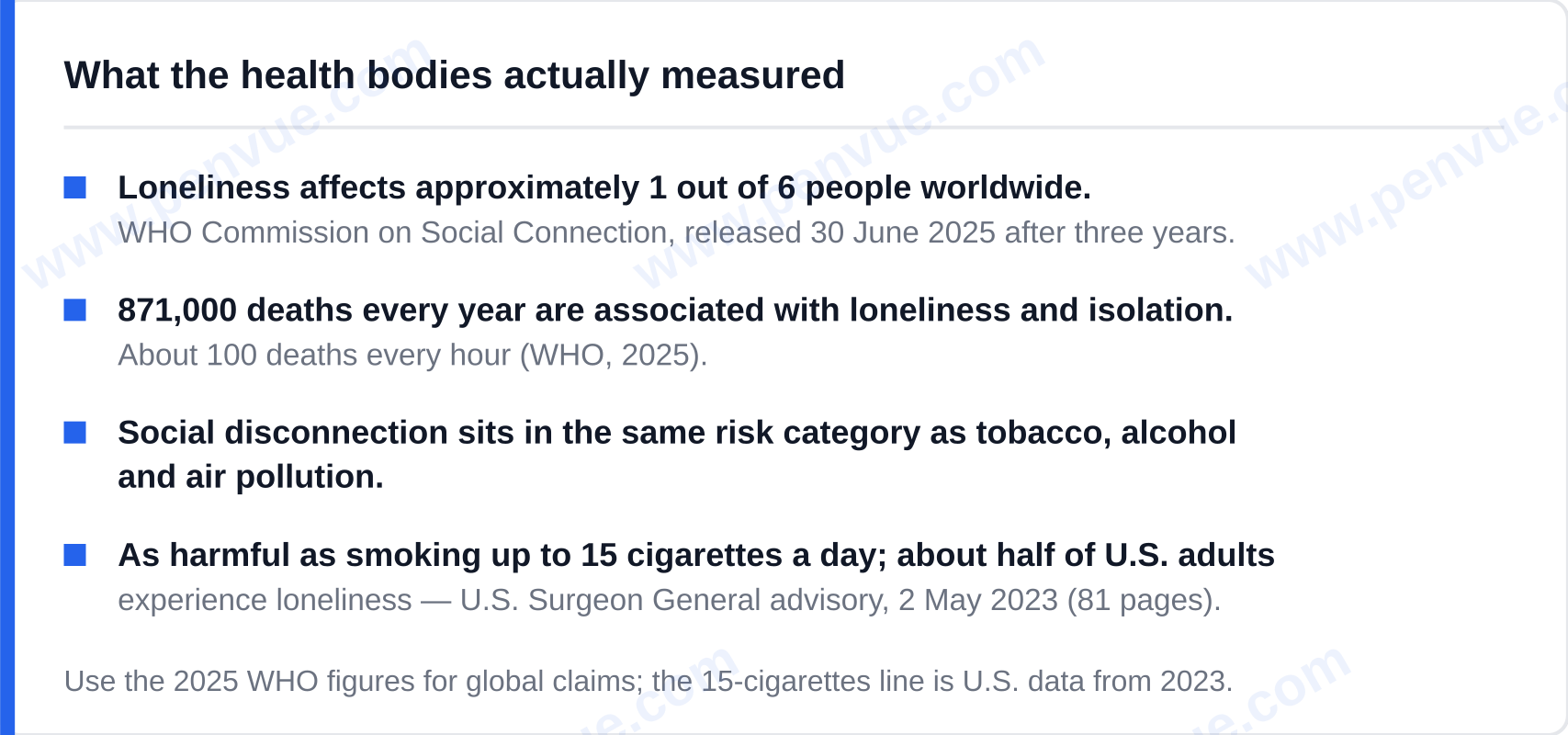
Because the pain in these quotes is associated with a measured increase in risk of premature death. On 30 June 2025, the World Health Organization released the findings of its Commission on Social Connection, completed over three years, and reported that loneliness affects approximately 1 out of 6 people worldwide. The WHO stated that loneliness and social isolation are associated with an estimated 871,000 deaths every year, about 100 deaths every hour. Researchers place social disconnection in the same risk category as tobacco, alcohol, and air pollution.
An older report — the U.S. Surgeon General’s 81-page advisory of 2 May 2023 — stated that social disconnection is as harmful to your health as smoking up to 15 cigarettes a day, greater than obesity or physical inactivity, and that about half of the adult population in the U.S. experiences loneliness. The Surgeon General’s report stated that social disconnection is associated with cardiovascular disease, dementia, stroke, depression and anxiety.
The famous “15 cigarettes” line is American and from 2023. It’s accurate to its time, but use the WHO numbers from 2025 if you want to reference global data. Both are accurate as of their dates — use the right one for the claim you’re making. The point of the comparison is simple: loneliness is a mortality risk. Being told your loneliness hurts isn’t oversensitivity. It’s the recognised experience of something two health bodies treat as a mortality risk.
What’s the Difference Between Loneliness and Solitude — and When Does That Reframe Stop Helping?
Loneliness is the pain of unwanted aloneness; solitude is the same physical state, chosen, and experienced as richness. Tillich’s two words, Sarton’s poverty and richness of self, Hammarskjöld’s solitude relieved by friendship. The lines on this page are useful if your aloneness is temporary, chosen, or already lifting — take the strength-in-aloneness lines and go.
The limit is worth stating. Almost every collection of these lines closes with that reframe — inspirational, overcoming, be-strong-alone — as though it applies universally, when it assumes the aloneness is temporary and chosen. For chronic, involuntary loneliness, the same framing asks you to aestheticise a condition the WHO classes alongside tobacco and air pollution. That isn’t a reframe. It’s a request to stop talking about it.
So, clearly: a quote is a way to name the feeling, not a treatment for it. If you’ve been reading lines like these for months and none have moved anything, the next step is a person — a GP, a therapist, a local helpline, one friend told the plain truth — not a better quote.
The One to Take With You
If you’re going to use just one, use Jung’s. It covers the most common case by a wide margin — lonely with people around you — and it’s checkable to the page. Beyond that, pain loneliness quotes help you by giving you the words you can’t find, and they show you that someone else has felt the same. They don’t treat the condition the WHO linked to 871,000 deaths a year in 2025. So, use the line which best applies to your case, and do the thing the quote can’t do; send one message to one person who you can name the plain truth to today, instead of quoting it. Browse more explainers on Penvue for related reads.
FAQ
What is the most famous quote about loneliness?
The most famous quote in English on loneliness is by Paul Tillich. He said, “It has created the word loneliness to express the pain of being alone. And it has created the word solitude to express the glory of being alone.” It’s the most-quoted line on the subject, because it gave English two separate words for the same physical state — one painful, one chosen. It is from his sermon “Loneliness and Solitude,” which is the first chapter of The Eternal Now (Charles Scribner’s Sons, 1963).
Who said “loneliness expresses the pain of being alone”?
Theologian Paul Tillich, in the “Loneliness and Solitude” sermon collected in The Eternal Now (New York: Charles Scribner’s Sons, 1963). The short version in circulation has been condensed. Tillich said in the full version: “Our language has wisely sensed these two sides of man’s being alone. It has created the word loneliness to express the pain of being alone. And it has created the word solitude to express the glory of being alone.”
Is it okay to post loneliness quotes as a status or caption?
You can post these quotes with two cautions. Put the actual citation in the caption itself, not the comments, because this is where quote misattribution begins. And consider the audience. A status reaches everyone who follows you, including people who will worry. If what you want to say is darker than anything you’d want to say out loud to a friend in person, decide whether you want that conversation before you post it.
How do I check whether a loneliness quote is correctly attributed?
Look for a primary source, not a surname, and verify the wording yourself. Find the book, publisher, year and chapter, then confirm the wording there — Tillich’s line is checkable in The Eternal Now (1963) at the Internet Archive, and Jung’s is in the “Retrospect” chapter of Memories, Dreams, Reflections (1962), translated by Richard and Clara Winston. If a quote is found only on quote aggregator sites and attributed to “Unknown,” treat the attribution as unverified.