

Evil eye meaning comes in two halves. The curse is a look — usually envious, sometimes merely admiring — believed to pass harm, illness or bad luck to whomever it lands on. The charm is the blue eye-shaped bead worn to absorb that look. Same two words, two opposite jobs.
You have probably watched it happen. Someone leans over a stroller and says “what a beautiful baby,” and an older relative instantly adds a blessing, or touches a blue bead pinned inside the baby’s clothes. That reflex is the belief in miniature: the compliment is the risk, and the bead is the insurance.
Evil eye meaning: the curse, the charm, or both?
Both, and that is exactly why the phrase confuses people. In its first sense, the evil eye is a supernatural harm — illness, misfortune, things breaking — transmitted by a glare, typically one powered by envy. It is documented across Mediterranean, Balkan, Eastern European, West Asian, Central Asian, South Asian, African, Caribbean, and Latin American cultures. In its second sense, it is the object: the eye-shaped bead or pendant you buy precisely to stop the first thing from reaching you.
The clearest academic definition comes from Alan Dundes, professor of anthropology and folklore at UC Berkeley and editor of The Evil Eye: A Casebook. Speaking to Cabinet Magazine, Dundes described it not as a single superstition but as a belief complex: the idea that one person can injure another, or that person’s property, simply by looking at it or praising it, with consequences running from sickness to death to ruined possessions.
The vocabulary is worth clearing up early, because it is the other half of the confusion. “Nazar” comes from Arabic for sight, gaze, or attention — so a nazar bead is literally a gaze-bead, named after the problem rather than the cure. The same belief answers to mati or kako mati in Greek, mal de ojo in Spanish, malocchio in Italian, mau-olhado in Portuguese, ayin hara in Hebrew, and nazar or drishti in Hindi and Urdu.
Why envy, not malice, is the engine of the belief
Most explainers skip the nuance that makes the whole thing coherent: the harm is usually framed as unintentional. It is the residue of a covetous or admiring glance, not a deliberate hex. Nobody has to wish you ill. That is why praise itself is treated as dangerous, and why so many of these traditions pair a compliment with an immediate blessing — a verbal reflex close to what humility actually means in everyday speech: say the nice thing, then take the shine off it. The American Academy of Ophthalmology, writing on the belief’s cultural and clinical context, names the groups traditionally held most vulnerable: babies, children, pregnant people and women.
Is wearing an evil eye good luck or bad luck?
Good — or at least protective. The charm is a shield, not a weapon. The “evil” part is the gaze it is designed to soak up, so wearing one is closer to carrying an umbrella than to casting a spell. Nothing in any of the traditions below treats the amulet as something that sends harm outward.
Where did the evil eye come from, and how old is it really?
Nearly every page you will read says the belief “dates back 5,000 years” and leaves it there. The AAO traces it to ancient Mesopotamia more than five millennia ago, to chants written to ward off harmful looks. But the round number is more convincing when you can see the objects sitting behind it:
- Alabaster idols with large incised eyes, excavated at Tell Brak in ancient Mesopotamia — modern Syria — at roughly 3,300 BCE.
- Mediterranean glass bead production around 1500 BC: the technology that made a layered blue bead possible at all. The deep blue itself comes from glass coloured with cobalt oxide.
- Greek kylix “eye cups” and Chalcidian drinking vessels carrying eye motifs, dated 530–520 BC. You drank, and the eyes stared back at whoever was watching you.
- A 3rd-century Roman gold ring from Colonia Aurelia Cibalae, carrying an evil eye protective talisman.
From there the route is traceable rather than mystical: Mesopotamia and the Near East into Greece and Rome, then outward across the Mediterranean along trade and colonial routes. The Eye of Horus sits alongside this as a parallel protective-eye tradition, not a proven ancestor of it.
The extramission theory: why a look could carry harm
Ancient readers were not being sloppy. They were working from the extramission theory of vision, the belief that the eye emits rays onto whatever it observes. Under that model a stare is physical contact, and contact can do damage. The language left fossils in modern medicine: ophthalmology still uses oculus sinister for the left eye, a term freighted with “sinister,” and Roman sources linked a “double pupil” with mystical power.
What the same belief is called — and how it is cleared — in each culture
This is the part that is almost impossible to find assembled anywhere. The jewellery blogs cover colours; the reference sources carry the rituals but scatter them across thousands of words, never aligned so you can compare them. Lined up side by side, the striking thing is that the evil eye meaning barely shifts from culture to culture, and neither does the removal logic: something is passed over or around the body, then read for a verdict. Only the object changes.
Cross-cultural comparison: name, charm, test, cure
| Culture and local name | Protective object | Detection test | Removal ritual |
|---|---|---|---|
| Greece — mati, kako mati | Blue glass mati charm | A drop of olive oil in holy water; if it sinks, the gaze landed | Xematiasma, a prayer passed down silently from an opposite-sex relative; healer and victim yawn if it worked |
| Turkey — nazar | Nazar boncuğu: concentric dark blue, white, light blue and black glass | No formal test; the bead’s own condition is the signal | Replace a cracked bead — it is read as having absorbed the harm |
| Latin America — mal de ojo | Nazar bead, often pinned to a baby’s clothing | A raw egg swept over the body, then cracked into water under the bed; a “cooked” look confirms it | The egg cleanse, or limpia, itself |
| Italy — malocchio | Cornicello of red coral or precious metal; the cimaruta | Oil-in-water reading | Protective gestures: the fig sign and the mano cornuta, descended from the Roman fascinus |
| India — nazar, drishti | Nazar battu | No set test; affliction is read from symptoms | Burning red chillies, or rock salt and mustard seeds, circled around the head |
| Judaism — ayin hara, discussed in Pirkei Avot | No object required | Not applicable | The spoken formula b’li ayin hara, said after praise |
| Islam — al-‘ayn | Scripture rather than an amulet | Not applicable | Reciting Surah Al-Falaq and Al-Qalam 68:51–52; saying Masha’Allah or TabarakAllah when admiring something |
Dundes offered one interpretation of why liquid keeps appearing in these rituals: the belief’s internal logic equates water with life and drying up with death, which makes oil, water and raw egg the natural materials for diagnosing and draining harm.
How many people actually believe in this today?
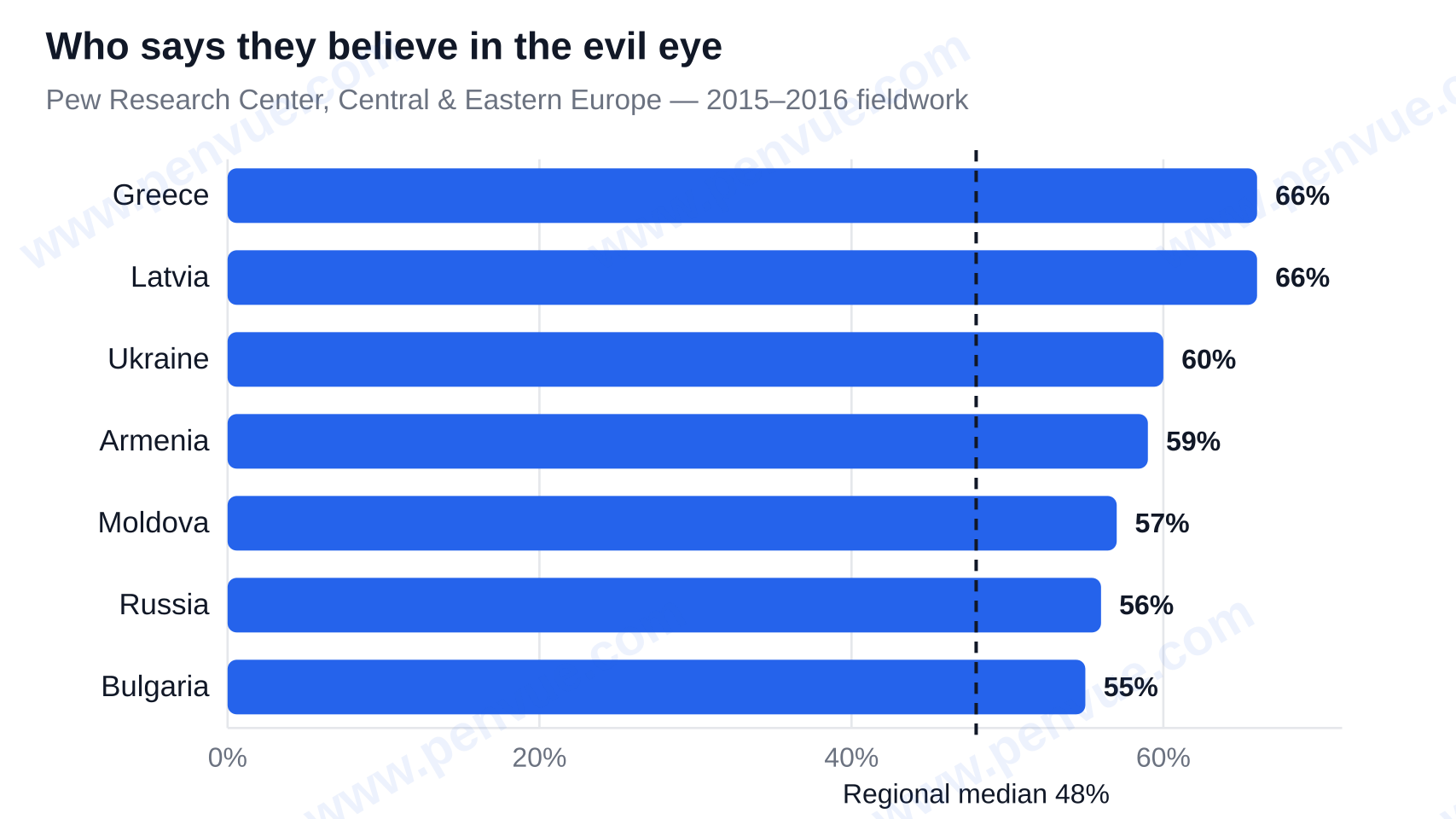
No competing page will give you a number, which is odd, because one exists. Pew Research Center surveyed religious beliefs in Central and Eastern Europe and found a median of 48% who say they believe in the evil eye. The country-level figures:
- Greece — 66%
- Latvia — 66%
- Ukraine — 60%
- Armenia — 59%
- Moldova — 57%
- Russia — 56%
- Bulgaria — 55%
Pew notes these levels are comparable to those recorded in Latin America and sub-Saharan Africa. Date them honestly: the fieldwork ran in 2015–2016, was published in Pew’s 2017 religious-beliefs report and carried into its October 29, 2018, Eastern and Western Europe comparison. They are not current-year figures. They still reframe the whole topic — this is a live belief held by roughly half the people in an entire region, not a dormant relic.
It also has a documented footprint in modern practice. The American Academy of Ophthalmology has published on the clinical and cultural context clinicians encounter, mal de ojo is catalogued in reference literature as a culturally specific illness among Latin American and Latino immigrant populations, and the belief is an active subject of peer-reviewed quantitative research, including work by Türkarslan in the journal Spiritual Psychology and Counseling.
What do the colours and the other amulets mean?
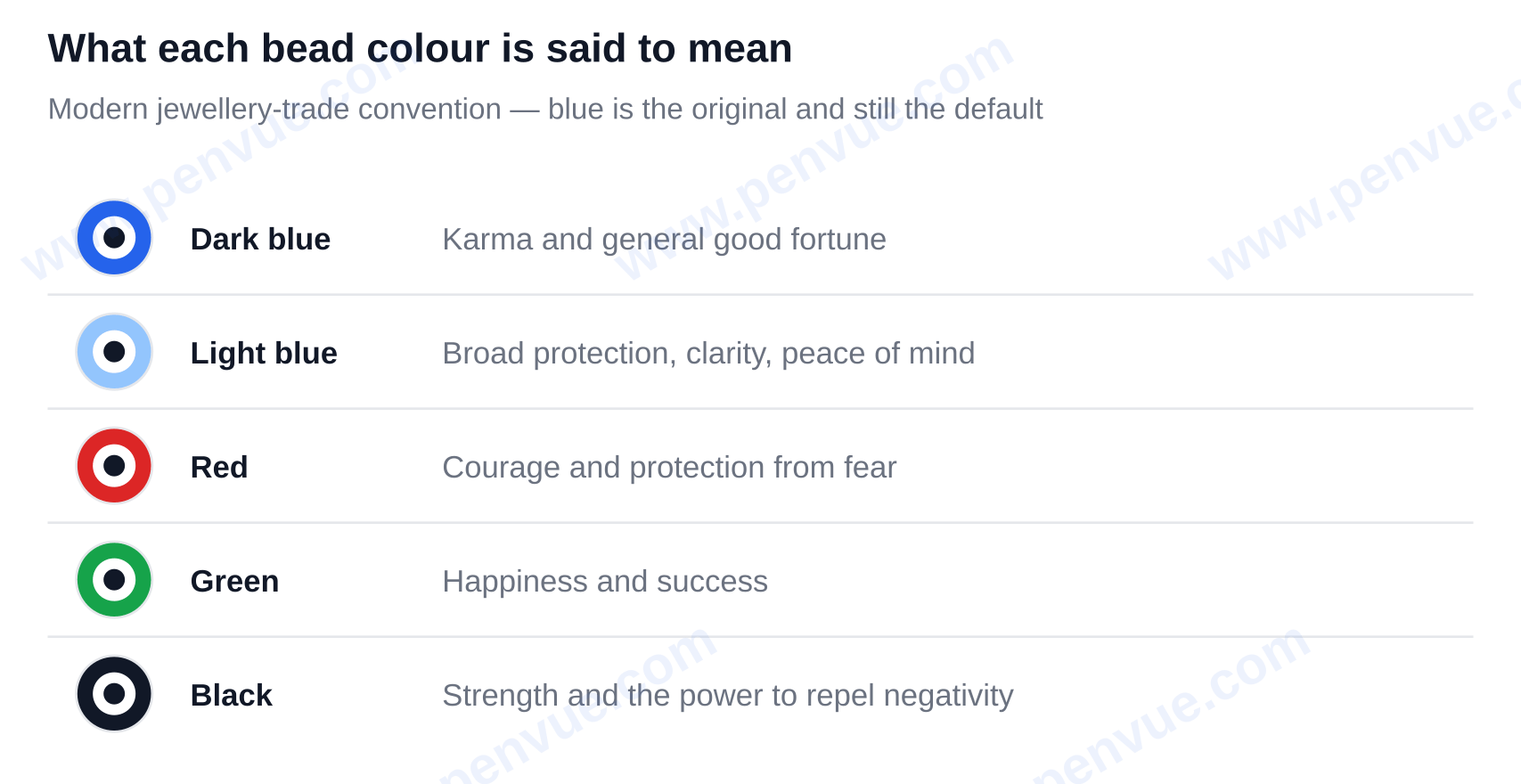
Blue is the original and still the default. It is the cobalt-glass bead the entire tradition is built on, and if someone hands you a charm without explanation, blue is what the evil eye meaning behind it refers to. The wider colour code is newer — modern jewellery-trade convention layered onto a tradition that was blue first — so treat it as style guidance rather than ancient doctrine:
- Dark blue — karma and general good fortune.
- Light blue — broad protection, clarity, peace of mind.
- Red — courage and protection from fear.
- Green — happiness and success.
- Black — strength and the power to repel negativity.
The bead also has relatives. The hamsa — the word means “five” — is known as the Hand of Fatima in Muslim tradition and the Hand of Mary among Levantine Christians. Southern Italy has the cornicello and the cimaruta. And some protection needs no object at all: the fig sign, the mano cornuta and the Roman fascinus all do the job with a gesture.
Signs people traditionally attribute to the evil eye
Sudden unexplained fatigue, headaches, restlessness, a run of bad luck, things breaking for no reason. Worth being precise here: these are traditional attributions, not diagnoses. Persistent physical symptoms are a reason to see a clinician, not a reason to buy a bead.
How do you wear one — and is it OK if it isn’t your culture?
Convention, not doctrine: the left wrist is the usual guidance for drawing protection inward, the right for projecting it outward. Beyond jewellery, the bead goes where attention lands — the front door or entryway, near a baby’s crib or pinned to their clothes, the rear-view mirror, a new shop, a new home. In Turkish tradition a cracked or broken bead is read as having absorbed the harm and finished its work; the guidance is to replace it rather than repair it or keep wearing it.
When the words matter more than the charm
Here is the exception the jewellery blogs never flag. In Islam the evil eye is affirmed as real, not dismissed as superstition — Muhammad is reported as saying “The influence of an evil eye is a fact” (Sahih Muslim, Book 26, No. 5427). But the prescribed response is verbal and scriptural: seeking refuge per Al-Falaq 113:5, “from the evil of the envier when he envies,” reciting Al-Qalam 68:51–52, and saying Masha’Allah or TabarakAllah when you admire something. Islamic rulings treat hanging amulets for protection as a separate and contested question, not the default remedy. The Jewish parallel is likewise spoken — b’li ayin hara — rather than worn. So a reader from either tradition who follows the standard “buy a blue bead” advice is being handed the wrong practice for their own framework.
Appropriation or appreciation? The honest answer
It is a live debate, and anyone who gives you a clean verdict is overselling. The prevailing position is that the symbol spans dozens of distinct cultures with no single owner, which makes it a shared folk symbol rather than a closed practice. The counter-argument deserves a fair hearing too: mass-market charm versions can hollow out the meaning for people who wear it out of genuine belief. In practice, respect is simple. Learn which tradition your piece comes from. Don’t wear it as a costume or pair it with sacred items you don’t practise. Buy from artisans in the originating cultures where you can. And don’t correct anyone who uses it differently from you.
So: the curse is an envious or admiring gaze believed to carry harm; the charm is the blue eye worn to absorb it. The belief is roughly 5,000 years old, anchored in objects you can actually check from Tell Brak to Greek eye cups, and still held by about half of Central and Eastern Europeans as of Pew’s 2015–2016 fieldwork. One thing to do next: find out which tradition your own piece belongs to — Turkish nazar, Greek mati, Italian cornicello, or a hamsa — and use it the way that culture does, whether that means wearing it, hanging it by the door, or simply saying the words.
People Also Ask
Is the evil eye mentioned in the Quran?
The concept is addressed directly. Surah Al-Falaq 113:5 instructs believers to seek refuge “from the evil of the envier when he envies,” and Al-Qalam 68:51–52 is recited for protection. Islam treats al-‘ayn as real rather than superstition — a hadith in Sahih Muslim (Book 26, No. 5427) states that “the influence of an evil eye is a fact.” The prescribed response is verbal and scriptural, including saying Masha’Allah or TabarakAllah when you admire something; whether amulets may be hung for protection is handled as a separate and contested question within Islamic rulings.
Can you give someone the evil eye without meaning to?
Yes — in most versions of the belief, that is the normal case. The harm is framed as the residue of a covetous or admiring glance rather than a deliberate curse, which is why open praise is treated as the risky act. Alan Dundes defined the belief complex as one person injuring another simply by looking at or praising them. It also explains the near-universal countermeasure: follow a compliment immediately with a blessing, such as b’li ayin hara in Jewish practice or Masha’Allah in Muslim practice.
Should you buy your own evil eye, or does it have to be a gift?
There is no rule in the documented traditions requiring a gift, despite how often you see that claim repeated. Across Greek, Turkish, Italian, Latin American and South Asian practice, protection comes from the object being present and in use — pinned to a baby’s clothes, hung at the door, worn on the wrist — not from who paid for it. Buying your own is fine. What the traditions do take seriously is replacing a cracked bead: in Turkish practice, breakage means the amulet absorbed the harm and completed its job.
Is it safe to put an evil eye bead on a baby?
Babies are among the groups the tradition names as most vulnerable, alongside children, pregnant people and women, so pinning a bead to a baby’s clothing or hanging one near the crib is standard practice in many cultures. The practical caution is a physical one, not a spiritual one: beads, pins and cords are choking and strangulation hazards for infants, so keep them out of reach rather than loose in the cot. And if a baby has persistent symptoms, that is a reason to see a doctor, not to add another charm.