

People generally think humility means thinking less of yourself, and they have dictionaries to support that definition. The humility definition supported by psychologists and that most closely aligns with how words are used in the English language is an accurate view of yourself. Merriam-Webster defines it as freedom from pride or arrogance, the quality or state of being humble. According to Merriam-Webster, that definition is dated to the 14th century. It comes from Latin humilitas, “lowly”. Pronounced Hyoo-MIL-ih-tee.
To illustrate: the surgeon that says “I’ve done four hundred of these, and I still don’t know why this patient’s bleeding — get me a second opinion” is exhibiting humility. She didn’t deny her skill; she stated the edge of her knowledge.
What does humility mean?
It’s the quality or condition of being humble; a modest, accurate, and realistic estimate of your own importance, rank, or ability. According to Dictionary.com, humility is “modest opinion or estimate of one’s own importance, rank, etc.”
The definition has two halves, which is why dictionary entries alone feel incomplete.
- An absence – no arrogance, no inflated opinion of oneself.
- A presence – self-knowledge, including knowledge of what you’re good at.
Drop the second half and you get self-erasure, not humility. That’s the single most common misreading of the word, and it has a historical cause — covered two sections down.
Humility: pronunciation, part of speech, and word forms
Pronunciation: hyoo-MIL-ih-tee. The stress is on the second syllable. It is a noun, normally uncountable. You write, “she showed great humility,” not “a humility.”
The word family trips people up, so here it is plainly:
- humble – adjective (“a humble reply”)
- humbly – adverb (“he spoke humbly”)
- humbleness – noun, a plainer synonym for humility
- humiliate – verb, and humiliation – noun, both mean degradation, and are not virtues
Is humility the same as being humble?
Being humble and having humility are similar, but not the same. Humble is the adjective describing a person or an act; humility is the quality itself. You can act humble without having humility, and that gap is exactly what the modesty section below is about.
Where does the word humility come from?
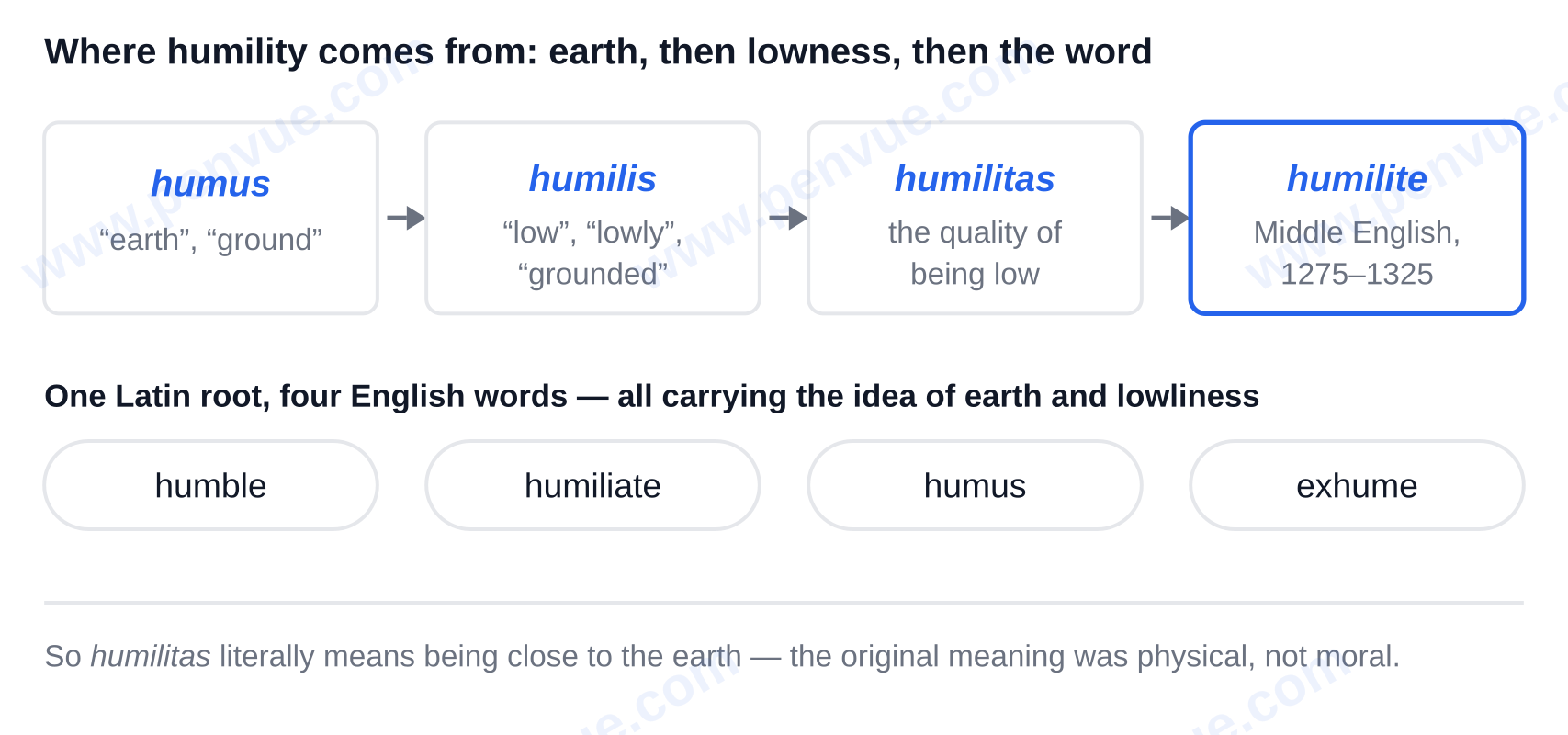
The first record of humility was between 1275 and 1325, and was Middle English humilite, from Latin humilitās. Merriam-Webster dates the first known use of the word in the 14th century.
The Latin roots: humilitas, humilis, and humus
The roots go backwards like this:
- humilitas – the quality of being low.
- humilis – “low”, “lowly”, “grounded”
- humus – “earth”, “ground”
So humilitas literally means being close to the earth. That is more significant than it appears. The original meaning of the word was not moral, but physical. Something was humilis if it was low, and soil is low. People only deemed whether humility was good or bad, later.
One Latin root fosters words as far apart as humble, humiliate, humus, and exhume, all with the idea of earth and lowliness.
This is why the classical world had no neutral vocabulary for the idea. The commentary on Philippians 2:3 at BibleHub states that in classical Greek there is no word for humility without some tinge of servility. The Greeks had Aidos, a figure tied to shame and modesty, but no neutral word for the humility which we mean today.
Why do humility and humiliation share a root but mean opposite things?
Most people become intrigued by this question and no dictionary gives an explanation. Entries give the shared etymology and are done.
This is the explanation. Humility sounds slightly demeaning because its ancestor meaning was truly demeaning. The same is true for humiliation. Both descend from humilis and humus, which means ground. As Neel Burton states, humility, like humiliation, derives from the Latin humus.
The distinction is simple; humility is a lowering you choose for yourself, humiliation is a lowering which is imposed on you by others.
Same word, three meanings: humility across three eras
The whole thing becomes clear when you realize that the word’s meaning reversed twice. For etymology, you’ll find stage 1 in the dictionary, stage 2 in devotional literature, and stage 3 in psychology papers. Side by side:
| Era | What humility meant | Was it good? |
|---|---|---|
| Classical antiquity | Humilitas as low, defeated, shamed — with, in the Greek, “some tinge of servility” | No — a thing to be despised |
| Christianity | Philippians 2:3 — do nothing from selfish ambition or empty pride, but in humility consider others more important than yourselves | Yes — a supreme virtue |
| Modern psychology | Reframed from “a low opinion of oneself” to “an accurate opinion of oneself,” with openness and broad-mindedness | Yes — but as accuracy, not lowness |
Track that order and the contemporary interpretation of the word stops feeling paradoxical. The premise “to have humility means to have an accurate view of yourself” only feels paradoxical if you are still operating within the parameters of the Roman definition. The reversal from a low opinion of yourself to an accurate opinion of yourself is documented in Wikipedia’s overview.
What is humility in psychology today?
In modern psychology, to be humble means to have an accurate self-assessment, to be conscious of your strengths and weaknesses. According to Psychology Today, a humble person is someone who has an accurate self-view, acknowledges their mistakes and limitations, is open to other points of view, keeps their accomplishments in perspective, has low self-focus, and appreciates the value of other people. Crucially, humble people also think positively of themselves.
How humility is measured: HEXACO’s Honesty-Humility factor
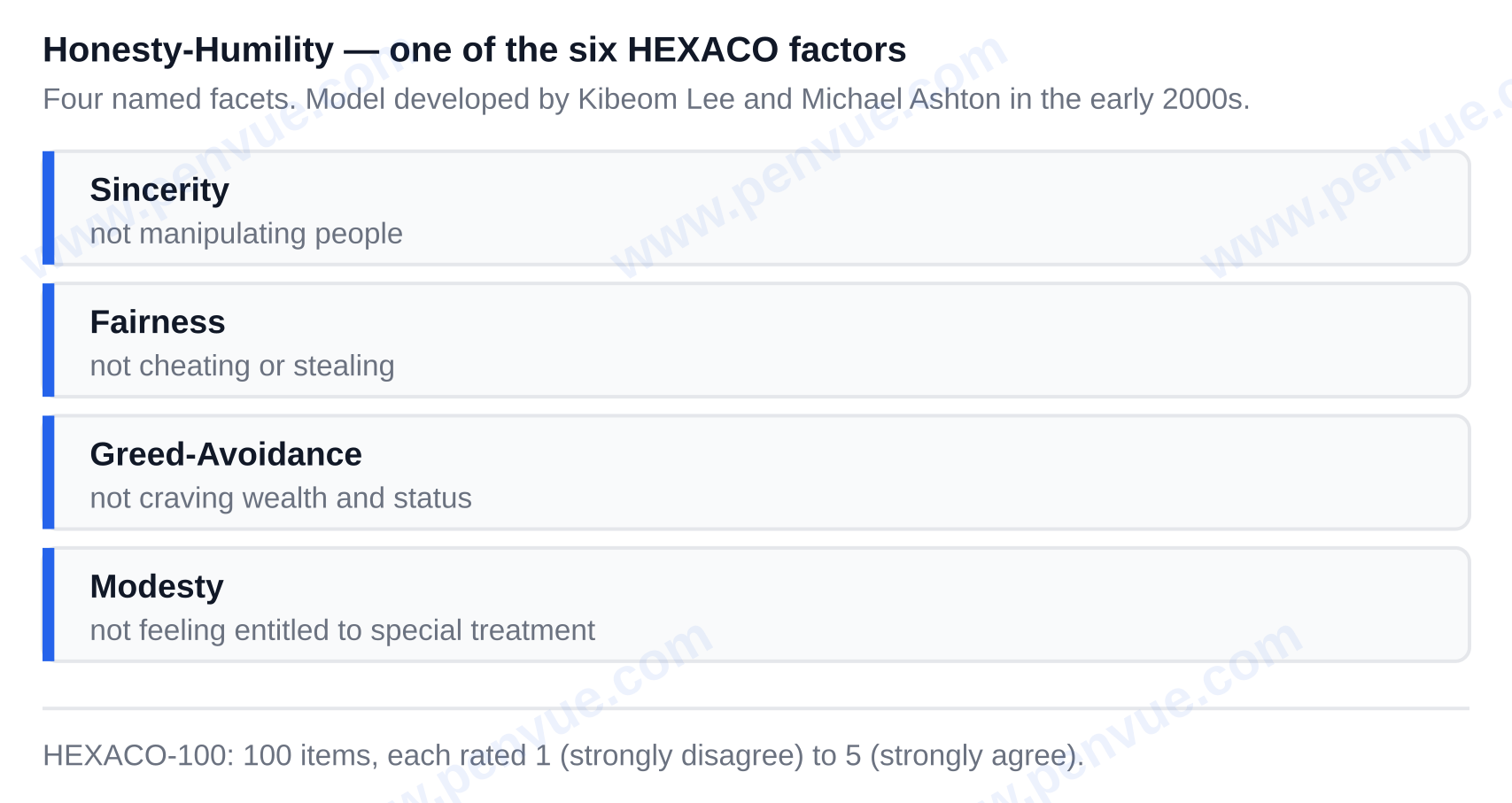
Most explainers touch on the psychology of humility, but not the measurement. The HEXACO model was developed by Kibeom Lee and Michael Ashton in the early 2000s. Honesty-Humility is one of the six factors, and it has four named facets:
- Sincerity – not manipulating people
- Fairness – not cheating or stealing
- Greed-Avoidance – not craving wealth and status
- Modesty – not feeling entitled to special treatment
The HEXACO-100 measurement includes 100 items which are rated on a 5-point Likert scale, from 1 (strongly disagree) to 5 (strongly agree). Humility also appears in the VIA Character Strengths as a strength under the virtue of Temperance.
What is intellectual humility?
Intellectual humility is the meta-cognitive ability to recognise the limits of your own beliefs and knowledge. In Porter and colleagues’ 2022 article in Nature Reviews Psychology, the authors address further characteristics associated with intellectual humility as: more acceptance of political viewpoints that differ from your own, less hostility toward members that are not a part of your ingroup, and improved learning, decision making, and satisfaction with your life. In regards to leadership, the authors also found intellectual humility to positively correlate with effectiveness in leading others.
The authors also found variation across cultures. Interdependent contexts such as Japan and China showed more intellectual humility than the USA and Canada.
As the authors themselves mentioned, the majority of the evidence that is provided is correlational, not causal. So while positive outcomes are associated with intellectual humility, it is hard to make a causal claim for the improvement.
What are the different types of humility?
There are multiple forms of humility, and identifying them helps bring this abstract notion to the concrete. Psychiatrist Ravi Chandra describes eight kinds of humility in Greater Good Magazine. They are:
- Intellectual – knowing the limits of your knowledge
- Cultural – learning to act as a student when in contact with a foreign culture
- Humility of knowledge – knowing the end of your information
- Humility of skill – knowing the edge of your skill when performing a task
- Humility of wisdom – holding judgment lightly
- Humility of awe – feeling small in the presence of something large
- Familial or intergenerational – knowing your place in a larger continuum
- Humility in the face of suffering
What is the difference between humility and modesty?
The one-sentence rule: Humility is an inward mindset; modesty is an outward restraint. Etymologically, the difference holds. Humility is rooted in humus, “earth” (i.e. your perspective of yourself), and modesty is rooted in modus, “measure” (i.e. how much you show). Humility is a mindset; modesty is a behaviour. Which is why, as Neel Burton points out, modesty can conceal vanity while humility always is self-knowledge.
Humility vs modesty vs humbleness vs humiliation: which word to use
| Word | Use it for | Example |
|---|---|---|
| Humility | Inner perspective on yourself | “The project taught her humility.” |
| Modesty | Restrained self-presentation | “He described the win with modesty.” |
| Humbleness | A plainer synonym for humility | “There was a humbleness to his answer.” |
| Humiliation | Degradation imposed from outside | “The public humiliation was deliberate.” |
Modesty, meekness, lowliness, submissiveness, and unpretentiousness are listed as synonyms of one another on Dictionary.com. Be careful when using these lists, as a flat list may give the false impression of flat differences. Meekness and submissiveness are not what psychologists mean by humility.
And here’s the usable test for the advice that trips people up: if guidance tells you to deny a real strength, that’s false modesty, not humility. Humble people, Psychology Today notes, think well of themselves and have a good sense of who they are. Rabbi Jonathan Sacks framed humility as self-appreciation rather than self-deprecation. Saying “oh, it was nothing” about work that took you six months isn’t humility — it’s inaccuracy, which is the opposite of the thing.
What is the opposite of humility?
Pride, in the dictionary sense, and all of its derivatives: arrogance, vanity, conceit and hubris. Humility isn’t self-deprecation. Humility isn’t synonymous with low self-esteem. Humility isn’t shyness and isn’t timidity. Humility isn’t servility. Those sit on the wrong axis entirely: they’re inaccuracy pointed downward.
What does humility look like in practice?
Three sentences showing correct usage across registers: “She accepted the award with genuine humility.” “The defeat taught him humility.” “Intellectual humility is the starting point of critical thinking.” That last register is where the word is trending — Dictionary.com’s live example feed currently pulls recent usage from a Salon piece on curiosity and humility underpinning critical thinking, alongside items from the Wall Street Journal and the Los Angeles Times.
Examples of humility in a sentence
In everyday behaviour, humility looks like:
- Saying “I don’t know” without softening it
- Not getting defensive when you’re corrected
- Giving credit to someone else when you led the effort
- Listening without interrupting to reload your argument
- Conceding when you know you’ve made an error, while it’s still cheap
Each example shows you something and ties into something else. You could say humility lowers defensiveness, which makes repair possible. The other end of that is humility is load-bearing in learning. When you think you know the answer already, you effectively can’t absorb the new information. In leadership, the intellectual humility literature associates it with better decision-making and effectiveness. See more about humility as a trait and how it’s recognized in our longer piece on what humility is and how it shows up.
Why is humility considered a virtue?
Because it’s arrived on nearly every path independently. There’s Philippians 2:3 and Matthew 5:5 for Christians; C.S. Lewis is a recent champion for the Faith; Judaism has Rabbi Jonathan Sacks; for Muslims, it’s tawadu and khushu; for Hindus, it’s amanitvam in the Bhagavad Gita; for Jains, it’s vinay; for Buddhists, it’s inseparable from non-attachment.
Not everyone thought this way. Nietzsche and Schopenhauer read humility as weakness. A virtue created by the powerless to make their position respectable. Keep that in mind. It’s essentially the Roman objection, resurfacing eighteen centuries later.
The three things to keep
- The definition: humility is an accurate, unexaggerated understanding of yourself and therefore the absence of arrogance and the presence of honest self-knowledge.
- The history: the word has endured two reversals — Roman insult, Christian supreme virtue, modern psychological measure — giving it the ability to sound demeaning and admirable at the same time.
- The word choice: humility is more of an inward perspective, modesty is outward restraint, and humiliation is something done to you.
What’s next? Pick one situation this week where you would normally defend your position and practise intellectual humility instead by naming out loud what you don’t know.
Common Questions
Is humility a strength or a weakness?
More of a strength on the modern definition, but the debate is old. Nietzsche and Schopenhauer read humility as weakness, essentially reviving the classical view that lowness was contemptible. Research, however, points the other way: Porter and colleagues (Nature Reviews Psychology, 2022) link intellectual humility to better decision-making, better learning, higher life satisfaction and improved leadership effectiveness, while noting most of that evidence is correlational. Humility also sits in the HEXACO model as the Honesty-Humility factor and in the VIA Character Strengths framework under Temperance — both of which classify it as a positive trait, not a deficit.
Can you have humility and confidence at the same time?
Yes, and that’s the point of the modern definition. In line with the modern definition of humility, you can have an accurate self-evaluation that includes a realistic appreciation of your strengths. Humble people, Psychology Today says, think well of themselves and are clear-sighted about who they are, while staying open about their limits. Humility and confidence only conflict if you define humility as self-deprecation — and if you’re told to deny a real strength, then that’s false modesty and not humility.
What is the adjective form of humility?
Humble. Humility is normally an uncountable noun, so it would be “she showed humility” and not “she showed a humility.” Humble is the adjective and humbly the adverb. Humbleness is another way to say humility. Don’t reach for humiliate and humiliation as part of the same family in meaning. While they share the Latin root humilis, they describe degradation imposed from outside, not a quality you hold.