
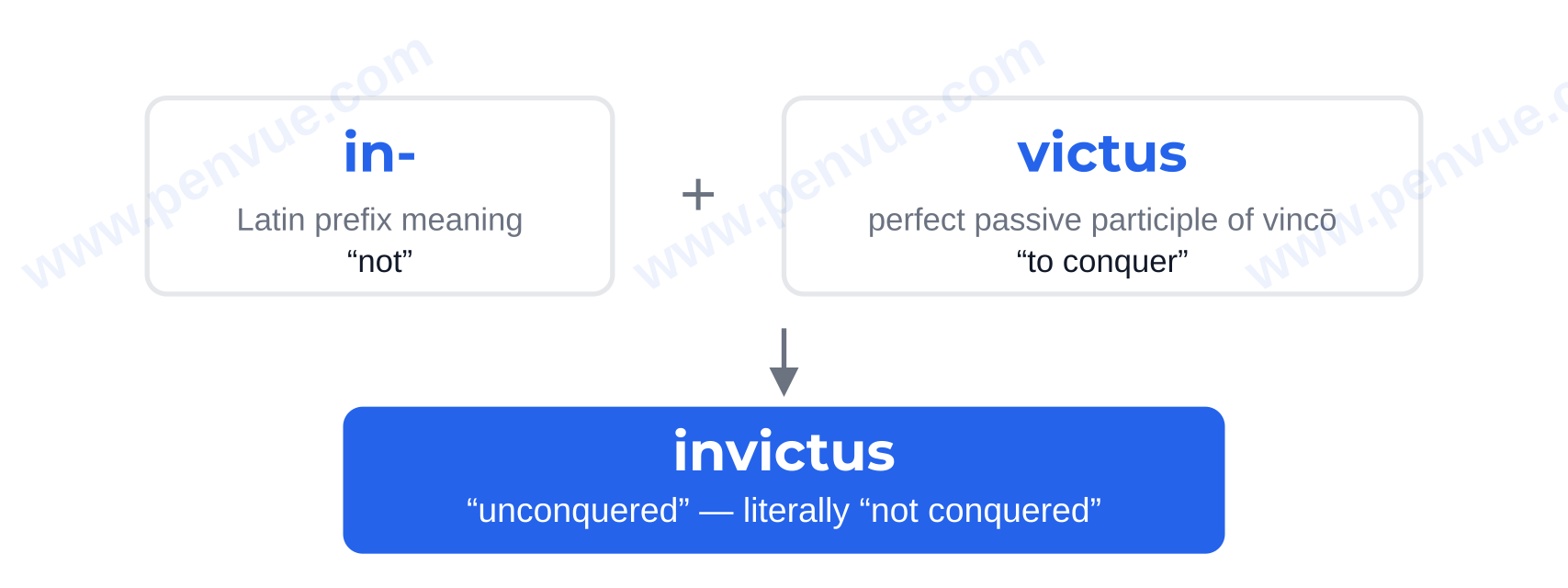
The word ‘Invictus’ means ‘unconquered.’ The meaning can be broken down to its components: the Latin prefix in- meaning ‘not’ and victus, the perfect passive participle of vincō meaning ‘to conquer.’ Hence, the word ‘Invictus’ means ‘not conquered.’ Today the word names William Ernest Henley’s 1875 poem, the Invictus Games, a 2009 Clint Eastwood film and a Paco Rabanne fragrance.
One example shows the word working long before any of that. Sol Invictus — the “Unconquered Sun” — was the official sun god of the late Roman Empire. Same adjective, same sense: something that has not been beaten.
What does invictus mean in English?
For its entry in English to English, the Latin entry for invictus holds several nuances. They are: unconquered, unsubdued, invincible, undisputed and undefeated. Invictus is an adjective and therefore cannot be used as a noun. You cannot have “an invictus.”
Invictus meaning vs. invincible vs. undefeated
‘Unconquered’ means something that has never been conquered. To make a claim that something is ‘unconquered’ is a smaller, harder claim than saying it is ‘invincible.’ This is why the word invictus works as a survivor’s word rather than someone who is boasting. Saying something is ‘undefeated’ is closest to what is meant by ‘invictus’ but again, ‘undefeated’ has lost its meaning due to overuse by sports pundits.
As a loan word from Latin, invictus behaves very differently from other words. Dictionary.com files it less as an entry in the vocabulary section and more as a cultural reference: Latin for ‘unconquered’ and the closing couplet of Henley’s poem. Most English speakers come across the word as a title and are not likely to use it in an everyday context.
How to pronounce invictus
There are three pronunciations, based on tradition. Classical Latin is pronounced [ɪnˈwɪk.tʊs] — in-WIK-tus — and distinguished from similar sounding words by hearing the v as a w sound. Ecclesiastical and Italianate Latin is pronounced [iɱˈvik.tus], with a true v sound. Standard English is in-VIK-tuss. The word lived on in the Romance languages: Italian invitto, Spanish and Portuguese invicto.
Invictus, invicta or invictum — which form do you actually need?
This is what dictionaries display and never explain. Invictus is a first/second-declension adjective, hence the ending changes with the gender of the noun it modifies. Using the wrong one gives a tattoo, gym name, boat name or brand a grammar mistake, as anyone familiar with the language will notice.
Quick reference: the gender forms of invictus
| Form | Use it for | Example |
|---|---|---|
| invictus | a masculine subject | Sol Invictus — sol, the sun god, is masculine |
| invicta | a feminine subject | Invicta, which stands alone as a motto and a brand name |
| invictum | a neuter subject | cor invictum — an unconquered heart (cor is neuter) |
| invictē | the adverb | describing how something is done, not what it is |
| invictissimus | the superlative | “most unconquered” — emphatic, rarely what you want |
Case affects the ending as well, so a longer Latin phrase may not contain invictus in the nominative case. This is especially important when creating a full motto rather than using the single word — check the whole phrase.
Mistakes people make when using invictus as a motto or tattoo
- Using it as an English noun — “my invictus” — rather than as an adjective that needs something to describe.
- Using invictus for a feminine subject when invicta should be used.
- Using invicta and “invincible” interchangeably; they are different claims, not spelling variants.
- Lifting a Latin phrase off an image without first verifying the case of the connecting word.
Doing a quick bit of homework before getting a tattoo gives the same effect as doing homework before wearing a symbol, as in the case of what the evil eye actually means.
Who wrote the poem “Invictus” and what is it about?
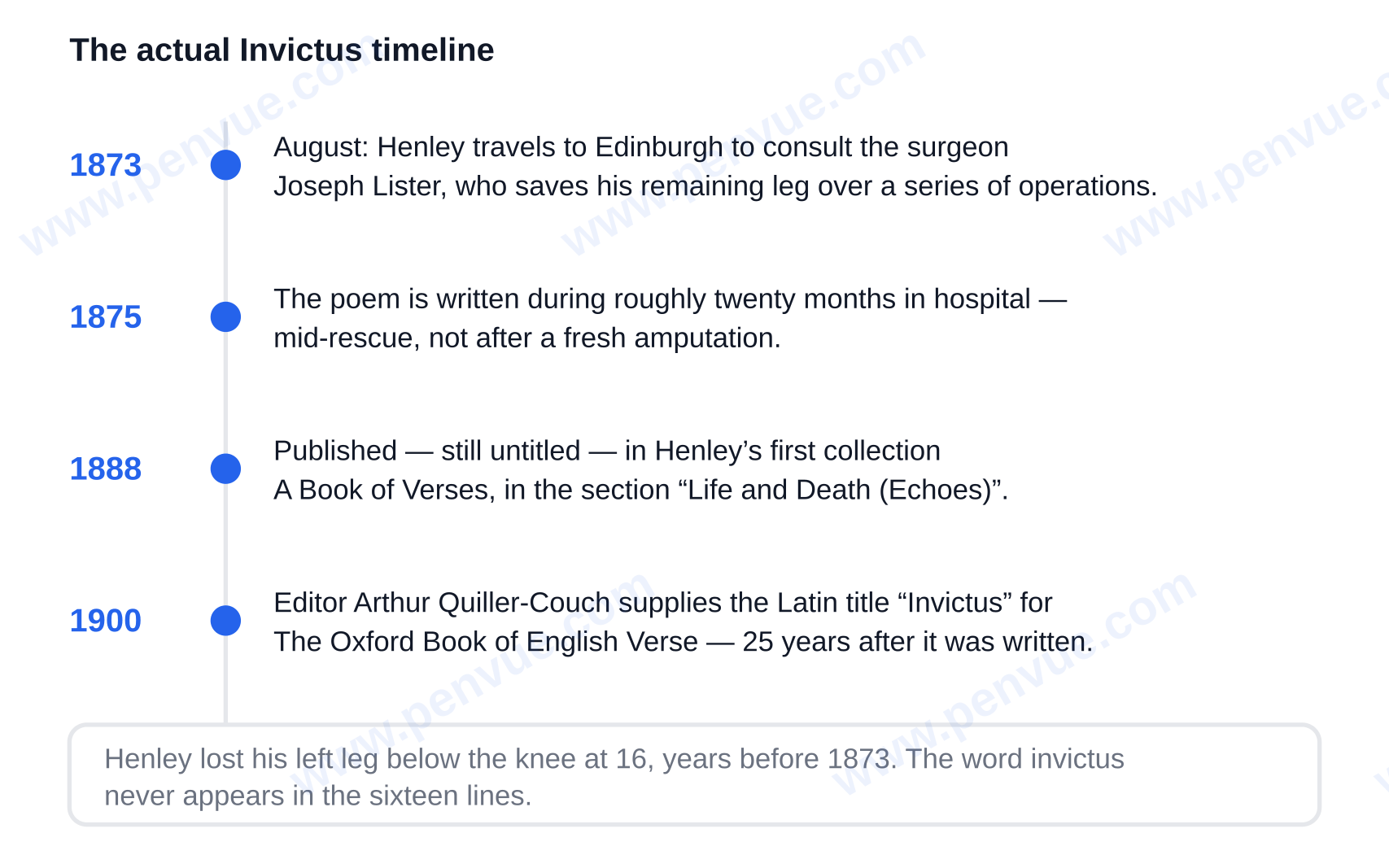
William Ernest Henley wrote the poem in 1875 and published it in 1888 in his first collection, A Book of Verses, in a section titled “Life and Death (Echoes)”.
The structure of the poem is very rigid. It consists of four stanzas, sixteen lines, each of which has eight syllables, and the stanzas alternately rhyme. Each stanza sets an image of adversity — the night, chance, wrath, the shade — against an assertion of the speaker’s inner control, then answers it.
The themes are resilience and Stoic defiance, plus one detail readers skip past. The speaker asks no deity for rescue. “Whatever gods may be” is a sideways thanks offered to no-name deities. The thanks are more of a courtesy than an actual prayer.
Early printings carried the dedication “To R. T. H. B.” — Robert Thomas Hamilton Bruce, a Scottish flour merchant, baker and literary patron. After Bruce died, per Wikipedia’s account of the poem, the 1900 edition of Henley’s Poems changed it to “I. M. R. T. Hamilton Bruce (1846–1899)”, where I. M. stands for in memoriam.
“I am the master of my fate, I am the captain of my soul” — what it means
There are several ways to interpret the closing couplet, and it is narrower than it sounds. Henley is not advocating control over the things that happen to him, but control over how we decide to engage with them. He claims that he is the master of his fate and the captain of his soul rather than requesting them to be that way for him. He cannot request to be the master over circumstance, but he is the owner of the response. Read the sixteen lines in full and you will notice something else: the word invictus never appears in them.
What the top-ranking pages get wrong about Invictus
Three errors repeat across the pages that currently rank for this word. They simplify the real-life story.
The amputation timeline runs the other way. Top ranking poem analysis pages describe “Invictus” as a response to an amputation that occurred just prior to Henley writing it. Wikipedia’s account reverses the order. Henley lost his left leg below the knee at the age of 16 to complications of tuberculosis of the bone. Several years later, in August of 1873, he traveled to Edinburgh to consult the surgeon Joseph Lister, who saved the remaining leg through a series of operations. The poem was written in 1875, during the roughly twenty months of that hospital stay. So “bloody, but unbowed” is the voice of a man mid-rescue, fighting to keep the leg that he still has — endurance under ongoing treatment, not a shout over a fresh loss.
The title belongs to an editor, not the poet. The title was given to the poem by an editor. The poet, Henley, left the poem untitled. Arthur Quiller-Couch supplied the Latin title in 1900, when he selected it for The Oxford Book of English Verse — twenty-five years after it was written and twelve years after it appeared untitled in A Book of Verses. Prior to 1900, newspapers ran it under improvised titles including “Myself,” “Master of His Fate” and “Captain of My Soul.” That is the honest answer to why the poem is called Invictus when the word is nowhere in it.
The film invented the Mandela handover. The 2009 film depicts Mandela giving the poem to Springbok captain Francois Pienaar before the 1995 Rugby World Cup. What Mandela actually handed Pienaar was the passage from ‘The Man in the Arena’ by Theodore Roosevelt. Mandela’s documented connection to the poem is earlier and quieter: he recited it to fellow prisoners on Robben Island. Barack Obama quoted it at Mandela’s memorial on December 10, 2013.
What does Sol Invictus mean, and why is it tied to Christmas?
Sol Invictus means “Unconquered Sun,” or “Invincible Sun,” in Latin. It was the official sun god of the late Roman Empire, and the word’s long life before any English poem touched it.
The emperor Aurelian revived and promoted the cult in AD 274, building a temple on the Campus Martius and founding the priestly college of the pontifices Solis. He also established a feast of the birth of Sol Invictus on December 25. Within about fifty years, Constantine I declared dies Solis — Sunday — the Roman day of rest.
Whether that December 25 feast shaped the date of Christmas is debated rather than settled. National Geographic’s survey of the competing explanations treats the overlap as real and the causation as argued both ways, which is the only defensible position to take on it.
Note the grammar while you are here: invictus takes the masculine ending because it agrees with sol. That is exactly the decision facing anyone building their own phrase, the invictus meaning stays constant, the ending does not.
Why the Invictus Games, the film and the fragrance share a name
- The Invictus Games — an international multi-sport event for wounded, injured and sick serving personnel and veterans, started in 2014. Prince Harry founded it with Sir Keith Mills, in partnership with the Ministry of Defence, after his 2013 visit to the Warrior Games in the United States. He chose this name because invictus is Latin for “unconquered,” applied to competitors whose injuries did not defeat them, and he pays tribute to Henley directly; a 2014 promotional video has Daniel Craig and Tom Hardy read the poem aloud. Harry appears in TIME’s TIME100 Most Influential People in Sports 2026, which keeps the Games the word’s most visible carrier.
- Invictus (2009) — the movie directed by Clint Eastwood where Morgan Freeman and Matt Damon star. Freeman plays Nelson Mandela and Damon plays Francois Pienaar. The film is based on John Carlin’s Playing the Enemy and is titled after the poem.
- Paco Rabanne Invictus — an eau de toilette launched in 2013 and still selling. The company markets it on the Latin sense as “the scent of victory.” Fragrantica credits Véronique Nyberg with Anne Flipo, Olivier Polge and Dominique Ropion, with grapefruit, a marine note and laurel. A real share of searches for the invictus meaning comes from the bottle rather than the poem.
Then there are the minor instances that drive a lot of this traffic. Gym names, team names, personal mottos. It’s also a given name for boys which, according to Nameberry, means “unconquerable, undefeated.” They all land on the same word for the same reason. It sounds strong but not aggressive — much the way humility reads as strength rather than weakness — and it is short, easy to say, and still unclaimed in English.
Who has claimed the poem — and why that should give you pause
A lineage you can be proud to have. Winston Churchill paraphrased the closing couplet in the House of Commons in 1941. Eugene V. Debs wrote out the final lines before his death in 1926. James Stockdale received the last stanza on toilet paper as a prisoner in Vietnam. John Lewis recited it as a teenager. Aung San Suu Kyi drew on it under house arrest.
A lineage you can draw more than a few concerns from is equally documented. Timothy McVeigh’s entire written final statement before his June 11, 2001 execution was a handwritten copy of “Invictus,” handed to the prison warden — as NPR reported at the time. The 2019 Christchurch mosque attacker cited it in his manifesto. Most recently, members of the Philippines’ Duterte family also quoted it a number of times through 2026, drawing focus to International Criminal Court proceedings.
There are structural reasons for that range. A poem that places all authority within the individual and asks for nothing of a higher court will fit anyone who feels besieged, whether or not they should. The meaning of invictus is quite portable; inspirational write-ups almost never allude to it.
This should not stop you from using the word or poem. It simply suggests you become familiar with the company prior to placing it on your person, team, or brand.
The short version
The word invictus means “unconquered” — in- plus victus, “not conquered” — and nearly everything else is layered on top of that single sense. A Roman sun god, an untitled Victorian hospital poem an editor named in 1900, a game for wounded veterans, a film, and a fragrance. If you plan to give the word an enduring place, especially as a tattoo, a team or a brand, check the gender table above first; the complete sixteen-line text is hosted by American Literature when you want the poem itself.
Rule of thumb: invictus doesn’t mean you can’t be beaten — it simply means that you haven’t been conquered.
Common Questions
Is invictus a real Latin word or just a poem title?
It’s an actual Latin adjective, meaning “unconquered” or “unsubdued”. It’s formed by in- meaning “not” and victus, the participle of vincō meaning “to conquer”. It has been used for centuries before Henley — Sol Invictus, the “Unconquered Sun,” was the official sun god of the late Roman Empire. The poem’s title came much later and was added by an editor. The actual poet never gave a title to the poem.
What is the feminine form of invictus?
Invicta. Invictus is a first/second-declension adjective, so it takes invictus for a masculine subject, invicta for a feminine one and invictum for a neuter one. If the thing you are describing is grammatically feminine — or if you want the word for a woman — invicta is the correct spelling.
Did Nelson Mandela write the poem Invictus?
No. William Ernest Henley wrote it in 1875. Mandela recited it to the fellow prisoners of Robben Island, which is his documented connection to the poem. In the 2009 Clint Eastwood film, Mandela’s character presents the poem to Springbok captain Francois Pienaar, but what Mandela actually presented to Pienaar was Theodore Roosevelt’s “The Man in the Arena” passage.
What does an Invictus tattoo usually mean?
It means “unconquered” as someone who has survived something rather than someone who is immune to something. That is the literal definition and it is the meaning used by the Invictus Games to describe wounded and injured servicemen and women. Two bits of practical information: check the gender form before committing to the spelling; and understand that the poem has been adopted across the entire moral compass, not only by people you’d want to be associated with.
Is Invictus a good name for a baby boy?
It is used as a boys’ given name, interpreted on Nameberry as “unconquerable, undefeated.” It is short, easy to pronounce and acceptable grammatically as a masculine form. The trade-off is weight. The name has a Roman sun god, a Victorian poem and a veterans’ sporting event associated with it. Therefore, the name will evoke a story every time it is heard.
What does “bloody, but unbowed” mean in the poem?
It means visibly hurt but not submitting — bowing is the gesture of surrender the line refuses. The context helps explain it further. Henley wrote the poem in 1875 during roughly twenty months in Edinburgh Royal Infirmary, where Joseph Lister was saving his remaining leg after a series of operations. So the line is about enduring ongoing treatment rather than defiance after a finished loss.