
“Karma” has two meanings, one involving action and its consequences and the other concerning reciprocal actions. The karma meaning rooted in Sanskrit is the first one — kárman, meaning work, deed, or action, together with the consequences that action sets in motion. Intentional deeds shape future experience, in this life or the next. In a more colloquial sense, “good karma” or “bad karma” represent payback, deserved or otherwise, or, at times, one’s vibes.
An immediate example where this split is apparent is as follows: “He believes his illness is the result of karma from a past life” uses the doctrinal meaning. “Returning the wallet earned her some good karma” uses the more colloquial sense. Both use the same four letters to convey different notions regarding the world.
What does karma mean in simple words?
Karma means action along with its results — what you do, and what follows from doing it.
It is generally used in the form of an uncountable noun, pronounced KAR-muh. Its plural form “karmas” is rare and mostly technical. Merriam-Webster defines karma as the force generated by a person’s actions, held in Hinduism and Buddhism to perpetuate transmigration and, in its ethical consequences, to determine the nature of that person’s next existence.
Therefore, it embodies a doctrinal meaning in four Indian religions as well as an English-language colloquialism regarding payback or atmosphere. Most of the ambiguity regarding the term karma comes from conflating the two meanings.
Karma, dharma, samsara and moksha — how the related terms fit together
- Karma — action and consequence.
- Dharma — that which determines your action or your right course of conduct.
- Samsara — the continuous cycle of birth and death which karma keeps turning.
- Moksha — liberation, exit from the samsara.
Where does the word karma come from in Sanskrit?
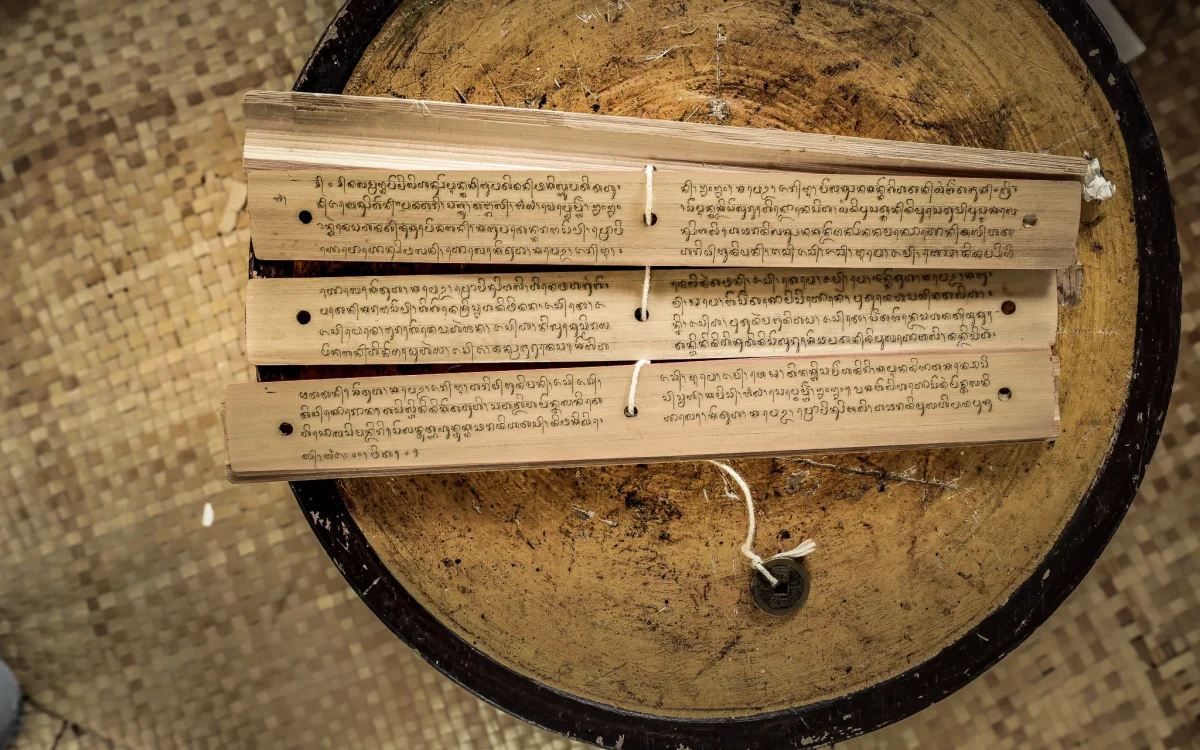
The Sanskrit word for karma is कर्म (kárman), meaning “work”, “deed”, or “action”. It is derived from the verbal root, kṛ, which means to do, to make, to perform or to accomplish. The Pali form of kamma is used in the Buddhist canon and teachings of Theravada.
In Vedic Sanskrit, the word has mundane meaning and is used to denote any work or ritual act about 40 times in the Rigveda, without any notion of moral ledger attached to it.
From ritual act to moral law: the shift in the Upanishads
The idea and theory of ethics is developed later, in the Upanishads. The clearest early statement sits at Brihadaranyaka Upanishad 4.4.5–6, in which the renowned sage Yajnavalkya states that by the performance of good or pious acts one becomes good and pure, and by the performance of bad or impure acts one becomes bad and impure. A date of 8th–6th century BCE is generally given to this text, but this is debatable, so treat it as approximate.
When did karma enter English — and who got the date wrong?
The term karma first appeared in English in 1827 according to Merriam-Webster. This is the number that is mostly cited on the Internet.
It is not the earliest. The Oxford English Dictionary’s earliest evidence is 1785, in a translation by C. Wilkins — Charles Wilkins’ English Bhagavad Gita, the first direct translation of the Gita into English. So, we can assume the word was in use in English for about 40 years before the most-cited dictionary on the topic suggests, and the year 1785 is the date more widely supported in the historical record, and should be used when citing the date of entry for this word in the English language.
Why does the gap in date of entry matter? Trivia aside, karma was first introduced in English via colonial-era Sanskrit translation, and it was not reintroduced in the 1900s by New Age philosophers as is widely assumed — which is where most readers assume it came from. And since major dictionaries now record the informal sense too, calling “good karma” wrong is now out of date.

What does karma mean in Hinduism, Buddhism, Jainism and Sikhism?
Four traditions, one word, four different mechanisms. They each have their own mechanism, so here they are compared on the same axes.
| Tradition | What karma is | How deterministic | Rebirth essential? | Release |
|---|---|---|---|---|
| Hinduism | Action and reaction governing consciousness across lifetimes, bound to dharma | Partly fixed: only present action is open to choice | Yes, via samsara — though schools differ on how central it is | Moksha; the Gita’s karma yoga and nishkama karma, action without attachment to results |
| Buddhism | Intentional action driven by cetanā — the act, not the outcome | Explicitly non-deterministic and circumstantial | Yes, but karma is one cause among several | The path; ending the craving that fuels action |
| Jainism | Literal subtle matter — “karmic dirt” particles that adhere to the soul | Most rigorous of the four; karma cannot be transferred between individuals | Yes | Austerity and non-violence that shed accumulated matter |
| Sikhism | An infallible sow-and-reap law: you harvest exactly what you sow | Lawlike, but tempered by divine grace | Yes | Grace, alongside right action and devotion |
There is internal discord. Even within Hinduism, schools of thought vary on whether samsara is central to the karma doctrine or secondary to it — so “Hinduism says” is a generalized statement.
What are the types of karma — and are the “12 laws of karma” real?
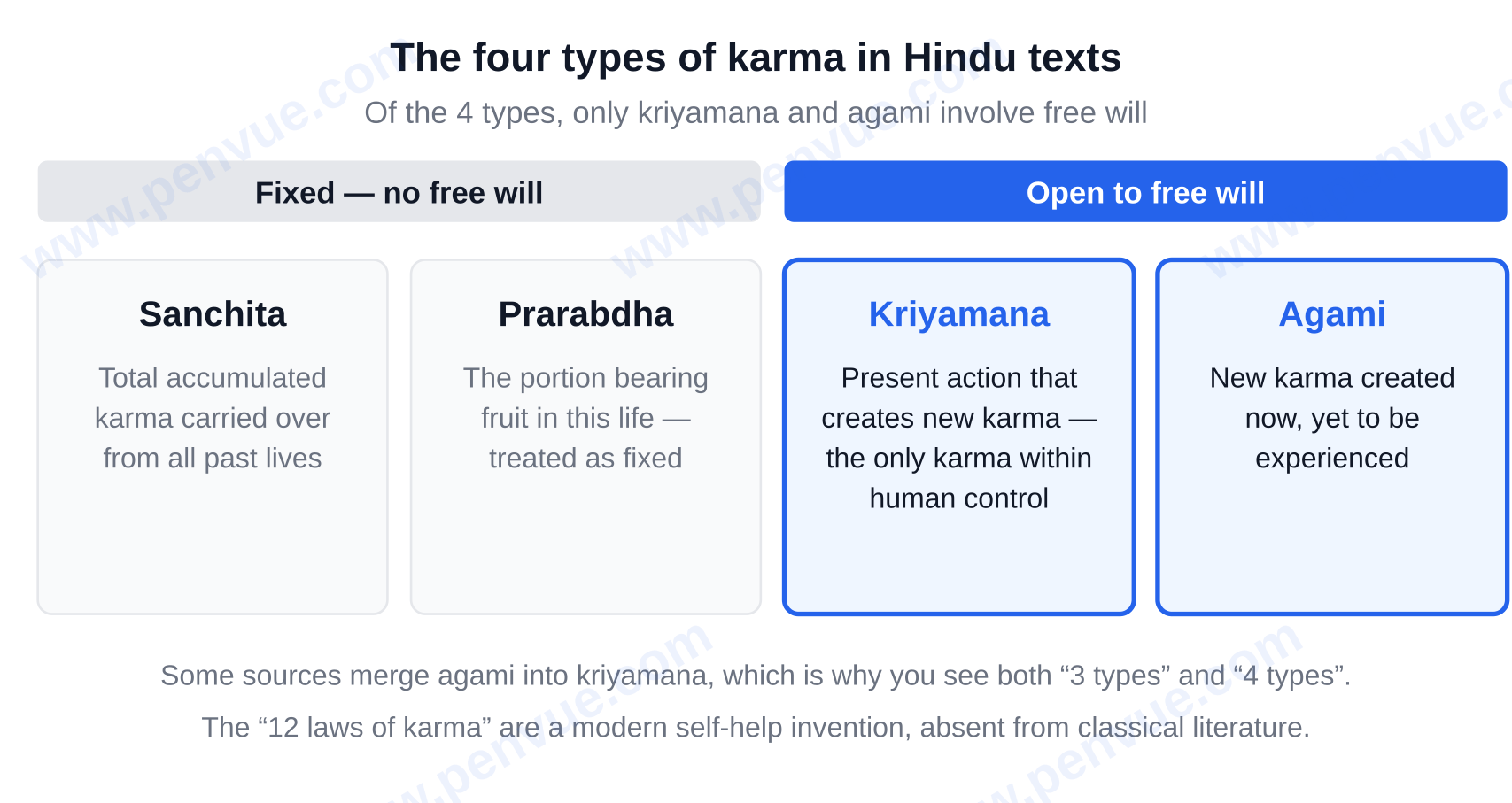
In the Hindu textual context, the classification is four-fold and it is the one worth knowing.
Sanchita, prarabdha, kriyamana and agami explained
- Sanchita — total, accumulated karma, carried over from all past lives.
- Prarabdha — the portion of karma that is currently bearing fruit in this life, treated as fixed.
- Kriyamana — the current action that creates new karma, and the only karma that is within human control.
- Agami — the new karma created now that is yet to be experienced.
Some sources combine this into 3 by combining agami with kriyamana. Therefore, you will see both the “3 types” and “4 types” of karma online. Free will sits in a narrow band: of the 4 types, only kriyamana and agami involve free will.
The “12 laws of karma” are different from the above. A modern, self-help, new-age invention, they don’t appear anywhere in the classical literature. Some sites list them in a different order and use different terminology. If you were referred to us from one of those sites, the “sanchita-prarabdha-kriyamana-agami” enumeration is the one that’s based in Hindu sources on karma.
Where the dictionary meaning and the doctrinal meaning part company
Here is the correction that almost no definition page makes. In Buddhism, kamma is the intentional deed or act — not the consequence. The effect is called karmaphala, vipāka or “fruit” and “ripening”.
Intention, the Nibbedhika Sutta (Anguttara Nikaya 6.63) says, is kamma. “Intention I tell you, is kamma. Intending, one does kamma by way of body, speech, & intellect.”
This is what people usually say, “Karma finally caught up with him.” The effect is what people usually have in mind, but in a doctrinal sense, the referent is the deed. In practice, when you check the major dictionary entries against the sutta, the flip is baked in at the source — they define karma as the force or the effect. That’s where the slang sense becomes authoritative. Reading the Sanskrit layer, the doctrinal layer and the slang layer side by side is the only way to clarify it.
Which karma does your sentence mean?
- Doctrinal — a more precise concept in Hinduism, Buddhism, Jainism or Sikhism. “Jain karma is understood as subtle matter.”
- Idiom (atmosphere) — something that is recorded in a dictionary. “The studio has good karma.”
- Loose payback — the deed/fruit flip above. “That’s karma.”
- Technical, non-religious — refers to Reddit scores, hacking a Wi-Fi router, coding a video game, etc. “My comment karma tanked.”
Both the doctrinal and colloquial sense are legitimate English now. Just be clear which one you are referencing before you use the word in a discussion of religion — the same is true of other words that have a religious connotation, the same care a word like humility rewards when it does double duty.
Is karma the same as fate or destiny?
No, karma doesn’t mean fate or destiny. Karma often gets confused with fate or destiny, but the different traditions hold the future to be a function of past action and present effort grounded in free will.
Two checkable limiting cases. In Buddhism, the Sivaka Sutta (Samyutta Nikaya 36.21) has the Buddha list eight possible causes of painful feeling, with karma being just one of them. So, you cannot say that every present condition is due to karma. In Hinduism, only kriyamana and agami karma are related to will, and prarabdha is considered to be immutable for that life. It is at this point that the doctrine is most susceptible to the criticism of fatalism and victim-blaming.
Which is why saying “it was just my karma” or “that’s their karma” is a misuse. These sayings use the mechanism of action to judge a person. One thing worth saving is that karma is a mechanism of action, not a judgement on a person. When it comes to New Age use, karma is a law of cause and effect assuring cosmic balance, usually dropping the punitive edge altogether — much like how the belief in the evil eye has faded, but it is still a decorative eye.
What does karma mean outside religion — including on Reddit?
Outside of religion and on a more casual level, good or bad karma explains the general character or feeling among a group of people or in a place. An example from Cambridge is period-perfect: “In the early 60s hippies arrived, attracted by the island’s ‘good karma’ and physical beauty.” Along with that is the payback sense or “that’s karma” to explain when someone gets what they deserve, and finally the relationship usage, which usually means reciprocity and consequence rather than doctrine.
Now what is Reddit karma? Reddit karma is your reputation score, earned from upvotes on posts and comments, and divided into post karma and comment karma. No connection to the religious sense beyond the metaphor of accumulated deeds. Other things this metaphor has been applied to include the KARMA Wi-Fi attack, Karma, the physics engine used in Unreal Engine 2, and trust metrics in online moderation systems.
Is karma real? Break the question down. As a cosmic law, it is unprovable, and thus, unfalsifiable. As a social observation — actions have consequences that come back to you through other people — it is plainly true. Both can be true at the same time.
Three things to remember
- The word means deed. From the Sanskrit kárman, built on the root kṛ, mundane in the Rigveda and moral only from the Upanishads onward.
- The doctrines differ. Hinduism, Buddhism, Jainism and Sikhism disagree on what karma is, how fixed it is, and how you get free of it.
- The slang is the reverse. English usually uses the term to mean the fruit, and in Buddhism, it is located in the intention.
Before you use the term, understand which of the four meanings you intend. If you want the doctrinal one, read Brihadaranyaka Upanishad 4.4.5–6 and the Nibbedhika Sutta side by side — about ten minutes, and it settles most of the confusion.