

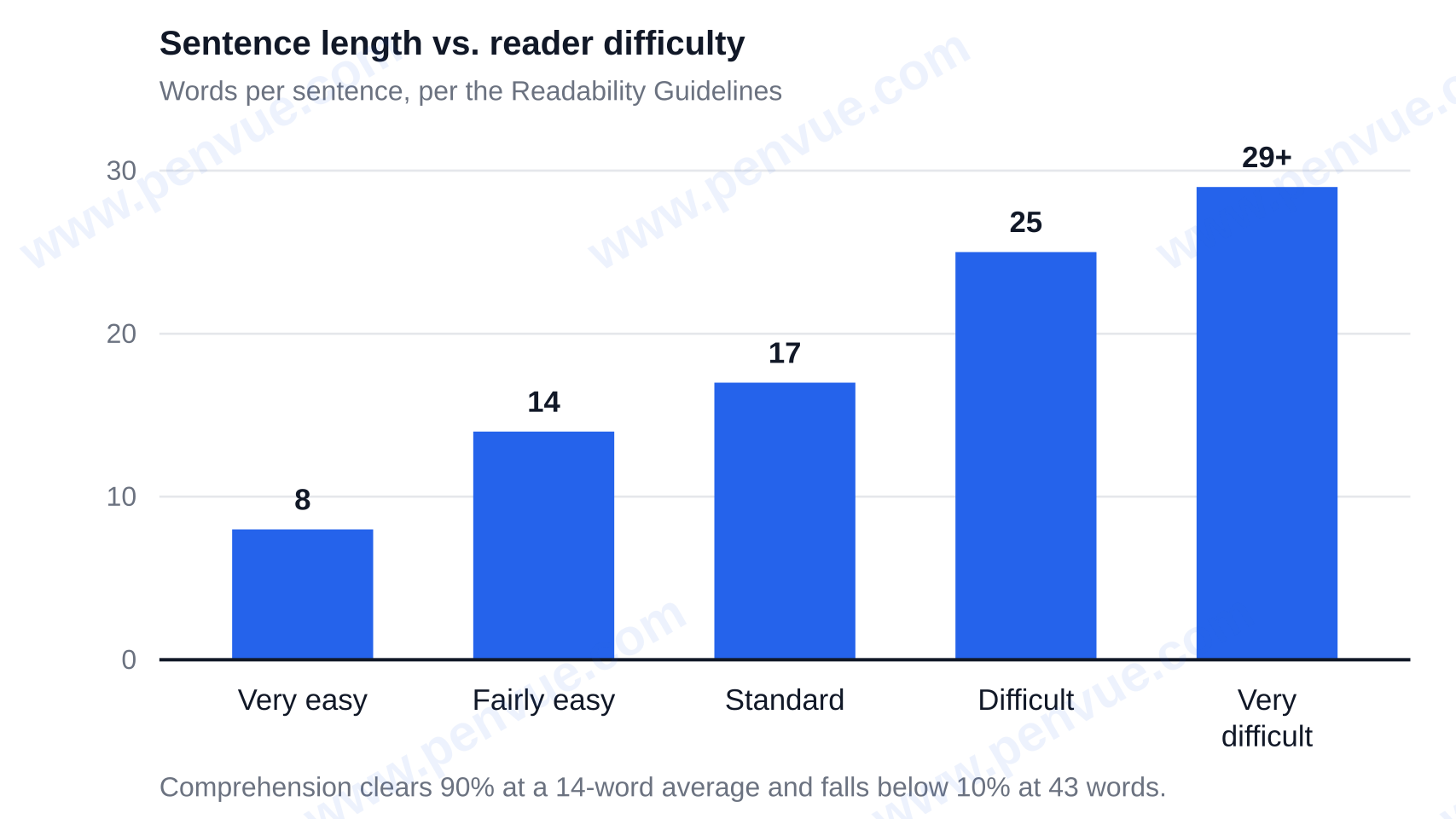
Under the Readability Guidelines, comprehension of a sentence falls below 10% at 43 words and rises above 90% at an average of 14 words. The number of words has no correlation with sentence simplicity. A simple sentence is one independent clause with no dependent clause — one subject, one verb, one complete thought. “Birds sing.” qualifies, and so does a 30-word version.
“Simple” describes structure. It doesn’t pertain to how easy a sentence is to read or how long it is.
What is a simple sentence, in plain words?
A sentence can be built of one independent clause. An independent clause can be built of one subject and one verb. There are other definitions as well. The technical one — a sentence built from one independent clause, with no dependent clause attached — is the wording Grammarly uses, and the wording in Wikipedia’s sentence clause structure article. The plain-English one: one subject-verb unit, saying one complete thing.
What are the two required parts of a simple sentence?
There is a subject and a predicate. The subject is who or what the sentence is about. The predicate is the finite verb plus everything that belongs to it. In “Fiona bought a car.”, Fiona is the subject and bought a car is the predicate.
“Complete thought” sounds vague, but a good test is to see if it can stand alone. If not, it is a fragment. A complete thought is a sentence. “Fiona bought a car.” is a complete thought. “Because Fiona bought a car.” is a fragment.
What counts as an independent clause?
A group of words that contains at least one subject and at least one verb that can stand alone as a sentence. “I woke up late” is a complete sentence. “Because I woke up late” is not. It contains both a subject and a verb, but the subordinating conjunction gives it off to another clause, making it a dependent clause. A simple sentence cannot contain a dependent clause.
Five patterns make a clause stand alone: SV (“Birds fly.”), SVC (“I am happy.”), SVO (“Fiona bought a car.”), SVOO (“She gave me a book.”) and SVOC (“They painted the door red.”). You can add adverbials to all five and the sentence will still be simple because adverbials are not clauses.
Real examples, from two words to thirty
Starting at the bottom, “Birds sing.” and “She sings.” are complete sentences with only two words each. “I run.” is a complete sentence as is, with two words of its own.
A direct object gets you “Fiona bought a car.” or “I missed the bus.” Prepositional phrases get you “The girl ran into her bedroom.” Adjectives, adverbs, an opening adverbial phrase, a second verb gets you “In the backyard, the dog barked and howled at the cat.” A second subject gets you “Mary and Samantha arrived at the bus station early but waited until noon for the bus.”
Each of the above is a simple sentence. Additions, in the form of adjectives, adverbs, prepositional phrases, direct/indirect objects, etc., are what determine the length, not the classification, of a sentence. The example containing 15 words is doing the same work as “Birds sing.” Extra words are always hanging off a single subject, single verb core.
Compound subjects and compound verbs inside one clause
Two subjects do not make two clauses. The Mary and Samantha example, cited by the ENG 1001 guide of the Illinois Valley Community College, provides a compound subject and a compound verb, and is still a simple sentence. The two subjects still share a single predicate, thus a single clause.
The same logic is true for the dog. In “Barked and howled,” the two verbs still make a single clause: two verbs, one subject, one clause. Compound predicates are the most common false positive in this subject, and Wikipedia addresses this example specifically, telling readers not to mistake a compound predicate for a compound sentence.
How long is too long, in actual word counts?
Many sources give ballpark figures and move on, with the Readability Guidelines being the exception. Readers find sentences with a length of 8 words or fewer very easy, 14 words fairly easy, 17 words standard, 25 words difficult, and 29 or more very difficult. Comprehension clears 90% at a 14-word average and collapses below 10% at 43 words. Current plain language guidance puts the average length of simple sentences at 15 and the maximum at 25, with the Plain Language Association International standard putting the average length at 15–20 and the maximum length of individual sentences at 30–35.
So a 30-word simple sentence is still grammatically simple. It is no longer readably simple. Keep “simple” as a structural term and remove the contradiction.
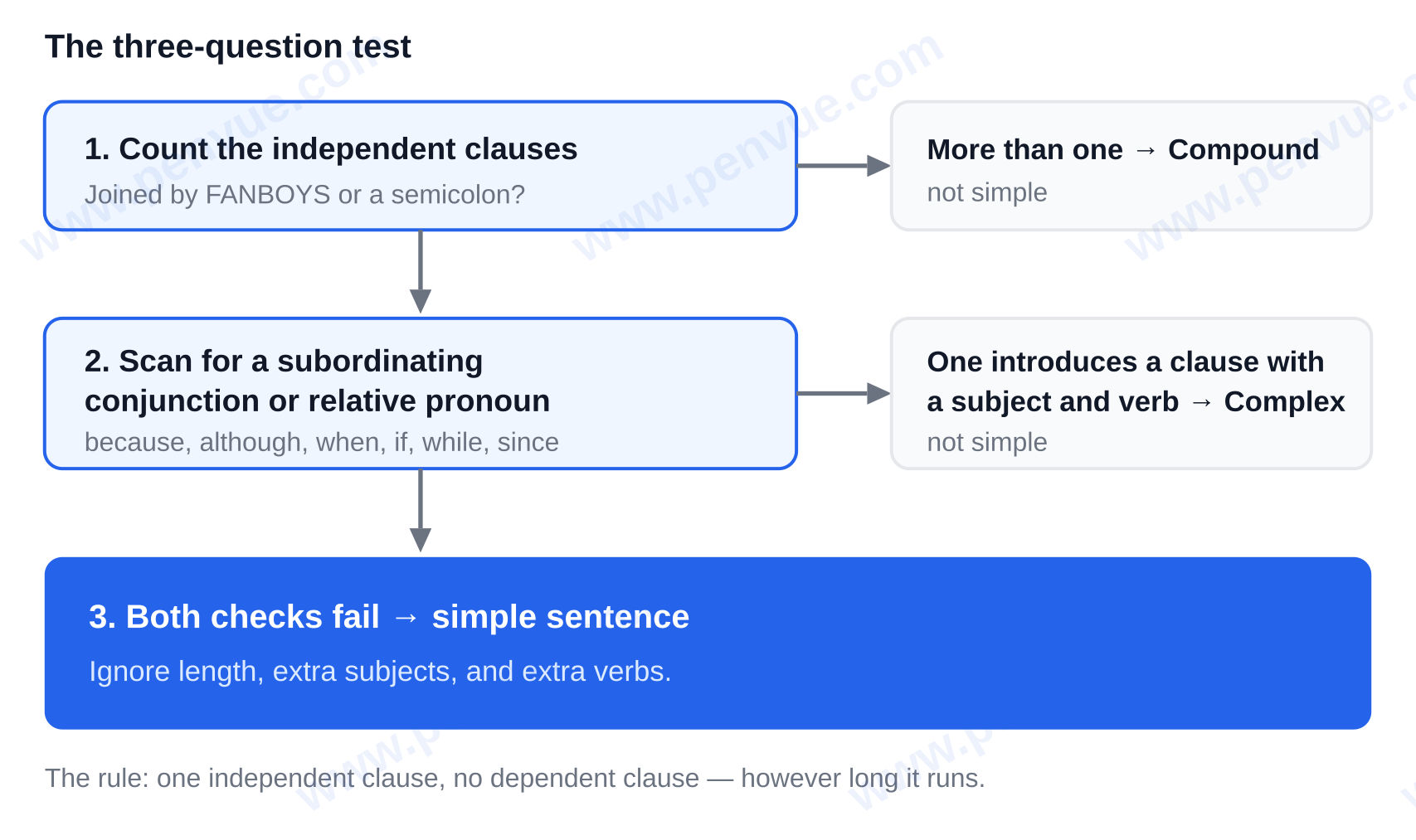
The three-question test that settles any sentence (including “Stop!”)
In deciding whether a sentence is simple, teachers and worksheets often have students count clauses. Use the following checks in order and you will not have to make an educated guess.
- Count the independent clauses. If there is more than one independent clause, it is compound and not simple.
- Scan for a subordinating conjunction or a relative pronoun. If you find one that introduces a clause with a subject and a verb, it is complex and not simple.
- Only if both the above checks fail, then you can completely ignore length, extra subjects, and extra verbs.
Step 1: count the independent clauses
Find two complete statements joined by a coordinating conjunction — the FANBOYS set, for, and, nor, but, or, yet, so — or by a semicolon. “I missed the bus, and I walked to school.” Each half of the sentence can stand alone, so that’s a compound sentence. You can still be in the running if you have only one clause.
Step 2: look for a subordinating conjunction
Look for words like because, although, when, if, while, since, the relative pronouns which and that. “I missed the bus because I woke up late.” The second part of the sentence has a subject and verb but can’t stand alone, so that’s a complex sentence. In practice this is the faster check to run first if the sentence is long, because one signal word is all it takes to settle it.
Is a one-word command like “Stop!” a simple sentence?
Yep, along with “Close the door.” and “Sit down and listen.”
As noted, in the case where the sentence has no visible subjects, the definition appears to break. Almost no page covers this outright.
The subject is there; it is just unexpressed. An imperative normally opens with the base form of the verb and leaves the subject implied — MIT’s writing guide calls it “the word you understood”. So “Stop!” still has exactly one subject-verb unit, and therefore exactly one independent clause. The subject and verb unit of “Sit down and listen.” adds a second verb to that same understood subject: a compound predicate, still one clause, still simple.
The rule disarms three kinds of traps in particular, and here’s where you’ll encounter them: long simple sentences; a subject combined with two or more verbs; and commands without an overt subject.
How does a simple sentence differ from compound, complex, and compound-complex sentences?
Run one core through all four and you’ll see the only real variation is structure.
Simple — “I missed the bus.” One independent clause, no dependent clause.
Compound — “I missed the bus, and I walked to school.” Two or more independent clauses joined by a coordinating conjunction or a semicolon. The giveaway is a FANBOYS word or a semicolon sitting between two things that could each be a sentence.
Complex — “I missed the bus because I woke up late.” One independent clause plus at least one dependent clause. The giveaway is a subordinating conjunction or a relative pronoun.
Compound-complex — “I missed the bus because I woke up late, so I walked to school.” Two or more independent clauses plus at least one dependent clause. Both giveaways appear in the same sentence.
There are really just those four. The complete traditional taxonomy of sentence structure is what people mean when they talk about “the four types of sentence structure.” Keep it apart from sentence purpose, or classifying a sentence as being declarative, interrogative, imperative, or exclamatory. Each of those could be applied to the same sentence on a different axis entirely.
Where did the “simple sentence” label come from?
This has been taught the same way for many years, and the history of this explanation shows where the strict definitions about sentences come from. Simple, compound and complex are not characteristics of the English language itself. They are a concept of traditional school grammar, codified for mass instruction by Lindley Murray’s English Grammar of 1795.
It has stuck because of its scale. As EBSCO states in their research starter on Murray, his grammar outsold every rival for the fifty years after its first edition, eventually ran to more than three hundred editions, and its outline and approach became the template of school grammars for the next hundred years. The Henry Sweet Society bulletin, marking the book’s bicentenary, counts at least 65 numbered British editions plus numerous American ones and describes Murray’s grammar as “without doubt the most popular and frequently reprinted grammar of English during the nineteenth century”. That makes 2026 year 231 of the scheme.
It is good to know this convention, and worth learning. However, you should know this is convention and not a strict law of language. This classification is in fact filed under traditional grammar, as noted by Wikipedia.
When should you use simple sentences in your own writing?
Use a simple sentence to express a single idea. This can be a definition, a key instruction, a conclusion, or a short line placed after two long ones. Nothing competes for the reader’s attention inside a single clause, which is exactly why it works.
Simplicity is advised, but often misinterpreted. Taking this advice literally yields very choppy prose. Several simple sentences strung together in a paragraph feel unnatural and list-like. The weight is typically evenly distributed among all the ideas in the paragraph. As a result, the reader may become confused about which is the main idea. Next comes the failure mode: attempting to smooth it out by joining two of them with nothing (aka a run-on) or with a bare comma (aka a comma splice), which are both incorrect.
To correct this, you must apply a rule. To join two independent clauses you need a comma plus one of and, but, or, so, or a semicolon, or a full stop. Joining independent clauses with nothing or with a bare comma are errors and do not count as compound sentences. The opposite error is a fragment, which is presenting a piece of a clause as a complete sentence (ex: “Because I woke up late.”). That one fails the complete-thought half of the definition rather than the one-clause half.
Mixing structure should be deliberate. Keeping the average sentence length near 15 words makes the prose easy to read, and keeps your simple sentences readable as well as structurally simple.
In essence, the rule is: one independent clause, no dependent clause. That is the gist of what is a simple sentence, however long it runs and however many subjects and verbs you can count. For more like this, explore Penvue.