
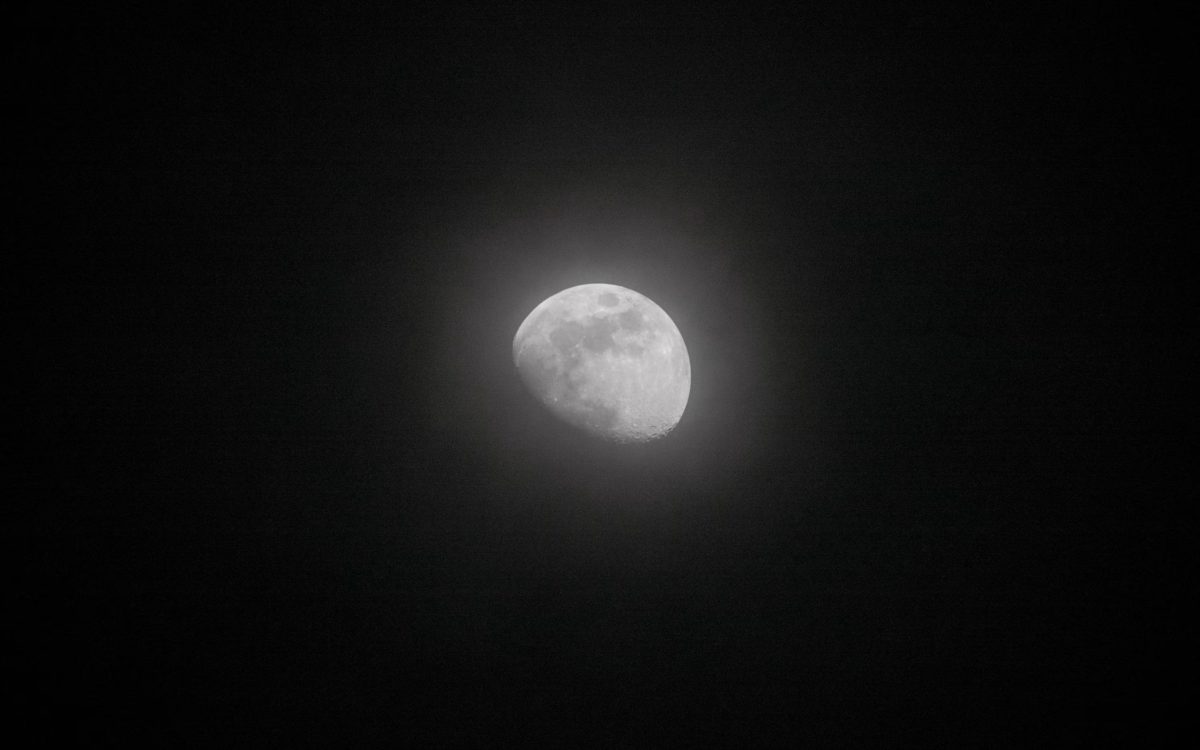
What is the Moon tonight? It’s the phase name, the percent illumination, and the hours it is above your horizon. On Tuesday, October 27, 2026 it is a waning gibbous, roughly 95–98% illuminated, about 16 days into the lunar month.
A day or so past the Hunter’s Moon, and the Moon is nearly fully lit once again, and, at 8 pm, is once again not in your sky. Those two facts live together, and the gap between them is what the rest of this page explains.
What is the moon tonight, exactly?
It’s actually three facts, the first of which is stable: everyone on the planet sees the Moon as a waning gibbous.
The second changes rapidly. The percent illumination of the Moon is measured as a snapshot of time, and changes over the course of the Moon’s cycle. The last, the hours the Moon is above your horizon, is strictly local. Combine all three, and you have a fact that is useful to track the Moon.
Trackers are useful because before live dashboards, astronomers published tables, or ephemerides, of the Moon’s phase, including the data the U.S. Naval Observatory’s Astronomical Applications Department publishes. “The Moon tonight” is just that, today’s entry from that table.
What a waning gibbous moon means
A gibbous moon is more than half lit. A waning moon is shrinking. Combine the two and you get a moon on the way from full to last quarter, losing a bit of light each day. The moon of tonight is at the top of that slide, about 16 days into the cycle and two days past the full phase.
What the illumination percentage actually measures
As defined by the USNO, the percent of moon illuminated is the ratio of the area lit by direct sunlight to the total area of the moon. This gives you fixed points: at new moon it is 0%, at first and last quarters it is 50%, and at full moon it is 100%. It measures lit area and has nothing to do with the actual brightness of the moon in the sky, or when it rises.
Why do moon trackers disagree about tonight’s moon?
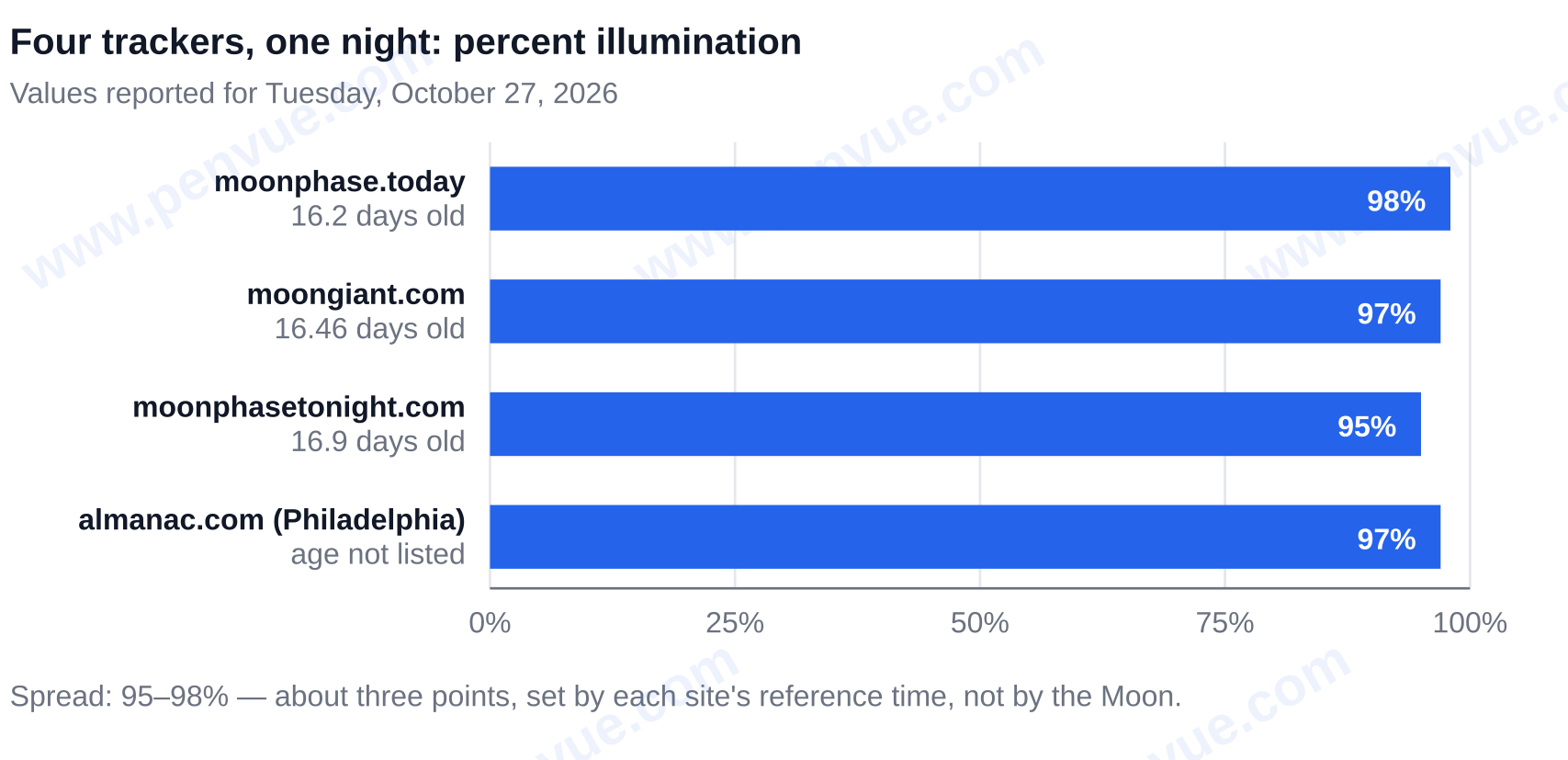
Four of the top moon trackers show four different numbers for the same day. Each tracks things their own way and none says what the others track, or when they came to that conclusion.
| Source | Illumination (Oct 27, 2026) | Moon age |
|---|---|---|
| moonphase.today | 98% | 16.2 days |
| moongiant.com | 97% | 16.46 days |
| moonphasetonight.com | 95% | 16.9 days |
| almanac.com (Philadelphia) | 97% | not listed |
Once you understand illumination is an instantaneous value, the mechanism is quite simple. During the gibbous phase it can fall several points in the course of just one day. Consequently, a page computing for local midnight, one computing for UTC noon, and one computing for the moment you loaded it will print different values; all are valid, none are labeled. The 0.7-day variation in “moon age” is simply the same thing expressed in different units. It is a discrepancy about a reference time, not about the Moon.
What to trust and what to ignore
- Trust phase names. Waning gibbous is waning gibbous on every page.
- Illumination values should be considered ±3 points. Nothing you do with the number, be it photography, stargazing, planning, changes across that range.
- Prefer a source that states its reference time and credits USNO ephemerides for its astronomical data, such as Almanac.com.
- Look for the empty field. Moonphase.today renders moonrise and moonset as a dash if no location is set. The field that is most often left empty is the one that determines if you see anything at all.
Why does the Moon change shape during the month?
Not shadow — geometry. The Sunlights exactly half the Moon at all times. What changes during the month is the shape of the lit half that is turned toward us, as the Sun–Earth–Moon angle shifts.
The USNO fixes the four primary phases when the Moon’s apparent ecliptic longitude exceeds the Sun’s by 0, 90, 180 and 270 degrees. The four intermediate phases each last about a week in between the primary phases.
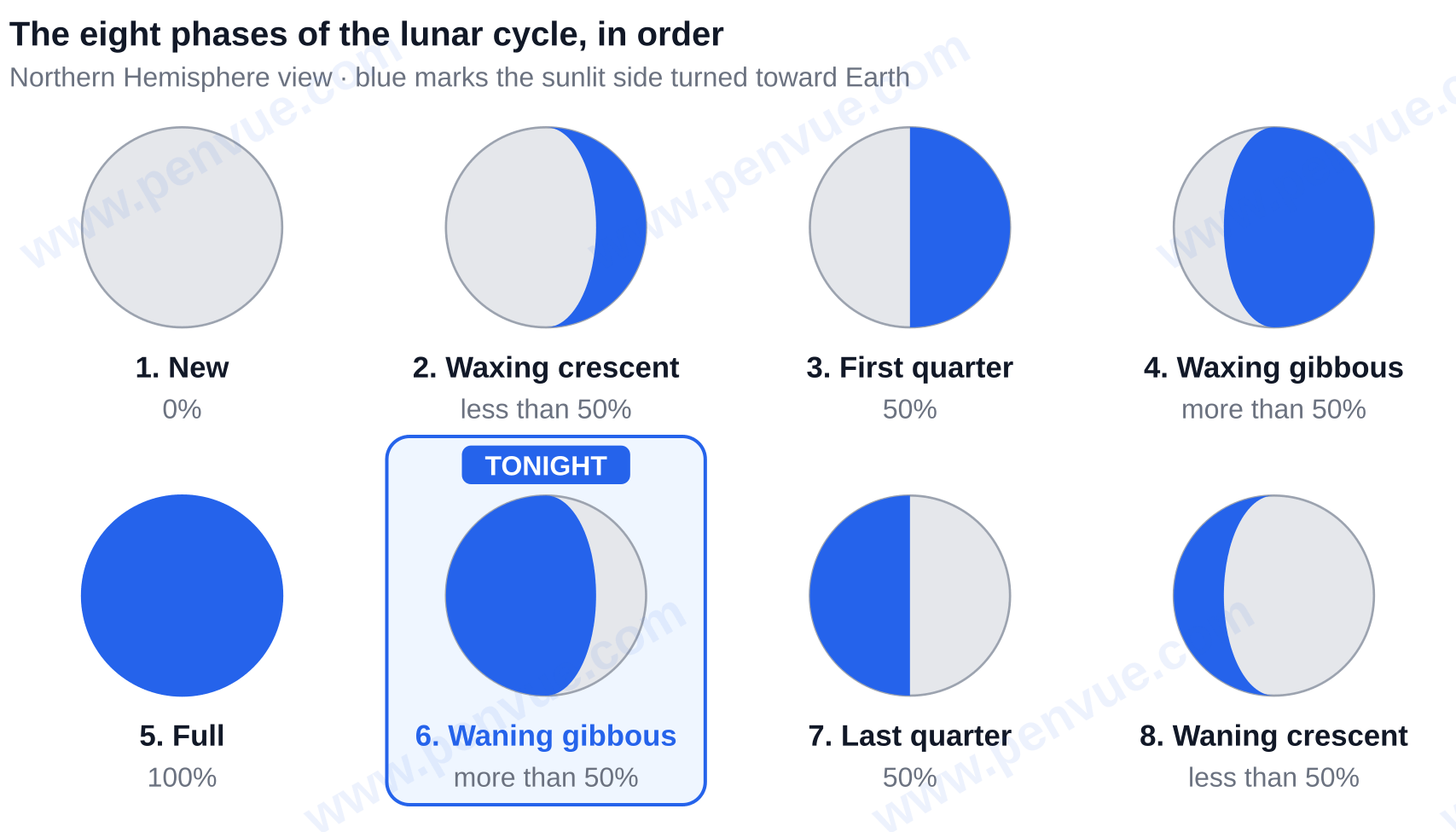
The eight phases of the lunar cycle, in order
- New — the unlit face is toward Earth and the Moon is not visible. 0% illuminated.
- Waxing crescent — the Moon is growing and has less than 50% illumination.
- First quarter — the Moon is 50% illuminated and continuing to grow.
- Waxing gibbous — the Moon has more than 50% illumination and is continuing to grow and become full.
- Full — the Moon has 100% illumination and is fully lit.
- Waning gibbous — tonight: the Moon is more than 50% illuminated and continuing to shrink.
- Last quarter — the Moon is 50% illuminated and continuing to shrink.
- Waning crescent — the Moon is less than 50% illuminated and continuing to shrink, heading toward new moon.
Waxing vs waning, crescent vs gibbous
To identify phases of the Moon growing toward full, use the term waxing. For the other phases, where the Moon is shrinking toward new, use waning. Crescent means less than half lit; gibbous means more than half. No other terms are needed to describe the intermediate phases of the Moon because there are only four combinations.
Why the lunar cycle is 29.5 days but the orbit is 27.3
Using 27.3 days would give the exact amount of time it takes for the Moon to go around the Earth. Because Earth also has an orbit that it moves in, the Moon needs a little over two extra days to catch back up to the same alignment with the Sun. That longer cycle, the synodic month or lunation, averages 29.5 days, the figure the USNO quotes and the one every phase calendar runs on. Orbital mechanics use 27.3; phases use 29.5.
Can you see the Moon tonight, and at what time?
A more or less honest answer: late. According to EarthSky, a waning gibbous moon rises between local sundown and midnight, climbs highest after midnight and sets in the morning between sunrise and noon. Therefore, the real viewing window is at night, from late to early morning. That is why we frequently see this phase in the morning daylight sky.
A 97% reading does not mean you’ll see a bright moon over your yard at dinner time. You may see nothing at all if you step outside at 8 PM expecting a near-full moon.
Why moonrise times depend on your location
According to Almanac.com’s Philadelphia page, tonight the moon will rise at 6:46 PM in the northeast and set at 9:17 AM in the northwest. Change your location a few hundred miles and those times will change as well. You should always set your location (city/ZIP) before trusting any clock time on a tracker; a phase percentage travels, but a rise time does not.
The 50-minute rule you can use without a tool
According to the Institute of Physics, the Moon drifts eastward about 12 degrees per day. Therefore, Earth has to rotate that far past a full turn to bring the Moon back to the same position (roughly 50 extra minutes). Thus, the Moon rises about 50 minutes later each day. This means tonight’s moonrise plus 50 minutes is tomorrow’s, and plus 100 minutes is the night after. These approximate times are good enough to plan around without reloading anything.
Naked eye, binoculars, or telescope
Your eyes are enough to read the phase. Binoculars help with the large dark maria and the brighter craters. A small telescope does the rest. A word of caution: a near-full moon is the worst phase to view for surface detail. This is because the sunlight is hitting it dead on and flattens out the detail. The best phases are near first and last quarter, where the terminator, or the line between the lit and unlit, lets low-angle light throw long shadows across craters and mountain ranges.
When is the next full moon and the next new moon?
The next new moon will be on Monday, November 9, 2026. The next full moon will be the Beaver Moon, which will occur on Tuesday, November 24, 2026, and the Farmers’ Almanac puts its peak at 9:53 a.m. Eastern Time. It is predicted to be a supermoon and the first of a run of consecutive supermoons. The most recent full moon was the Hunter’s Moon, which occurred on Monday, October 26, 2026 at 12:12 a.m. EDT and did not meet supermoon criteria.
Why the peak time is not the best viewing night
A rule that the full moon calendars and the live moon trackers never state together is that a full moon’s listed peak is usually not in the evening hours. This means the best evening to view the moon is whichever evening’s moonrise falls closest to sunset, and not automatically the exact calendar day of the peak. November 24’s peak is at 9:53 a.m., meaning the evening before is often the better show.
Supermoon, blue moon, and blood moon explained
A supermoon is a full moon that occurs during perigee, which is when the moon is closest to the Earth. Because of this, the moon appears slightly larger and brighter. A blue moon is the extra full moon in a season or calendar month. A blood moon is a total lunar eclipse. During a total lunar eclipse, light from the sun is bent and refracted by Earth’s shadow and hits the moon. It makes the moon appear reddish. In North America, there are traditional seasonal names for the full moons, such as Hunter’s Moon and Beaver Moon, carried into modern almanacs. These are folklore, not astronomy.
What zodiac sign is the Moon in tonight?
When people search this, they usually have two concerns. So, here they are. The first is the astrology layer and the second is a contradiction nobody flags. For this same night, the moon is listed as being in Taurus on moongiant.com and Gemini on moonphasetonight.com.
The cause is boundary timing. The moon changes sign roughly every 2 to 2.5 days, so on a cusp day, a date-level sign label depends entirely on the reference time and timezone the site calculated for. Since neither site timestamps their sign labels, that’s how they get away with being simultaneously correct and utterly worthless. If you are concerned with it, look up the exact ingress time in your own timezone. Any undated sign label is approximate.
Also, keep the boundary clear: phase, illumination, and sign are three separate readings. Only the first two come out of ephemeris geometry.
When you ask what the moon is like tonight, you are in fact asking three questions with different levels of certainty: a phase name you can trust outright, an illumination figure good to within a few points, and a rise-and-set window that means nothing until you set your location. Tonight we have a waning gibbous, around 95–98% lit, generally good from late evening through pre-dawn, and not at dusk. Look up moonrise for your own city, add 50 minutes for each night afterward, and mark Tuesday, November 24 for the Beaver Moon supermoon.
As a general rule, trust the phase name, and round the illumination percentage, but never, ever, take a moon-gazing excursion without finding the rise time for your own location. For more on this, see our Lifestyle coverage.
Frequently Asked Questions
Does the Moon’s phase affect the tides?
Yes, absolutely. Tides are caused by the gravitational pull of both the Moon and Sun, and the phase tells you how those two are lined up. A new moon, or full moon, means the Sun and Moon are pulling along the same axis and create the largest tidal range. A first, or last quarter Moon means they are pulling at right angles to each other and create the smallest. The phase name gives a quick read on which kind of week you’re having.
Can you see the Moon during the day?
Yes, often. A waning gibbous like the one you can see tonight sets in the morning between sunrise and noon, so it is frequently visible in the daytime sky after sunrise, according to EarthSky. The Moon is only invisible by day when it is near new, meaning it is close to the Sun in the sky. Phases on either side of full are regularly up while the Sun is.
Does the Moon look the same tonight from the Southern Hemisphere?
Same phase but different orientation. Waning gibbous is waning gibbous everywhere and the illumination percentage is effectively identical, but the lit portion is on the other side and the whole disc looks rotated about 180 degrees compared to a Northern Hemisphere view. Moonrise and moonset are also different because they are relative to your latitude and longitude.
What does the Moon’s “age in days” mean?
Moon age describes the number of days since the last new moon, and the U.S. Naval Observatory puts the average of a lunar cycle at 29.5 days. Trackers for tonight show ages between 16.2 and 16.9 days for the same date, which looks like disagreement but is just because of the reference moment each site uses in their calculation. Another way of representing where you are in the lunation is with age.
How long does each moon phase last?
The four primary phases — new moon, first quarter, full moon and last quarter — are instants, defined by the apparent ecliptic longitude of the Moon exceeding the longitude of the Sun by 0, 90, 180, and 270 degrees respectively. The four intermediate phases, including the waning gibbous you can see tonight, each run about a week between those instants, explaining why a given phase is represented by the same name for several nights in a row.