
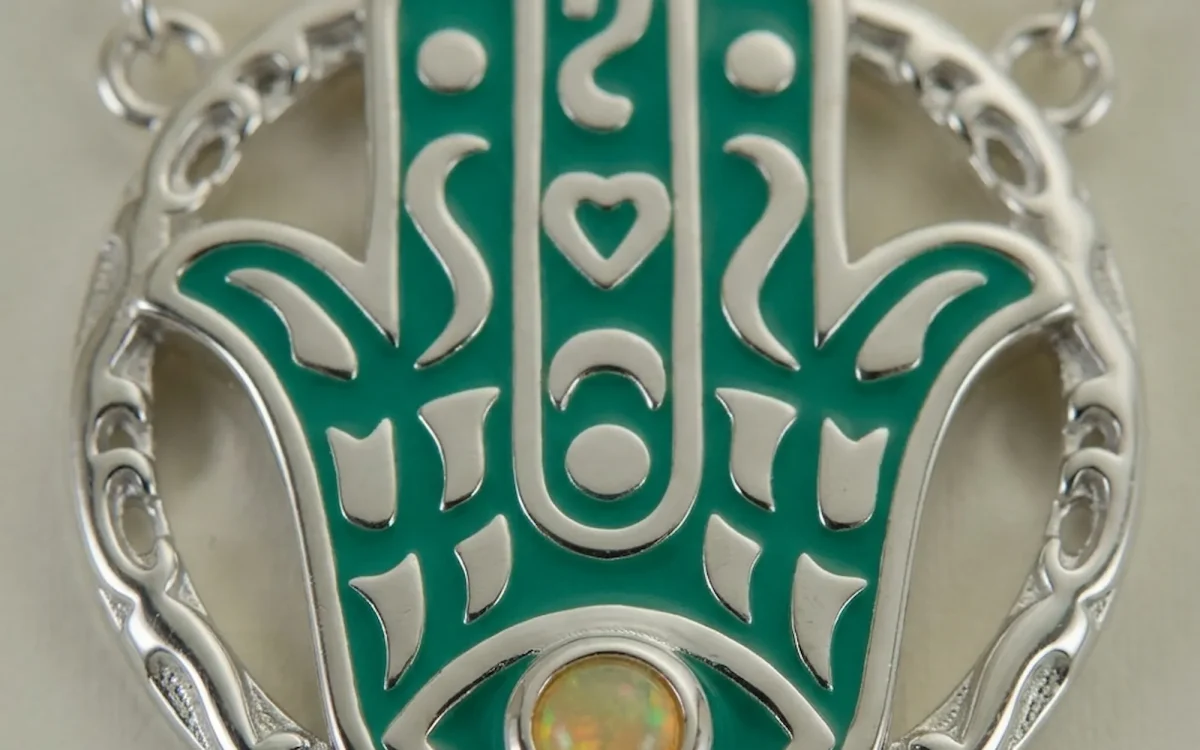
You’ve probably seen hamsa hands on necklaces or hung on friends’ doors. An open palm with an eye in the center is easy to spot. Understanding hamsa hand meaning is simple. Hamsa is a stylized hand with three middle fingers and two outer thumb-like digits, and its name comes from the Semitic word for “five” (Arabic khamsa, Hebrew hamesh). It is believed to give divine protection and blessings. It is also used to shield people against the evil eye.
What does the hamsa hand mean?
The shape of a hamsa hand is similar to that of a palm pressed flat against a window from the other side. It is made up of three middle fingers and two outer digits or thumbs, which curve away from the center. Very often there is one eye set into the middle of the palm. In English, it is known as the khamsa, the Hand, the Hand of God, the Hand of Fatima in Islamic contexts, the Hand of Miriam in Jewish ones, or the Hand of Mary among Levantine Christians, among other names.
Among all religions, it represents similar things including divine feminine energy as well as blessings, protection, warding off the evil eye, good fortune and strength. It is an ancient symbol, but many things that are said about it are relatively modern. This site will discuss some of those things.
Where the word ‘hamsa’ comes from
Wikipedia’s entry on the hamsa describes the origin of ‘hamsa’ in the Semitic root for five. In Arabic it is khamsa and in Hebrew it is hamesh or chamesh. It is simply the counting of the fingers. Mystical meaning was assigned to the number later.
Why there is an eye in the middle of the palm
The hamsa is typically drawn in an open palm with the eye facing outward and looking forward. The eye reflects back harmful or evil gazes. The eye in the hamsa is an integral part of the hamsa. It is not a nazar bead. The latter is a talisman that is sometimes set into hamsa palms. The two objects are related but separate, and the difference matters below.
Which hamsa claims are documented — and which are jewellery-blog folklore
Ten pages of writing on the hamsa gives you the same two paragraphs ten times: the etymology, then the up-or-down line. People omit the separation of actual archaeology, folklore, and marketing in their writing. So I will include that.
The archaeological record: what is actually dated
Three of the earliest recorded examples of this talisman, each with its context named:
- Mesopotamia and Babylon — amulets of the hand of Ishtar to protect against evil and disease from entering a building.
- Ancient Egypt — the Mano Pantea, the Hand-of-the-All-Goddess, with Isis, Osiris and Horus.
- Punic Carthage — stelae with carved open right hands, in the realm of Tanit and Phoenicia, in what is now Tunisia.
And one hard date for the hamsa itself: one of its first documented appearances is in Israelite tombs dating back to 800 BCE. mindbodygreen places the symbol in ancient Mesopotamia and Egypt by at least the 8th century BCE, but acknowledges that the exact origins are not known. Use that figure. “Thousands of years old” is unfalsifiable; 800 BCE is checkable.
‘Hand of Fatima’ is a newer name than the symbol
Nearly every ranking page shows “Hand of Fatima” to be the native, ancient name in the Islamic tradition. However, Wikipedia’s article indicates the designation is relatively recent in origin and appears to have been popularised during the colonial period, rather than in pre-modern Arabic usage — where the symbol was simply khamsa, “five.” The connection to Islam is valid; the term “Hand of Fatima” is recent.
Two different words: the Semitic khamsa and the Sanskrit haṃsa
“Hamsa” in English is a misnomer for two unrelated terms that collided. The Semitic form of the word is khamsa / hamesh, which means five — the protective hand. In Semitic cultures, the khamsa hand is a protective amulet, especially in Judaism where it represents the five books of the Torah. In Islam, the khamsa hand is commonly linked to the five pillars.
The other form of haṃsa is a Sanskrit word for an aquatic migratory bird. Wikipedia maintains a separate article for the bird, where Monier Williams translates it as “a goose, gander, swan, flamingo (or other aquatic bird),” with scholars split between the bar-headed goose (Anser indicus) and the swan. The bird is the vahana of Brahma, Saraswati, Gayatri, and Vishvakarma. The bird represents moksha and the ability to discern between good and evil. In Buddhism the bird is deemed sacred as a representative of wisdom. The bird also gives the title paramahamsa, described in the Paramahamsa Upanishad.
So, when you see pages listing traditions of the hand and including Hinduism and Buddhism, they are referring to the bird. If you’re interested in yoga and came here from a related page, that is probably the term you are looking for.
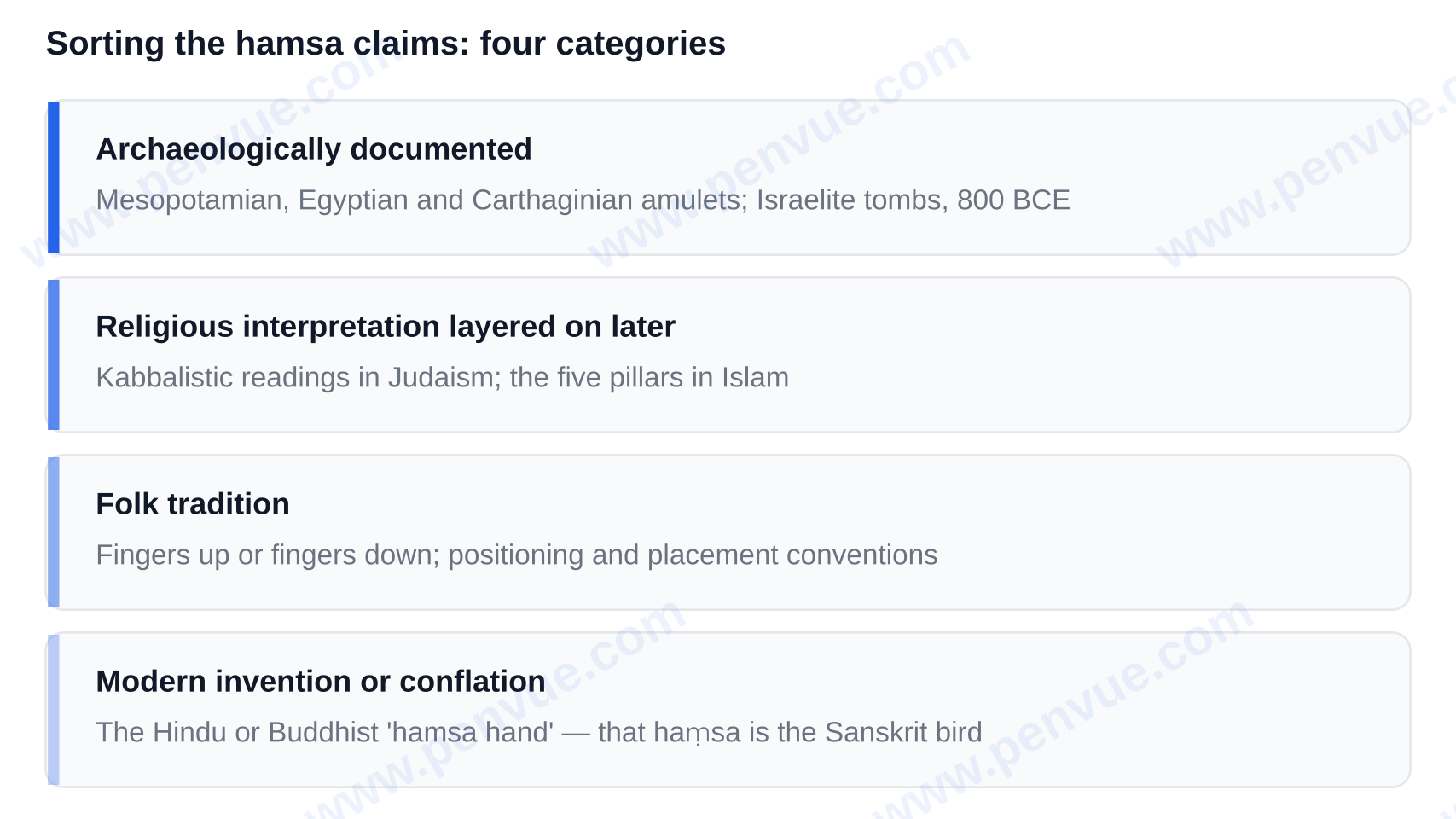
Four terms are applicable to each claim:
- Archaeologically documented — the amulet contexts listed above and the 800 BCE tombs.
- Religious interpretation layered on later — Kabbalistic and Islamic readings.
- Folk tradition — directions and positioning conventions.
- Modern invention or conflation — the Hindu/Buddhist “hamsa hand.”
What does the hamsa mean in Judaism, Islam, and Christianity?
The hamsa as the “hand of God” in Judaism is also associated with the Hand of Miriam, named for the sister of Moses and Aaron, and the five books of the Torah. Chabad.org explains the Kabbalistic layer: the hand doubling as the Hebrew letter Shin, first letter of Shaddai, a name of God; the fifth letter Heh, which appears twice in the Tetragrammaton; the five fingers read as five of the sefirot and the five levels of the soul; and the open eye in the palm as a defence against the evil eye.
In Islam the hamsa is the Hand of Fatima, for Fatima al-Zahra, daughter of the Prophet Muhammad, and is also commonly linked to the five pillars and protection from the evil eye — carrying forward the dating caveat above. Among Levantine Christians, the hamsa becomes the Hand of Mary, absorbing a local Marian reading.
This hand-like symbol originated in the region as a shared protective amulet, and is read differently by the three traditions in reference to their own theology of five — not one religion’s symbol borrowed by the others. That is why “is the hamsa Jewish or Muslim?” has no single answer. Where the hand is not native is Hinduism and Buddhism, whose haṃsa is the bird.
Hamsa vs. evil eye: what is the actual difference?
Hamsa hands are not evil eye charms. In fact they are completely different things, and people should stop using them interchangeably.
| Axis | Hamsa | Evil eye (nazar) |
|---|---|---|
| Form | Stylised open palm, mirrored outer digits, often an eye in the centre | Round or teardrop blue glass eye bead (nazar boncuğu) |
| Scope | Broad protection; also invites peace, prosperity, fortune and good health | Specifically deflects envious and jealous gazes |
| Cultural footprint | Roots specifically Jewish, Islamic, Middle Eastern and North African | Belief arose independently across dozens of cultures — Turkish, Greek, Italian, Latin American |
| Relationship | Often contains an eye, but protects you from the evil eye | Is the threat being deflected, rendered as an amulet |
Many misread the last row. Learn more about the meaning of the evil eye and aJudaica’s hamsa versus evil eye comparison.
Can you wear a hamsa and an evil eye together?
Yes, and it is common to see them worn or displayed that way — stacked on a bracelet, hung side by a door. Having them both is not a contradiction. A hamsa is a protective shield, and the evil eye is a specific threat being deflected.
Should your hamsa face up or down — and can anyone wear one?
Convention holds that a hamsa hand is defensive when displayed fingers up, a raised palm or stop sign held out against harm and the evil eye. Fingers down is receptive, an open hand welcoming abundance, luck and blessings. The intent or reason for wearing or displaying a hamsa determines the correct way to wear it.
Hamsa facing up vs. facing down
However, there is a loophole in the convention, and that it is not religious law, so the correct way to display it is based on the reason or intent. In the real world, this loophole is a mixed bag in three ordinary situations: a hamsa pendant is a mixed bag due to constant rotation and fluctuating display, so a stated direction is often fiction; cast symmetrical hamsas look identical either way; and a wall-hanging or door hamsa is really a placement question, not an orientation one.
A two line rule. Set the intent, not the angle. Choose fingers up if there is a need for protection through a hard season — a move, a pregnancy, a run of bad luck. Choose fingers down to attract good energy and blessings.
Where to hang a hamsa in your home
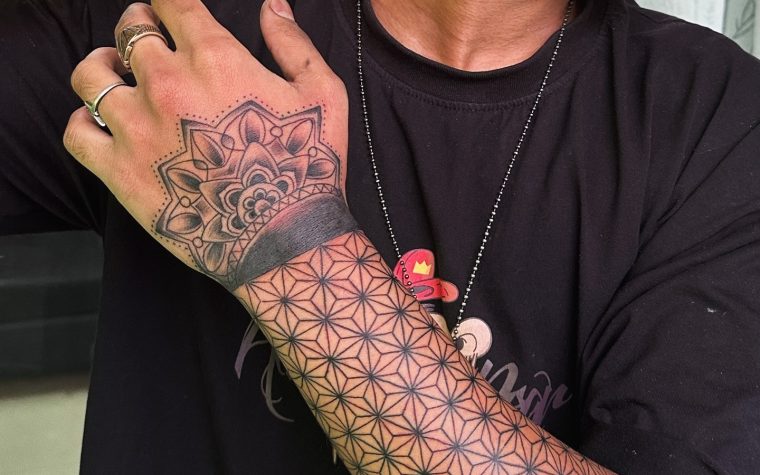
It’s traditional to place the hamsa above your entranceway or front door. The earliest uses of the hamsa talisman in Mesopotamia were to keep evil from entering a building. The hamsa has proliferated in popular culture and can be found on necklaces, bracelets, rings and tattoos, as well as on car mirrors, and across yoga and wellness design.
Is wearing a hamsa cultural appropriation?
Ultimately, it depends on your intent and knowledge. Wearing a decontextualised hamsa as part of a “boho” aesthetic reads very differently from recognising the symbol for what it is and wearing a protective symbol you understand. A workable standard: if someone asks you what it means, and you can answer — the hand, five, protection, and roughly whose tradition it came from — you’re on the right side of the line.
The three things to remember
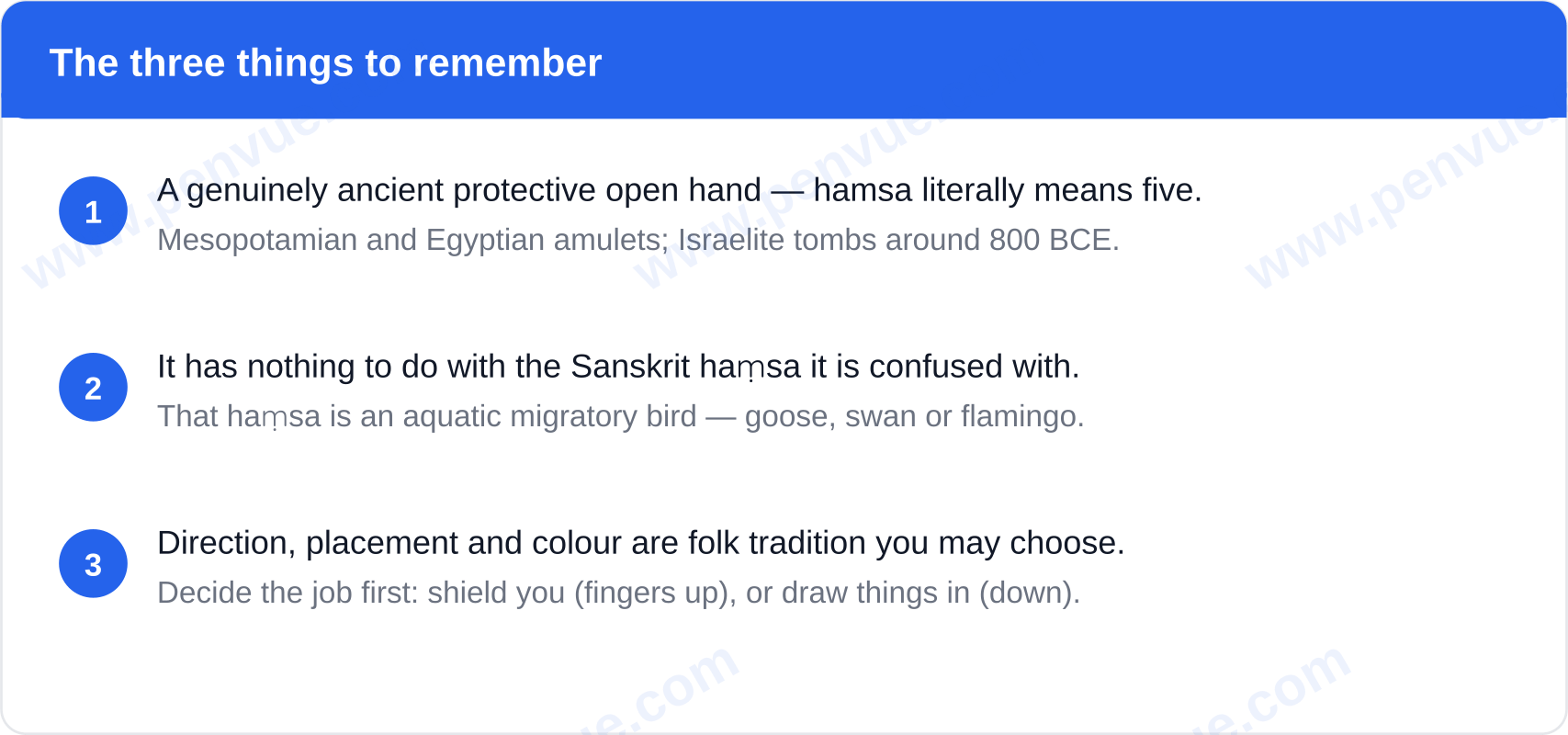
First, the hamsa is a genuinely ancient protective open hand where hamsa literally means five — documented in Mesopotamian and Egyptian amulets and in Israelite tombs around 800 BCE, later read into Jewish, Islamic and Levantine Christian theology. Second, the hamsa has nothing to do with the Sanskrit haṃsa bird it is constantly confused with. Finally, everything else regarding the hamsa — direction, placement, colour — is folk tradition you are allowed to choose with intention. So before you don’t or hang the hamsa, decide which job you want it to do: shield you, or draw things in.
People Also Ask
Is the hamsa a religious symbol or a good-luck charm?
It’s both, depending on who is holding it. It originated as a regional protective amulet and was later read into Jewish, Islamic and Levantine Christian theology, as the Hand of Miriam, the Hand of Fatima, and the Hand of Mary. Today it is also worn widely as a secular good-luck and protection charm, with no religious claim attached.
Does the hamsa have to have an eye in the palm?
Not at all. The eye is very common but optional, and not necessary for it to be considered a hamsa. When it is there, it is an open, watchful eye meant to return a harmful gaze to the person who cast it — a feature of the hamsa itself, not a separate nazar bead set into the palm. Plenty of hamsas use filigree, Hebrew or Arabic inscriptions, fish or floral motifs instead.
What does a hamsa tattoo mean?
Like the object, it means protection and blessing and offers defence against the evil eye. Tattoo orientation carries the usual folk reading: fingers up means shield, and fingers down means to draw in abundance. Because a tattoo cannot rotate the way a pendant does, the direction you choose stays fixed, which makes it worth deciding deliberately.
Is the hamsa the same as the Hindu hamsa in yoga?
No, this is the most common mix-up on the subject. They are two unrelated words that collided in English. The protective hand is the Semitic khamsa or hamesh, meaning five. The hamsa in yoga is the Sanskrit haṃsa, an aquatic migratory bird — Monier Williams translates it as a goose, gander, swan or flamingo — the vahana of Brahma and Saraswati, a symbol of moksha and of discriminating good from evil, and the root of the title paramahamsa.
What colour should a hamsa be, and does blue mean something?
There is no required colour. However, blue is the most common choice because it carries over from the blue glass of the nazar, the evil-eye bead, and reads as protective by association. That is folk convention rather than rule, so colour is one of the things you can choose freely — metal, ceramic, enamel or glass all serve the same purpose.