
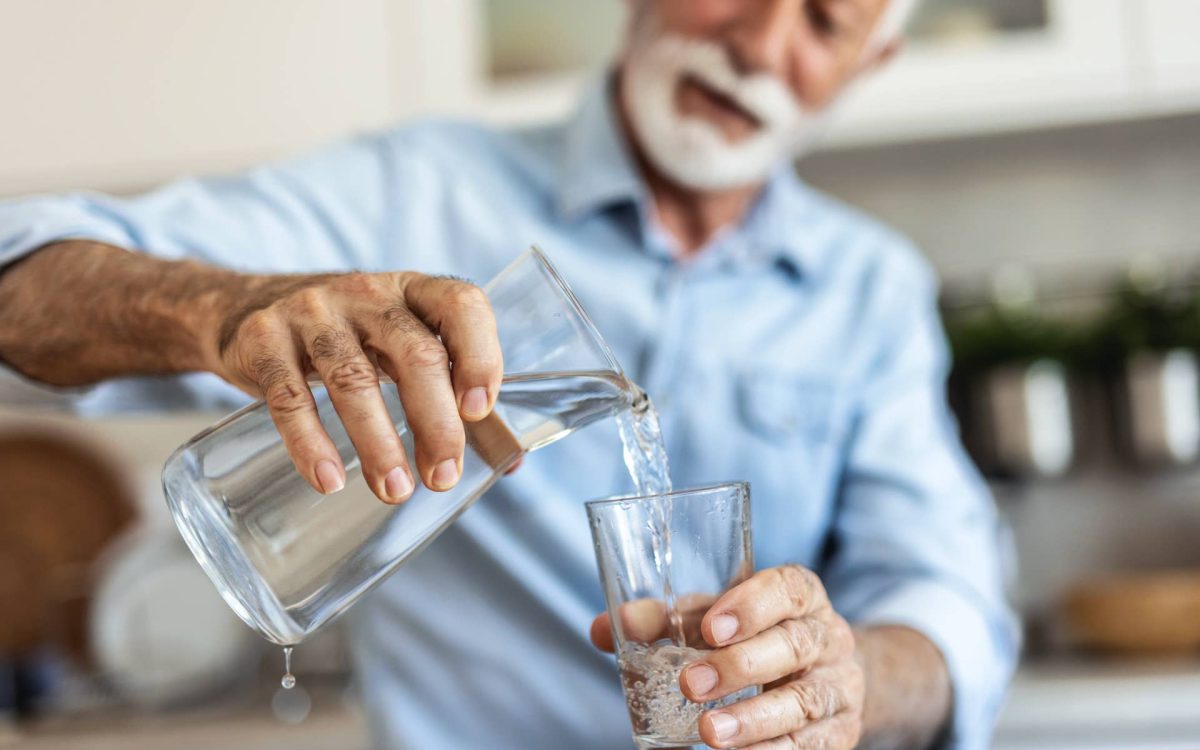
The fastest way to hydrate fast is to sip an oral rehydration solution — one litre of water with half a teaspoon of salt and six teaspoons of sugar — in 150–250 ml amounts every 15 minutes. Sodium and glucose pull water across the gut wall, so salted fluid rehydrates faster than plain water. Healthy kidneys cap absorption near one litre per hour.
That is the whole shortlist below, in order: check you are actually dehydrated, mix the right fluid, pace it to the clock, respect the ceiling, pick the right drink, get the temperature right, avoid five specific mistakes, and know whether the advice applies to you at all. What makes this cut different from the generic version is that it carries the two numbers nobody else prints — the kidney’s clearance rate and the exact grams of salt and sugar — so you can check whether you are doing it right instead of guessing.
1. Are You Actually Dehydrated? Check These Signs First
Confirm the problem before you treat it. Mild to moderate dehydration shows up as thirst, dark urine, dry mouth, headache, fatigue, muscle cramps and light-headedness when you stand up quickly. Urine colour is the cheapest marker you have: pale straw is on target, apple-juice dark means you are behind.
Thirst lags behind the actual deficit, and it is actively unreliable in older adults and in anyone with heart failure or kidney disease. Name the cause in one line too — sweat, vomiting, diarrhoea, alcohol, heat, illness, a long flight, a fast — because the cause decides how much sodium you need to put back.
Signs that mean skip the home protocol and get care
Concur Urgent Care lists the red flags that mean stop self-treating: rapid heartbeat, weak pulse, dizziness or fainting, dark or absent urine for 8 or more hours, sunken eyes, low blood pressure, chills and cold extremities. Infants, older adults and people with chronic conditions warrant a lower threshold for seeking care.
2. What Is the Fastest Way to Hydrate? Water Plus Sodium, Not Water Alone
Fluid absorption is rate-limited by sodium-glucose cotransport in the small intestine. Water carrying sodium and a little glucose crosses the gut wall faster and stays in your plasma longer. Plain water is absorbed but poorly retained — it dilutes blood sodium, triggers urine production, and a large share goes straight back out.
Sodium is the pacesetter. Potassium, chloride and magnesium matter, but you lose them in far smaller quantities: LMNT’s figures put typical sweat losses near 500 mg of sodium and 120 mg of potassium per hour, rising to 1,000–2,000 mg of sodium per litre of sweat in heavy sweaters, plus 2.3–60 mg of magnesium per litre.
Do you need to buy an electrolyte powder?
No. A kitchen-made solution matches the clinical one, and the Beverage Hydration Index trial found the drinks that beat still water were simply those with meaningful sodium and potassium concentrations.
3. The Timed Protocol: What to Drink, How Much, How Fast
This is the part the ranking pages leave as a vibe. Run it to the clock.
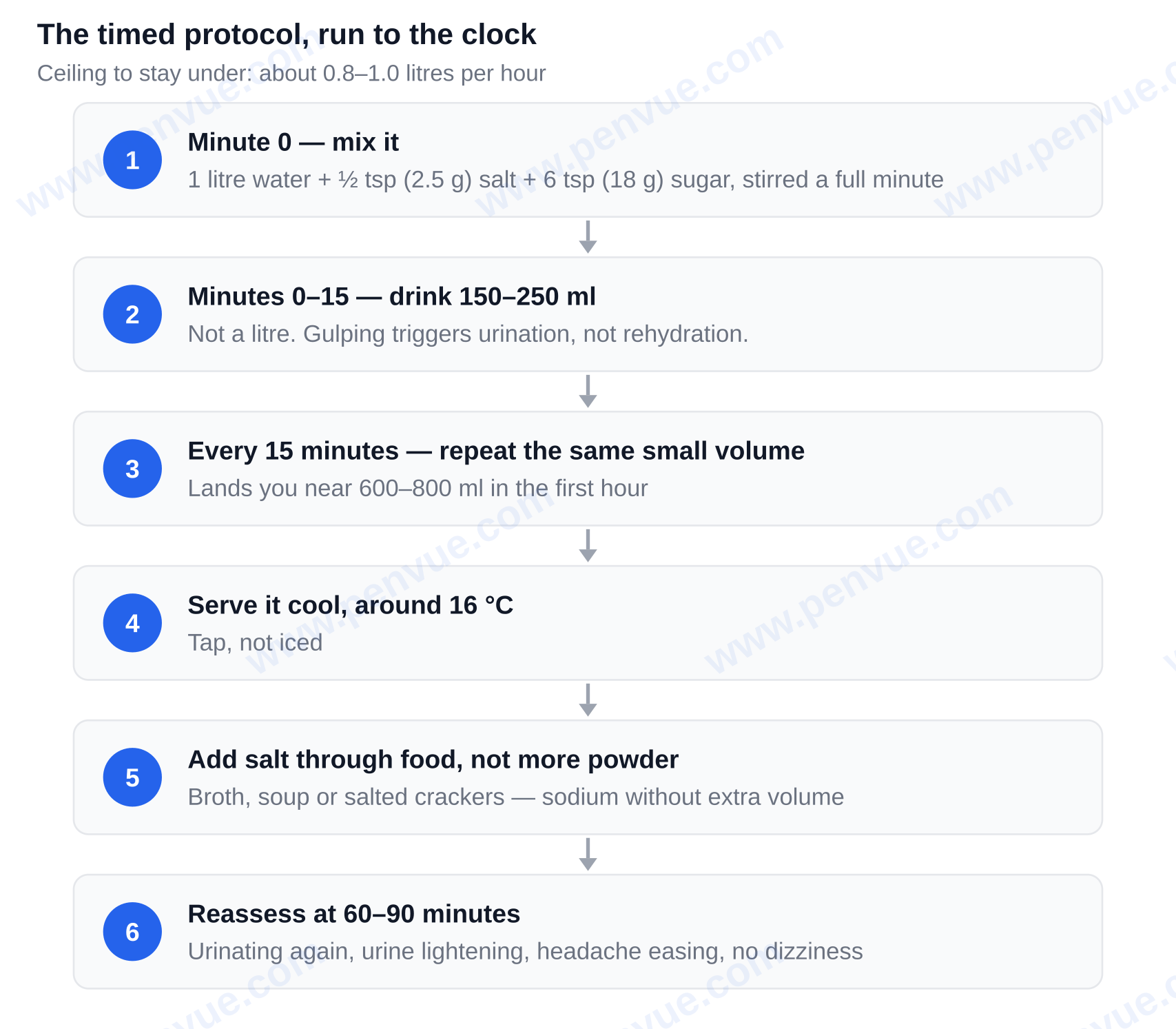
- Minute 0 — mix it. One litre of clean water, half a level teaspoon (2.5 g) of salt, six teaspoons (18 g) of sugar. Stir a full minute until no grains sit at the bottom. The classic homemade formula uses a full teaspoon (3 g) of salt, but the Rehydration Project recommends the half-teaspoon variant as lower-risk with very little loss of effectiveness — and reduced-osmolarity ORS is what the World Health Organization now recommends.
- Minutes 0–15 — drink 150–250 ml. Not a litre. Gulping overshoots absorption and triggers urination, not rehydration.
- Every 15 minutes — repeat the same small volume. That lands you near 600–800 ml in the first hour and keeps you under the ceiling in the next section.
- Serve it cool, around 16 °C. Tap, not iced — see the temperature section for why that number specifically.
- Add salt through food, not more powder. Broth, soup or salted crackers speed sodium replacement without adding fluid volume.
- Reassess at 60–90 minutes. Urinating again, urine lightening, headache easing, no dizziness on standing.
If you sweated hard and know your weight loss, use the number instead of the feeling. ACSM-aligned guidance from Science in Sport is about 1.2–1.5 litres of fluid per kilogram of body mass lost, because some of it leaves as urine during recovery. Weigh yourself before and after to get the figure.
4. The Real Speed Limit: ~1 Litre Per Hour
Healthy kidneys clear only about 0.8–1.0 litres of water per hour. Medical News Today puts that figure at the centre of it, and it is the physical ceiling on how fast you can rehydrate. Drinking faster does not hydrate you faster — it raises risk.
Exceed the ceiling and you dilute blood sodium. Exercise-associated hyponatremia is diagnosed when blood sodium falls below 135 mmol/L, and exceeding that clearance rate is its primary cause. In practice, this is the mechanism behind “sip, don’t chug” — every ranking page gives the rule, none gives the threshold, so readers have no way to tell whether they are breaking it.
How to self-check against the ceiling
Count your intake in millilitres for the first hour rather than estimating in “glasses” or “bottles”. After heavy sweat loss, the fix is not more water — it is more sodium per unit of water. Two numbers are worth writing on your hand: one litre per hour maximum, and 2.5 g salt plus 18 g sugar per litre.
5. Best Drinks for Rehydrating Fast, Ranked
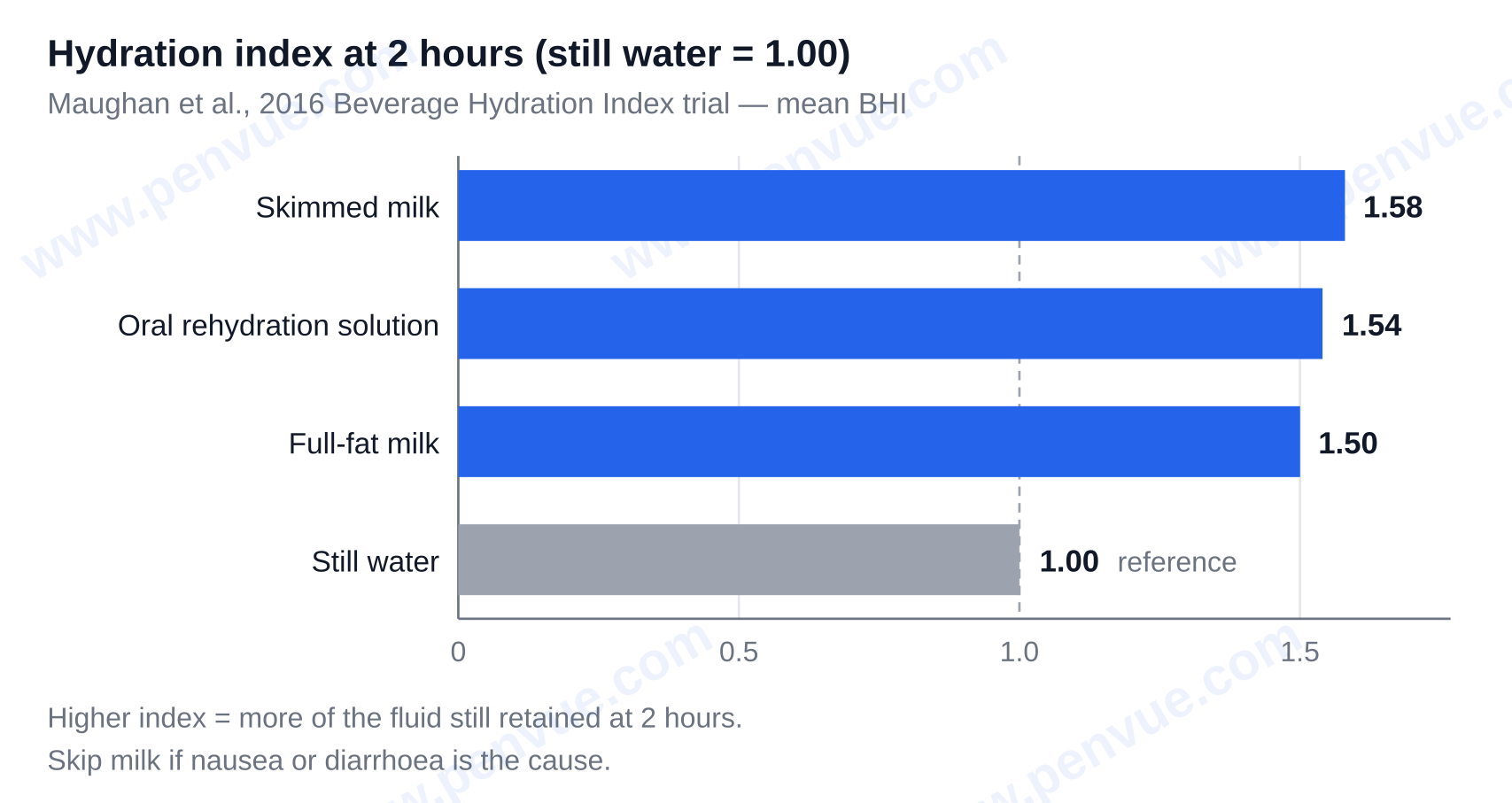
Milk is the surprise winner, and it is already in your fridge. In Maughan and colleagues’ 2016 Beverage Hydration Index trial, mean BHI at two hours was 1.58 for skimmed milk, 1.54 for an oral rehydration solution and 1.50 for full-fat milk, against a reference of 1.0 for still water. Ordinary milk retained fluid about as well as a clinical ORS — though skip it if nausea or diarrhoea is the cause.
| Drink | Sodium | Hydration index (2 h) | Best use |
|---|---|---|---|
| Skimmed milk | Moderate | 1.58 | Best home substitute with no ORS to hand |
| Oral rehydration solution | High | 1.54 | The gold standard; illness and heavy sweat loss |
| Full-fat milk | Moderate | 1.50 | Same as skimmed, slightly slower |
| Broth or soup | High | Not tested | Easy to keep down when ill |
| Sports drink | Low-moderate, high sugar | Not above water | Fuelling exercise, not rehydrating |
| Coconut water | Low (decent potassium) | Not above water | Mild thirst; under-replaces sodium |
| Still water | None | 1.00 (reference) | Mild cases only |
How ORS differs from a sports drink
More sodium, less sugar. Sports drinks are formulated to deliver fuel during exercise, not to restore fluid afterward. What to skip entirely while you rehydrate: alcohol, and very high-sugar soft drinks or undiluted juice, which can worsen diarrhoea-driven losses.
6. Does Drink Temperature Matter? Cool, Not Ice-Cold
Cool tap water, about 16 °C. The search results contradict themselves here and never resolve it. In Khamnei and colleagues’ study of dehydrated taekwondo athletes, roughly 16 °C water produced the highest voluntary intake and the lowest end fluid deficit.
The counterweight is real: gastric-emptying research shows cold drinks leave the stomach more slowly than warm ones, and warm drinks at 50–60 °C increase gastric contractions. Both findings hold, and they trade off. Volume consumed beats emptying speed, because a drink you keep sipping outperforms one that clears your stomach fast but you stop drinking. So ice water and 50 °C tea are both worse, for opposite reasons. Fill the glass from the tap, not the freezer tray.
7. The 5 Mistakes That Slow You Down
- Chugging a litre at once. You blow past the ~1 litre-per-hour clearance ceiling, dilute your blood sodium and urinate most of it away.
- Plain water after heavy sweating. It replaces volume without replacing the sodium that holds that volume in place, and in extreme cases contributes to hyponatremia.
- Treating a sports drink as the serious option. Too much sugar, not enough sodium for genuine rehydration.
- Cutting out coffee. This one is a decade behind the evidence. Killer, Blannin and Jeukendrup’s counterbalanced crossover study in habitual coffee drinkers found no significant difference in total body water between a coffee arm and a water-only arm, with a diuretic effect appearing only at large doses of 500 mg of caffeine or more. For habitual drinkers, coffee counts toward fluid intake. Alcohol is the half of that old warning that genuinely still applies.
- Ignoring food. A dietitian-sourced figure puts roughly 20% of daily fluid intake as coming from food. Watermelon is about 92% water, and many fruits and vegetables are over 90% — cucumber, strawberries, oranges, and soup are all substantial contributors.
One bonus mistake: treating thirst as the all-clear. Thirst fades hours before urine colour recovers.
8. When the Standard Advice Is Wrong for You
If a clinician has given you a fluid limit, their number overrides this page. Everything above is written for someone who needs more fluid. For people on a prescribed fluid restriction it is the opposite of their instructions — dialysis patients are typically limited to around 500 ml a day plus their urine output.
For people with kidney disease, over-the-counter electrolyte powders and sports drinks are generally not recommended, because damaged kidneys cannot clear the extra sodium and potassium. And as the University of Maryland Medical System’s heart failure hydration guidance makes clear, in heart failure thirst is often driven by dietary salt or medication in someone who is already fluid-overloaded — so thirst there is not a dehydration signal and should not trigger the protocol above.
Groups that need a modified approach, not a bigger one
- Infants and young children — ORS only, in teaspoon volumes, with a clinician’s input
- Older adults — blunted thirst and more medication interactions
- Pregnant people and anyone on diuretics
- Outdoor and heat workers, and endurance athletes — the highest sodium needs of any group here.
9. How Long It Takes — and When You Need IV Fluids
You feel better long before you are done. Plasma volume starts recovering within roughly 30 minutes to two hours of steady sipping. Full recovery takes longer, and LMNT’s and Concur Urgent Care’s timelines split cleanly by severity.
| Severity | Time to resolve | Where to do it |
|---|---|---|
| Plasma volume restored | 30 minutes – 2 hours | At home, sipping |
| Mild | 1–3 hours | At home |
| Moderate | Up to 6 hours, by some accounts a day or more | At home, with monitoring |
| Severe | 24 hours to several days | Not a home job |
| IV fluids (normal saline) | Administered over 30–60 minutes | Urgent care or ER |
IV fluid therapy bypasses the gut entirely, and it is genuinely necessary when you cannot keep fluids down, when you have had no urine output for 8 or more hours, or when symptoms are severe. Urgent care or the ER is where that happens — elective “hydration drips” are not the same thing and are rarely the right call for ordinary dehydration.
You are rehydrated when urine output has resumed, colour is back to pale yellow, body weight has returned to baseline and dizziness on standing is gone. To stay ahead of it next time, drink to a schedule rather than to thirst during heat or exercise, pre-salt your fluid when you know you will sweat hard, and weigh yourself before and after long sessions.
The One Pick for Most People
For the ordinary case — a hot day, a hard session, a hangover, a mild stomach bug — the homemade ORS is the pick: half a teaspoon of salt and six teaspoons of sugar in a litre of cool tap water, sipped 150–250 ml every 15 minutes. It beats every bought product on cost and matches the clinical formula. If you have no scales or no patience for mixing, drink a glass of milk instead; the index data says you will barely notice the difference.
Next step: mix one litre now, set a 15-minute timer, and check your urine colour again in an hour. If you have a prescribed fluid limit, or you have gone 8 hours without urinating, skip the glass and call a clinician instead. There’s more to read under Lifestyle.
FAQ
Can I use table salt and sugar from my kitchen, or does it have to be a sachet?
Kitchen ingredients are fine. One litre of clean water, half a level teaspoon (2.5 g) of ordinary table salt and six teaspoons (18 g) of sugar gives you a WHO-style oral rehydration solution. Stir it for a full minute until no grains sit at the bottom — undissolved salt means the first glass is stronger than the last. The classic homemade recipe uses a full teaspoon (3 g) of salt, but the Rehydration Project recommends the half-teaspoon version as lower-risk with very little loss of effectiveness, and reduced-osmolarity ORS is the formulation the World Health Organization now recommends. Sachets are more convenient and more precise, not more effective.
How much water should I drink to rehydrate after a night of drinking?
Pace it rather than loading up. Alcohol is the one item in the old “caffeine and alcohol” warning that genuinely still dehydrates you, so treat it like any other fluid deficit: 150–250 ml of a salted solution every 15 minutes, which puts you near 600–800 ml in the first hour. That keeps you inside the roughly 0.8–1.0 litres per hour that healthy kidneys can clear, a figure Medical News Today identifies as the real ceiling. Downing a litre before bed does not hydrate you faster — most of it leaves as urine. Add something salty, like broth or soup, to replace sodium without adding more volume.
Is it better to rehydrate with a sports drink or milk after a workout?
Milk, on the evidence. In Maughan and colleagues’ 2016 Beverage Hydration Index trial, mean BHI at two hours was 1.58 for skimmed milk and 1.50 for full-fat milk, against a reference of 1.0 for still water — putting milk essentially level with the oral rehydration solution’s 1.54. Sports drinks are built to deliver fuel during exercise: more sugar, less sodium than a rehydration formula needs. If you sweated heavily, milk plus something salty beats a sports drink for restoring fluid. The exception is nausea or diarrhoea, where milk is a poor choice and ORS is the right call.
What should I drink to rehydrate when I can’t stop vomiting?
If fluid will not stay down, this is no longer a home problem. Vomiting that prevents you from keeping any fluid in is one of the situations where IV fluid therapy is genuinely necessary, along with no urine output for 8 or more hours and severe symptoms. Normal saline is typically run over 30 to 60 minutes and bypasses the gut entirely. Concur Urgent Care also flags rapid heartbeat, weak pulse, fainting, sunken eyes, low blood pressure and cold extremities as signs to stop self-treating. Go to urgent care or the ER — and go sooner for infants, older adults and anyone with a chronic condition.
Does drinking cold water hydrate you faster than room-temperature water?
Cool beats both ice-cold and warm. In Khamnei and colleagues’ study of dehydrated taekwondo athletes, water at roughly 16 °C — cool tap, not refrigerated — produced the highest voluntary intake and the lowest end fluid deficit. The counterweight is that gastric-emptying research shows cold drinks leave the stomach more slowly than warm ones, and warm drinks at 50–60 °C increase gastric contractions. Both are true, and they trade off, but volume consumed matters more than emptying speed: a drink you keep sipping outperforms one that clears fast and then stops. Ice water and hot tea are both worse, for opposite reasons.
How do I know when I’ve rehydrated enough to stop?
Do not use thirst — it fades hours before you are actually topped up, and it is especially unreliable in older adults and in anyone with heart failure or kidney disease. Use four checks instead: urine output has resumed, urine colour is back to pale straw rather than apple-juice dark, your body weight has returned to its pre-exercise or pre-illness baseline, and standing up no longer makes you dizzy. Weighing yourself before and after a long session is the most precise marker available at home. Mild dehydration usually clears in about 1–3 hours on the protocol above; moderate can take up to 6 hours or longer.