

What are self care quotes and which are legitimate? Self care quotes are short lines mainly from writers and poets, and sometimes from clinicians, that encourage and promote rest, and setting boundaries to take care of yourself. Self care has a negative connotation for many people, but quotes like these are trying to change that mindset. Quotes from Audre Lorde, Parker J. Palmer and Lalah Delia, are well known and used to help people alleviate their guilt for taking time to rest, in captions, journals, cards and texts.
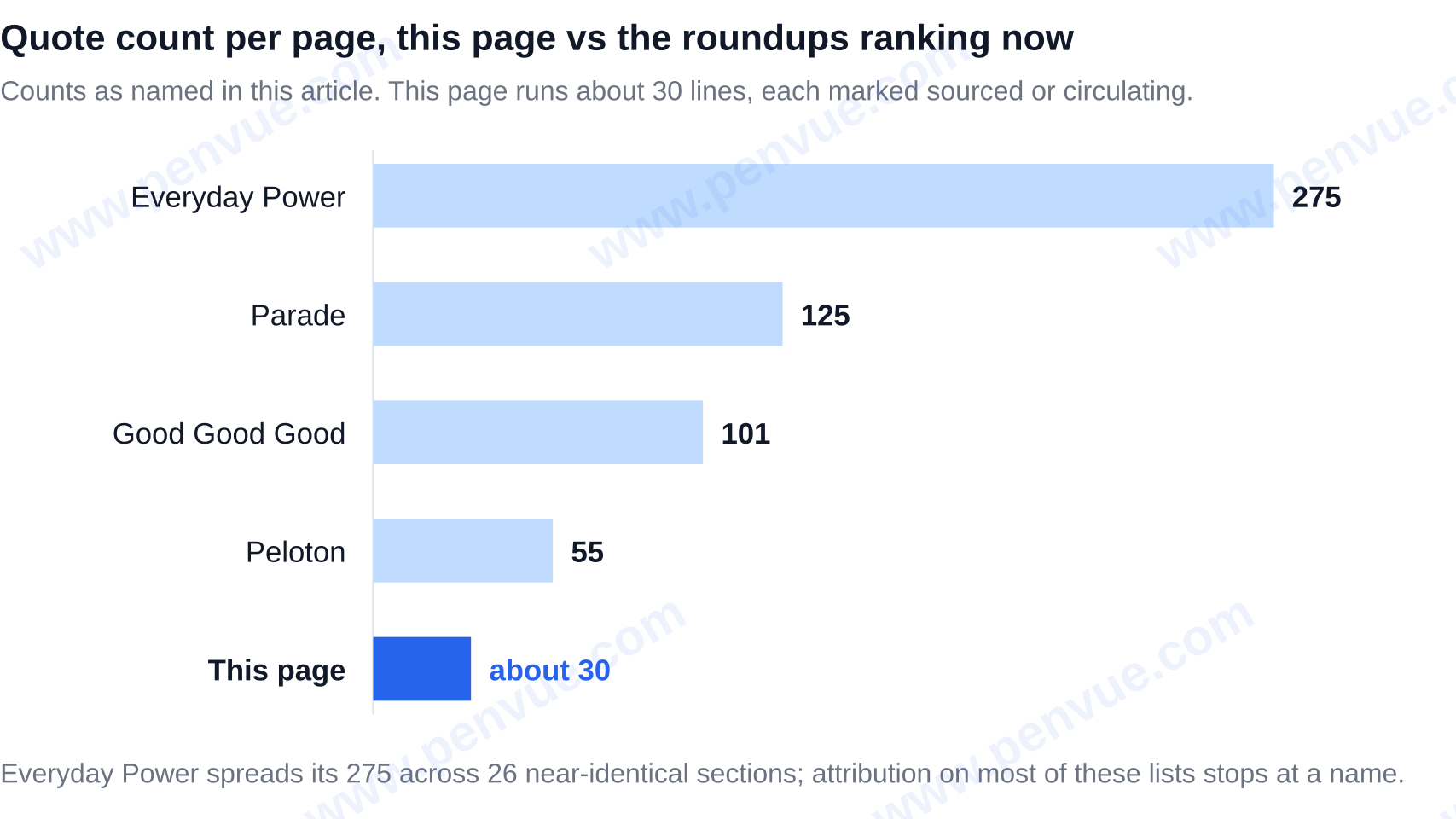
Here is what makes this cut different. The pages already ranking for this search are volume plays: 101 quotes in 14 themes at Good Good Good, 55 in one numbered run at Peloton, 125 at Parade, 275 across 26 near-identical sections at Everyday Power. Line attribution on most of these lists stop with the last name. This list is about 30 lines, which group quotes related to the topic that prompts the search, and each quote on this list is marked sourced (book and year named) or circulating (widely attributed, no primary source).
What makes a good self-care quote worth keeping?
A line that does work, not a line that decorates. A good self care quote is short, does work, and serves one of these three functions: gives permission, states a limit or breaks the tension with a joke. Everything else is fluff — a nice font on a square image.
The actual concept is quite clear. The National Institute of Mental Health describes self-care as taking time to do things that help you live well and improve your physical and mental health — and links it to managing stress, lowering your risk of illness and raising your energy. The World Health Organization expands on this definition to include not only the individual, but families and communities as well: the ability to promote health, prevent disease, maintain health and cope with illness, with or without a health worker. This is far more comprehensive than the bath and candle description most roundups open with.
There were three criteria for selection of quotes on this page: it must be sayable out loud, it must fit a specific moment, and it must be attributable to the person who actually said it.
How self-care quotes differ from self-love quotes
A self-care quote describes and endorses an activity that a person undertakes to take time for themselves, as opposed to self-love quotes which describe a person’s feelings about themselves. Usually it is about what you stop doing for other people long enough to do it. For this reason self-care quotes read like a defense or justification of a person’s actions as opposed to self-love quotes.
Why attribution matters more than you’d think
When quoting someone in a published post, a slide, a card or a sermon, adding a name is not giving attribution. Everyday Power credits author names with no book titles. George Mason University’s well-being center attributes roughly 50 different quotes with only the names of the people being quoted. Those quotes, published without a checkable source, are repeated, and when your byline is published with them, you are repeating an attribution you cannot verify.
Which self care quotes are actually sourced — and which are just circulating?
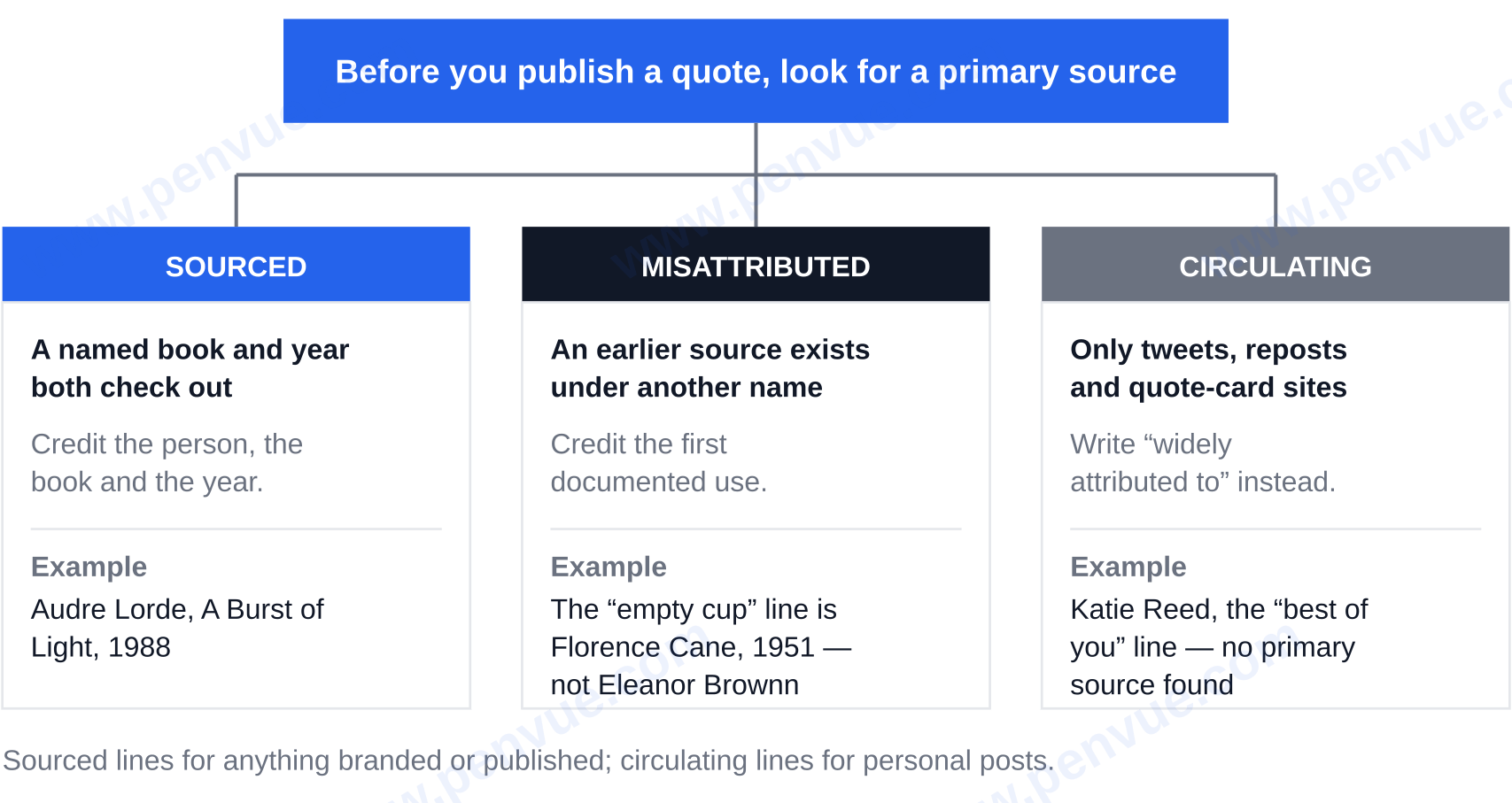
This is the part no competing page does. Those who share these self-care quotes usually don’t say where they got them. Here are the quotes people share the most along with the name of the book and the year it was published where one exists — and an honest blank where it doesn’t.
| Quote | Attributed to | Primary source | Status |
|---|---|---|---|
| “Caring for myself is not self-indulgence. It is self-preservation, and that is an act of political warfare.” | Audre Lorde | A Burst of Light, 1988 | Sourced |
| “Self-care is never a selfish act — it is simply good stewardship of the only gift I have, the gift I was put on earth to offer others.” | Parker J. Palmer | Let Your Life Speak: Listening for the Voice of Vocation | Sourced |
| “Self-care is how you take your power back.” | Lalah Delia | Vibrate Higher Daily: Live Your Power (HarperOne) | Sourced |
| “One cannot pour from an empty cup …” | Usually Eleanor Brownn | Florence Cane, The Artist in Each of Us, 1951 | Misattributed |
| “Self-care is giving the world the best of you, instead of what’s left of you.” | Katie Reed | None found — tweets and quote-card sites only | Circulating |
Sourced: quote, book, year
Lorde’s line originally appeared in A Burst of Light, published in 1988, when Lorde was living with cancer. The hardcover reissue came out in 2017, but the quote is from the 1988 edition, and referring to the 2017 edition would give a misleading attribution. The context of this quote changes its meaning: this is a line about surviving a system that was killing her, not about booking a massage. Palmer’s stewardship line is from the book Let Your Life Speak, and Delia’s is from Vibrate Higher Daily on HarperOne — a named book and a named publisher, which is all you need for a clean credit.
Who said “you can’t pour from an empty cup”?
Not Eleanor Brownn, not Norm Kelly. The first known use of this phrase, per Barry Popik’s etymology entry, is in Florence Cane’s 1951 book The Artist in Each of Us, where she states that teachers should take time to nourish their own souls before attempting to guide and guard children. A 1984 book by Bernie Warren credits the phrase to his wife, Roberta. It doesn’t seem to have caught on until the 2000s. So the most repeated metaphor in this search was written 75 years ago about teachers.
Circulating: widely attributed, no primary source
The best example is Katie Reed. Searching this results in quote cards, Medium reposts, and tweets. No original, published, dated source exists. The line is quite good, and calling it “widely attributed to Katie Reed” would be an accurate statement.
Quotes for when you feel guilty saying no
Reach for Palmer first. Palmer is probably the best place to start. The most common theme in the results of this search is that you already know you need to take some time off to rest, you just need a line to justify it to yourself and to others. Using Palmer’s framing you are not caring about other people less, you are protecting your capacity to care for others.
- Sourced. “Self-care is never a selfish act — it is simply good stewardship of the only gift I have, the gift I was put on earth to offer others.” — Parker J. Palmer, Let Your Life Speak
- Sourced. “Caring for myself is not self-indulgence. It is self-preservation, and that is an act of political warfare.” — Audre Lorde, A Burst of Light (1988)
- Sourced. “Self-care is how you take your power back.” — Lalah Delia, Vibrate Higher Daily
- Circulating. “Rest and self-care are so important.” — often attributed to Eleanor Brownn. Note the “empty cup” metaphor she is credited with has been in circulation for decades prior.
- Circulating. “Self-care is giving the world the best of you, instead of what’s left of you.” — often attributed to Katie Reed.
Given how often this comes up, there’s some innate recognition that it is often needed, especially by parents, teachers and caregivers — the person asking usually needs something real. “Treat yourself” generally doesn’t register in the same way, and Lorde’s self-preservation line does. One says you need to reward yourself for breaking even. The other says it’s for the sake of your survival.
Quotes for when you’re the one doing the caring
Start with the 1951 original — it was written for you. Nurses, teachers, parents and therapists are on different pages of this search, but share the same condition of taking care of the wellbeing of others: everyone else’s wellbeing routes through you. Cane’s passage about teachers needing time to cultivate their own souls is the oldest specific reference to the problem that is available, and names the problem rather than the mood, unlike most of the others.
Anne Lamott’s advice to not run yourself into the ground applies to everyone on the staff, and works on a staff-room noticeboard. Christopher Germer’s self-compassion framing — being kind to yourself as you would obviously be to someone you were caring for — works mid-shift, because it borrows a skill you already have. These kinds of statements require little explanation and are perfect for texting a colleague at 9pm without sounding like a poster.
One structural point every quote page skips: if you depend on someone else to cover for you to take a break, a quote is encouragement, not a plan. Burnout caused by caseload does not respond to a caption. Before pinning any of these to your wall, know quotes are no substitute for action. Lines about pain and loneliness often land better with this reader than cheerful ones, for the same reason.
Short self-care quotes for captions, wallpapers and journals
Copy-paste section: everything here is under about twelve words. Lead with Delia’s “Self-care is how you take your power back” — it’s short, easy to attribute to a named book and publisher, and the cleanest option when your caption needs a credit that holds up.
- Instagram caption. “Self-care is how you take your power back.” — Lalah Delia, Vibrate Higher Daily. Sourced.
- Lock screen or wallpaper. “Caring for myself is not self-indulgence. It is self-preservation.” — Audre Lorde, A Burst of Light (1988). Sourced, and short enough to read at a glance.
- First page of a journal. “Self-care is never a selfish act.” — Parker J. Palmer, Let Your Life Speak. Sourced.
- Card or text to a friend. “Self-care is giving the world the best of you, instead of what’s left of you.” — widely attributed to Katie Reed. Circulating; hedge it if you publish it.
- When there’s no other way in. Most of these jokes are posted by unidentified users, so they belong in group chats and staff Slack channels, not on branded posts — treat the whole bucket as circulating.
This is especially true when building content for Mental Health Awareness Month or Self-Care Month, and the rule is simple: sourced lines for anything branded or published, circulating lines for personal posts. That single split saves you the correction in the replies.
Where self-care quotes stop being enough
A quote can change how a day feels. It cannot treat a mental illness. Nobody on the first page of this search says this outright, so: the National Institute of Mental Health is explicit that self-care can play a role in maintaining mental health and help support treatment and recovery — support, not substitute. The World Health Organization says the same thing, structurally, stating that self-care functions as an addition to the health system and its workers rather than replacing them, per the 2022 revision of its self-care interventions guideline.
A single hard number, because this isn’t only a caveat: NIMH notes that about 30 minutes of walking a day can boost your mood. That is a floor that outlasts any caption, and it is the sort of specific the quote dumps never carry — Peloton’s page is the only top result that reaches for NIMH at all, pairing its list with licensed clinical psychologist Hannah Yang, PsyD.
Be clear about who “just practise self-care” fails. Quotes will not help people in a mental health crisis. They will not benefit those whose exhaustion comes from workload or caregiving load rather than mindset. Anyone whose symptoms need clinical attention. Quotes, in these cases, send the message that you don’t care.
The honest use case is narrower and still worth it: people having a bad day might appreciate the nudge toward rest, or it might provide the shared language you need to encourage a friend struggling to do the same. Quotes can also influence your outlook for the week.
The one to take if you only take one
Parker J. Palmer’s stewardship line, from Let Your Life Speak. It’s sourced, it’s sayable, and it addresses the major concern people are arguing with — that resting takes something from the people who need you. Finding the right quote to cite for the moment you are actually in is more useful than a 275-quote dump, because you can cite it without guessing.
You should have two of these handy to save where you will see them the most: one for when you feel guilty about taking a break, one short enough for a lock screen. Make note of whether each quote is sourced or merely circulating before you publish it anywhere. And if the exhaustion behind the search keeps coming back, try treating that as information — the next thing that changes won’t be the quote you choose.
People Also Ask
What is the most famous self-care quote?
Audre Lorde’s “Caring for myself is not self-indulgence. It is self-preservation, and that is an act of political warfare” is the most quoted and the most citable. It comes from her 1988 collection A Burst of Light, written while she was living with cancer. Cite 1988 rather than the 2017 hardcover reissue. Parker J. Palmer’s “Self-care is never a selfish act” line, from Let Your Life Speak, runs a close second and is easier to use in everyday contexts.
Why do people get the “you can’t pour from an empty cup” attribution wrong?
Because it spread as a quote card before anyone traced it. Nearly every roundup credits Eleanor Brownn, and some credit a Norm Kelly tweet, with no book and no date. The earliest documented appearance is Florence Cane’s 1951 book The Artist in Each of Us, in a passage about teachers needing time to cultivate their own souls. A 1984 book by Bernie Warren credits the phrase to his wife, Roberta, and it does not appear to have gone viral until the 2000s.
Can reading self-care quotes actually improve your mental health?
They can prompt the behaviour, which is where the evidence sits. NIMH describes self-care as taking time to do things that help you live well, and links it to managing stress, lowering your risk of illness and increasing your energy — noting that about 30 minutes of walking a day can boost mood. NIMH also frames self-care as support for treatment and recovery, not a replacement for it. A quote is the nudge; the walk is the thing that does the work.
How do I credit a self-care quote properly in a post or slide?
Name the person, the book and the year if a published source exists — “Audre Lorde, A Burst of Light, 1988” rather than just “Audre Lorde”. If the line traces only to tweets, Medium reposts and quote-card sites, as the Katie Reed “best of you” line does, write “widely attributed to” instead of asserting authorship. That one phrase keeps you accurate without dropping a good line, and it is the difference between a citation and a repetition.