
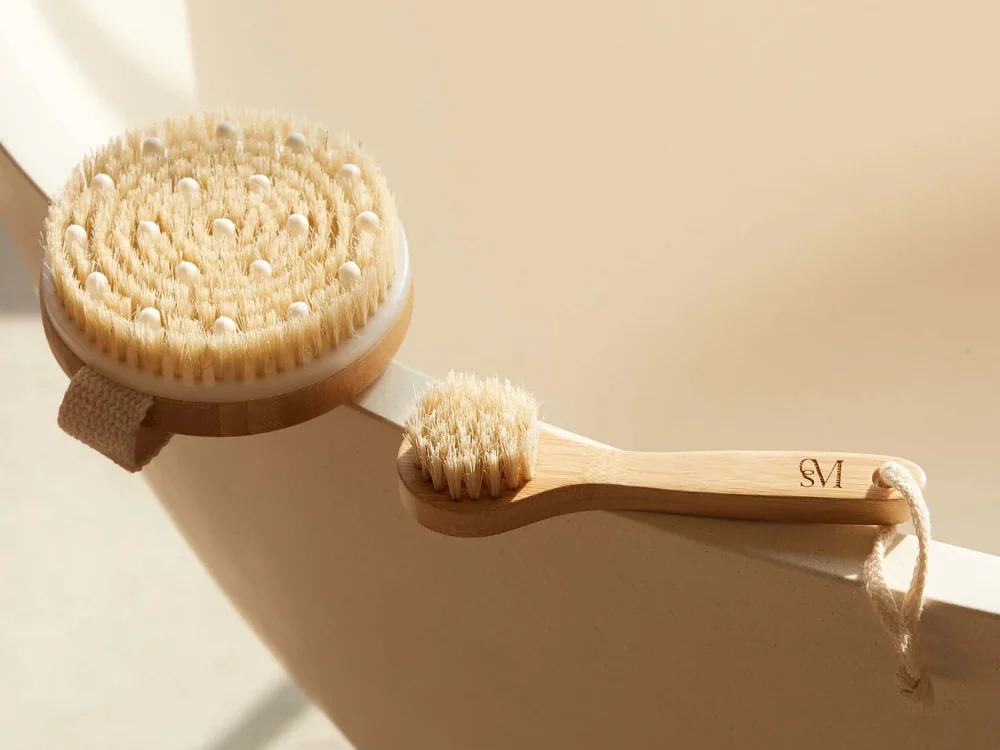
Here’s how to dry brush: Using a stiff natural-bristle brush, brush on your bare, dry skin in short, firm strokes in the direction of your nearest lymph nodes. This is typically up the limbs and down the neck. Spending 3–5 minutes doing this before your shower is all it takes. Stop if your skin gets too pink. Remember to rinse and then moisturize while your skin is still a little wet.
Also worth dropping before you begin is the assumption the brush is usually sold on. Dry brushing is not a detox and it is not drainage therapy. It is exfoliation. That is a smaller claim, but it is a claim worth making and it is the reason you should be spending the five minutes. The following routine uses 1 tool and takes 1 short session with zero skill and the only hard part is pressure. This guide gives you numbers for that.
What dry brushing does, and what it doesn’t
It is mechanical exfoliation. Using stiff bristles you slough off loose dead skin cells on the stratum corneum — no water, no soap and no scrub. “Dry” is quite literal and separates this from the many other “dry” things we do: wet body scrubbing, drybrushing paint onto miniatures, cleaning your makeup brushes, and the solvent process behind dry cleaning.
Also because of the lack of water, it means more friction and a better grip and this is precisely why pressure plays a much bigger role here as compared to a shower scrub.
What you can expect:
- A noticeably smoother surface.
- A better slip for body oils and lotions, so moisturizer spreads instead of dragging.
- A momentary rush of blood to the surface.
- An enjoyable two-minute ritual that does have benefits.
What you should not expect: toxin removal. Brushing the outer layer of your skin doesn’t change the function of your kidneys and liver. There are also no hard evidence-based studies that have demonstrated that a brush improves lymphatic drainage in healthy people.
Dry brushing is not manual lymphatic drainage
Manual lymphatic drainage (MLD) is performed by a trained therapist and has a real evidence base for conditions like lymphedema. A brush in your bathroom is not that. The stroke direction in the guide points toward the lymph nodes because that is the conventional map that the technique was built on. It is easy to memorize, it isn’t costing you anything to follow along — not because the brush is pumping anything.
What you need, and when to brush
Deciding when to dry brush is almost as important as deciding which brush to use.
- The brush. Cleveland Clinic recommends a natural stiff-bristled bath or shower brush, ideally long-handled so you can reach your back without having to twist. Boar bristle is the usual natural option.
- If you have sensitive skin. Instead of a gentler brush, the Cleveland Clinic suggests using a plain, dry washcloth. You get the sweep without the bristle edge.
- Moisturizer, open and within reach. Body oil, lotion or a serum, ready before you hop in the shower.
- Five minutes you are not rushing. Five minutes in the morning doesn’t work for most. Evening works better because the routine ends in moisturizer and clothes.
It’s strict about timing. Your skin has to be totally dry and totally bare, immediately before a shower. Not after. Not on damp skin — damp skin drags, grips and tears. Brushing before is the point because the rinse washes away everything you just lifted instead of leaving it on your skin or in your towel.
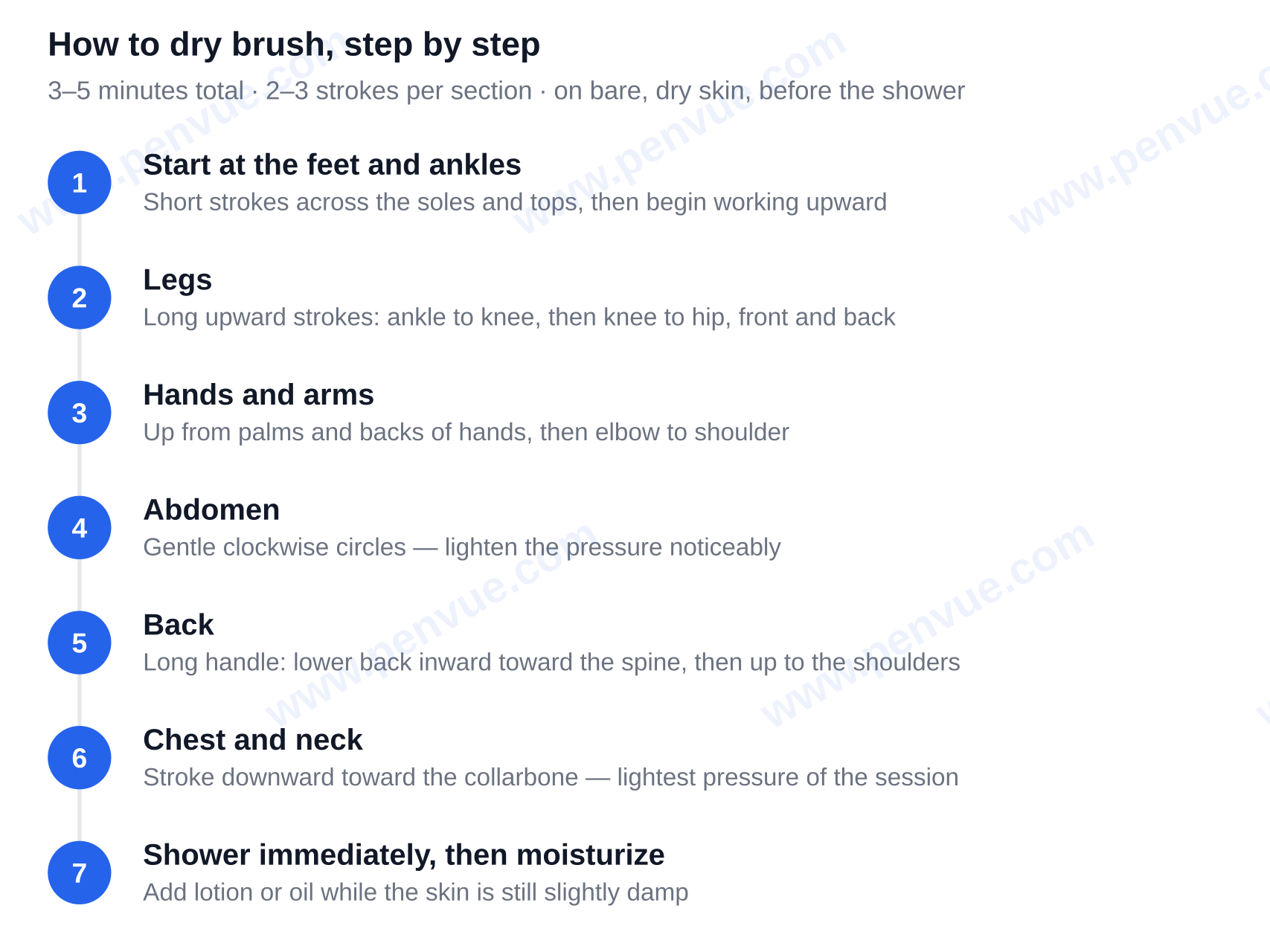
How to dry brush your body, step by step
Three to five minutes total. Two to three strokes per section. A few overlapping swipes per area rather than lots of passes over the same spot. Firm enough to feel the bristles, never enough to scratch.
- Start at the feet and ankles. Make short strokes across the soles and the tops of your feet, then begin working upward.
- Legs. Make long upward strokes from ankle to knee, then from your knees to your hips, front and back, and slightly overlapping each stroke.
- Hands and arms. Stroke up from the palms and the backs of the hands up the forearms, then from elbow to shoulder.
- Abdomen. Use a light pressure and do gentle clockwise circles, and lighten the pressure noticeably — only your abdomen is thin enough to require a pressure reduction, since this is thin skin over no bone.
- Back. Use the long handle to reach your back and work from the lower back inward toward your spine. Then work up toward your shoulders.
- Chest and neck. Lightest pressure of the session, and here you work downward toward your collarbone, not up.
- Shower immediately, then moisturize. Moisturize first thing after showering. While your skin is still slightly damp, add body lotion or oil. This helps seal in the water you just added.
Where never to brush
Do not brush your face, breasts or genitals. Do not brush moles, warts or raised bumps. Do not brush broken skin — cuts, scrapes, lesions, sores, sunburn — or anything that is red, irritated, inflamed or infected, including rashes, active acne, cellulitis and areas affected by skin cancer.
How to tell it worked
Check your skin to see if it worked before you decide to do it again. A session that went right leaves faint, even pinkness that fades on its own, skin that feels smoother to the back of your hand, and lotion that spreads easier than the day before. By the next morning there should be no lingering redness, no tightness and no new flaking. If any of those three are present, you should try using softer bristles, lighter pressure, or a longer time between each session — not more minutes.
You can start at once a week, and if your skin stays completely calm in between you can add a session.
The conflicting dry brushing instructions, resolved
Search how to dry brush and you get roughly the same five steps everywhere — except the top results tell you opposite things on two points, sometimes inside the same article, and none of them admits it. Both conflicts resolve cleanly once you know the rule underneath.
| The conflict | Who says what | The rule that reconciles it |
|---|---|---|
| Direction: start at the feet or start at the neck? | Cleveland Clinic and goop both say begin at the feet and ankles and stroke upward. The dermatologists in NBC Select’s dry brushing explainer say begin at the neck and work down to the feet. | Strokes travel toward the nearest cluster of lymph nodes. Limbs go up because the nodes sit at the groin and armpits; the neck goes down because its nodes sit at the collarbone. Pick either start point, keep the rule, and neither instruction is wrong. |
| Frequency: daily or monthly? | In that same NBC Select piece, Dr. Liza Moore and Dr. Arash Akhavan allow once daily if the skin tolerates it, while Dr. Lily Talakoub recommends once monthly to avoid irritation. | That range is not a disagreement about dry brushing — it is a disagreement about whose skin. Treat frequency as a dial: start monthly or weekly, add a session only after two calm weeks, and drop back at the first sign of lingering redness, tightness or flaking. |
One important thing to say directly: “brush daily” is no longer the agreed-upon advice. Currently, the dermatologists’ opinions are not unified in this regard. “Brush daily” is the ceiling for tolerant skin, not the starting point.
The mistakes almost everyone makes
If you only address one thing, address the pressure. Pressing too hard is the single most frequent error, and it is the one that has a physical mechanism behind it: News-Medical notes that brushing too vigorously, too frequently, or with overly rough bristles can create micro-cuts and micro-tears that may lead to infection. The pinkness (erythema) of the skin looks like evidence the technique is working, hence the motivation to continue. Pinkness is the stop signal, not a checkpoint on the way to more. The rule is: if the skin is stinging, or if a raised line of redness remains after the brush has been removed, stop! Furthermore, if you can feel that the bristles of the brush are catching and pulling on the skin, then stop.
The other mistakes in order of how often they occur:
- Going too often. Exfoliating too many strips intercellular lipids and damages the skin barrier, leaving the skin more susceptible to infections. The irony is that over-exfoliation results in rougher skin than before.
- Brushing damp skin, or brushing after the shower. More drag, and you skip the rinse that makes the whole routine worthwhile.
- Using a brush that is too stiff for you. The solution is to use a softer brush or, if you have sensitive skin, to forgo the brush and use a dry washcloth — not a lighter grip on a harsh one.
- Not moisturizing. The one reliable benefit of the whole routine is completely negated if you do not moisturize. Freshly exfoliated skin is better at retaining and holding on to moisturizer than at any other point in the week, so make sure you use all of the product!
The dirty brush, and the folliculitis it causes
Nobody treats this as a mistake, and the potential for infection due to improper brush maintenance is an issue all on its own — it is the only dry brushing risk that is an infection rather than irritation. NBC Select’s dermatologists say improper cleaning and storing of the brush causes folliculitis. They explain the buildup of oils and dead skin cells feeds bacterial growth, and next time you use the brush, it drags that back across your skin.
In order to remedy this, in order: tap the bristles clean after each use, at least once a week wash the brush in warm water with a mild soap, dry it bristles-down on a clean towel, store the brush in a cool and dry place, never leave it in the shower, and replace your brush roughly every three months.
Deeper skin tones: the hyperpigmentation risk the big how-tos skip
Melanated skin is more prone to post-inflammatory hyperpigmentation, which can occur when the skin has experienced irritation or injury. The inflammation stimulates the skin to create more melanin, which leaves dark spots or patches. This darkness can stick around for weeks or months. With that being said, the standard “brush daily, press firmly” advice carries a cost it does not mention. For the melanated community, the adjustment is not a flat no: much lower frequency, softer bristles or a dry washcloth, gentle pressure and stopping well before pinkness, or using a gentler, barrier-supportive chemical exfoliant instead.
Who should go gentler, and who should skip it
- Very sensitive skin: start with the washcloth, and treat weekly as your maximum.
- Active eczema, psoriasis flares or active acne: avoid using the brush. Stiff bristles across a compromised barrier or inflamed follicles spread irritation and bacteria.
- Any open skin: cuts, sunburn, healing wounds, infection — wait for it to fully close and stop irritating before brushing.
- Keratosis pilaris and ingrown hairs: gentle exfoliation can improve the surface texture, but aggressive brushing over inflamed bumps makes both worse. A board-certified dermatologist has better tools for these than a brush.
- Ask first if you have lymphedema, diabetes with reduced sensation, blood thinners, or any condition affecting wound healing or skin sensation.
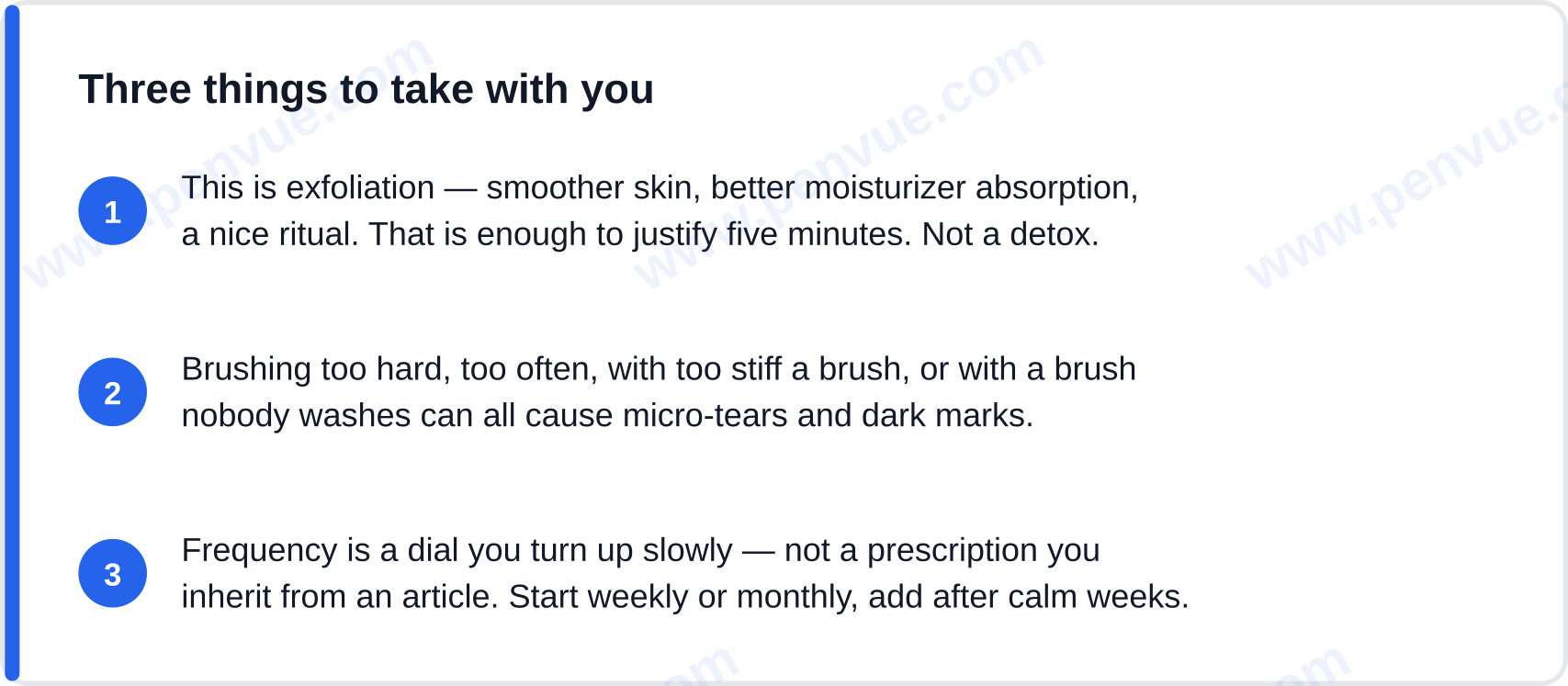
Three things to take with you
First, this is exfoliation — smoother skin, better moisturizer absorption, plus it’s a nice ritual to do for yourself — and that is enough to justify five minutes. Second, brushing is not without its consequences: brushing too hard, too often, using too stiff a brush, or a brush nobody washes can all lead to micro-tears and dark marks on the skin. Third, frequency is a gradual adjustment you turn up slowly, not a prescription you inherit from an article.
So tonight, before your shower, do one short session at the lowest pressure you can manage, stop at the first sign of pink, moisturize while you are still a little damp, then wash the brush and leave it bristles-down to dry. Wait a week, see how your skin feels, and only then decide if you want to up the frequency.
FAQ
Does dry brushing get rid of cellulite?
No. Cellulite happens in the subcutaneous fat layer beneath the skin, and a brush on the surface cannot reach it. Dr. Shilpi Khetarpal, a Cleveland Clinic dermatologist, attributes the improvement dry brushing supposedly causes to a temporary plumping up of the skin from increased blood circulation — which is why it looks better for an hour and then looks the same as before.
Can you dry brush your face?
No. Cleveland Clinic lists the face among the areas to avoid, and for good reason. Facial skin is thinner and more reactive than skin on your limbs. Bristles that are stiff enough to be effective on your shins are too stiff to use on your face. If you want to exfoliate your face, use a product made for the face, or consult with a board-certified dermatologist.
Should you dry brush before or after shaving?
Brush first, then shave in the shower that follows. Brushing lifts loose dead skin cells out of the way, and the rinse clears them before the blade goes over your skin. Do not brush over skin you shaved the same day — shaving is already mildly abrasive, and it can cause razor burn and irritated follicles.
How long does it take to see results from dry brushing?
You will notice a textural difference almost immediately — your skin should feel smoother the same evening, and moisturizer will glide on with less friction. There is no proven cumulative benefit beyond that, so judge it over about a week of your chosen cadence. If your skin is calm and feels smoother after a week of doing this, keep it up. If your skin is pink, tight or flaking between sessions, you are brushing too aggressively or too often.