
Sigil meaning, in one line: a sigil is a symbol believed to possess magical or spiritual power. Say it SIDGE-il, with a soft g. It is originally a seal or signet, then a spirit’s or angel’s pictorial signature, and now a glyph that stands for a personal wish. From Latin sigillum, “little sign,” first recorded in English around 1600.
What does sigil mean?
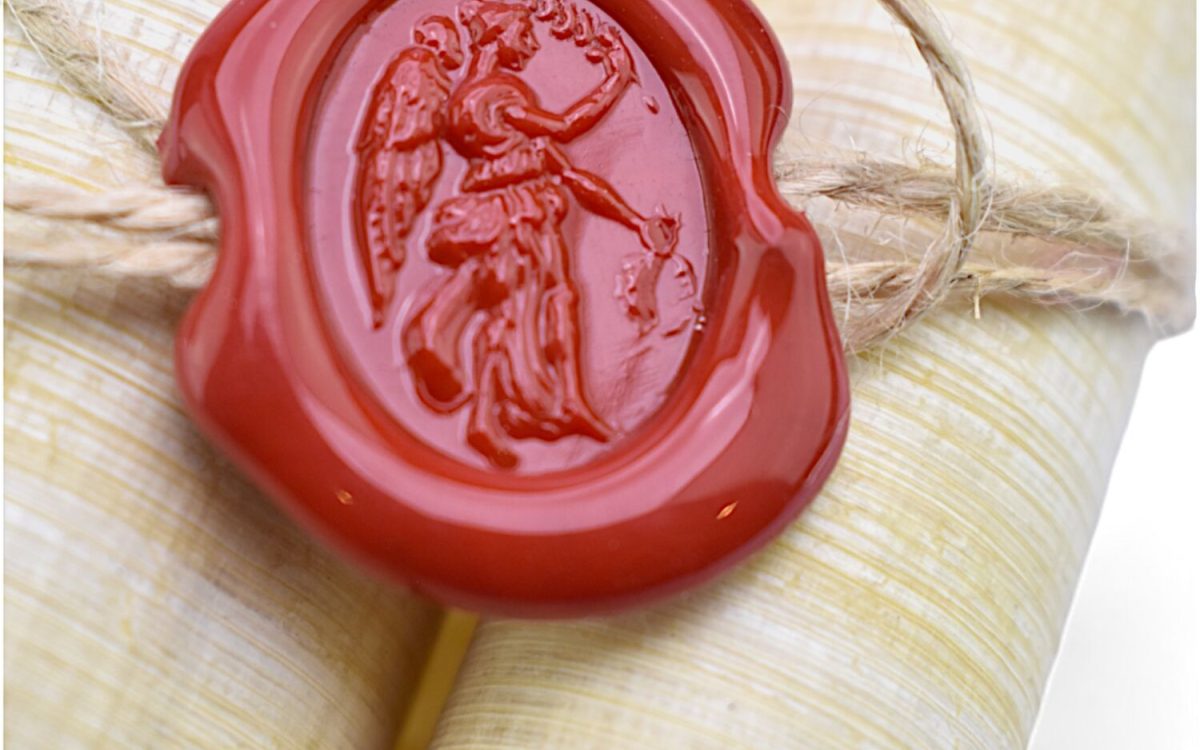
A sigil is a mark believed to contain power that transcends its literal meaning. Originally, a sigil was a signet, or an official seal: a wax seal pressed with a signet ring, proving a document came from the person whose device was stamped on it. In the modern sense, it is a glyph that represents a spirit, or something you want.
Which of the two definitions you first come across depends on the dictionary you first open. American dictionaries, including Dictionary.com’s entry for sigil, list the definition “a pictorial symbol used in ritualistic magic and supposed to have supernatural power” first and the definition “a seal or signet” second. British dictionaries do the reverse and list the definition “a seal or signet” first and the definition “a pictorial symbol” second. This discrepancy is not a quirk in lexicography. It represents a shift in the word’s primary sense, away from officialdom, and toward occultism.
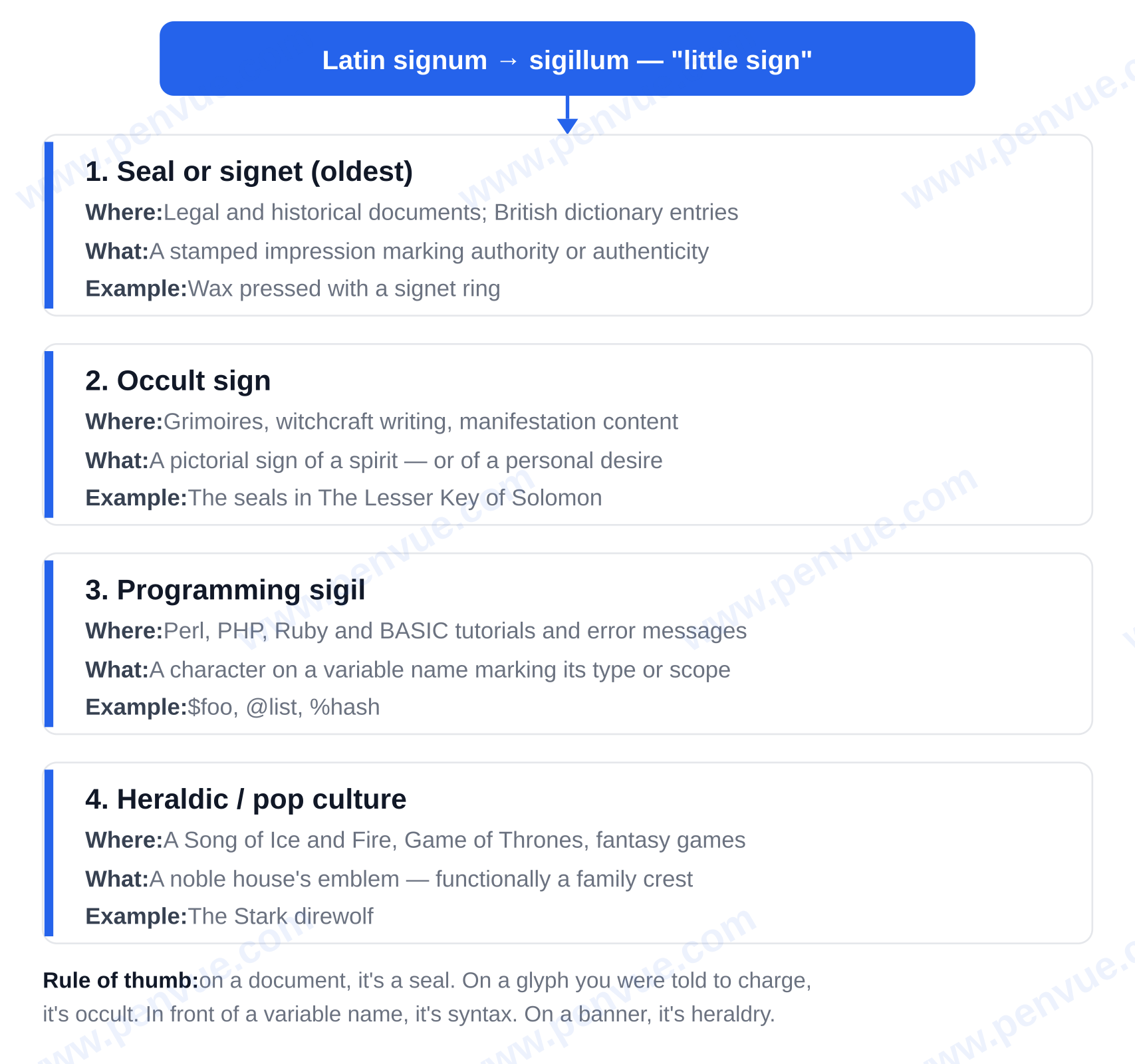
Four separate senses are in use today, and one of them has nothing to do with magic at all. The table in the following section sorts these out, so anyone who arrived here from a novel, a game, a code tutorial or a short video can quickly find their answer.
How do you pronounce sigil?
/ˈsɪdʒ.ɪl/ — SIDGE-il. Two syllables, stress is on the first syllable. Soft g as in ginger rather than give. The hard-g “SIG-il” is the common mistake, and it is one of the main reasons people look the word up at all. Sigils is the plural.
Sigil used in a sentence
- Seal sense: “The letter was closed with the bishop’s sigil.”
- Magical sense: “She inked a sigil on her wrist.”
Which sigil did you just meet? Sigil meaning in four senses
No single page provides all of these, which is why answering the question “which one did I just encounter?” is so difficult. Wikipedia maintains a disambiguation page for the word, and separates articles for the occult and the computer programming senses — proof the ambiguity is real rather than pedantic.
| Sense | Where you’d meet it | What it actually is | Example |
|---|---|---|---|
| Seal or signet (oldest) | Legal and historical documents; British dictionary entries | A stamped impression marking authority or authenticity | Wax pressed with a signet ring |
| Occult sign | Grimoires, witchcraft writing, manifestation content | A pictorial sign of an angel, daemon, spirit — or of a personal desire | The seals in The Lesser Key of Solomon |
| Programming sigil | Perl, PHP, Ruby and BASIC tutorials and error messages | A character affixed to a variable name marking its type or scope | $foo, @list, %hash |
| Heraldic / pop culture | A Song of Ice and Fire, Game of Thrones, fantasy games | A noble house’s emblem — functionally a family crest | The Stark direwolf |
Rule of thumb: on a document, it’s a seal. On a glyph you were told to charge, it’s occult. In front of a variable name, it’s syntax. On a banner, it’s heraldry.
Where does the word sigil come from?
From Latin sigillum — “statuette, figure, stamped figure” — a diminutive of signum, “sign.” Hence sigil means “little sign.” Dictionary.com dates the word’s first recorded appearance in English to 1600–10, which is also the time of the Renaissance, and a flowering of interest in alchemy and natural magic. This is part of the reason the sense of sigil related to magic was so quickly adopted.
Sign, signal, signature, design, insignia, and seal all derive from signum, and thus there is a close relationship with signature, and that kinship explains the whole magical theory that follows. The Hebrew segulah, roughly meaning “word or thing of talismanic effect,” is sometimes given. However, it is safe to treat it as contested rather than established. In the process, the primary sense quietly narrowed. As wax seals left everyday legal life, the only surviving use was the occult one.
What is a sigil in magic?
In medieval and Renaissance practice a sigil was an occult sign standing for a specific entity — an angel, a daemon, a deity — not for a concept. The similarity between a sigil and the spirit’s true name was the basis of the assumption of the sigil’s power, as the Wikipedia article on sigils records. Since knowing a name was held to grant leverage, a sigil, like a true name, could confer control over a spirit: draw it correctly and you could summon the entity, and command it.
The family of names and uses of sigils in magic draws its lineage from Roman and Greek magic and eventually migrates into the tradition of grimoires, where sigils were catalogued alongside the hierarchies of spirits they belonged to. The Lesser Key of Solomon — the Goetia — is the most notable example, listing the sigils of 72 demonic princes, each with its own seal to be drawn or engraved.
How traditional spirit sigils were built from magic squares
It’s a common misconception that these figures were drawn freehand. Traditionally, a spirit’s name would be converted into a numeric value, and those numeric values would be placed onto a kamea, or magic square. The points on the kamea would be joined into one abstract figure. Because the points would be joined to form a sign using a grid, traditional spirit seals and planetary sigils appear angular, as if drawn diagrammatically, rather than decorative: they are paths traced across a grid. Note what this sense is not. It is not a wish, not an affirmation, and not something you invent.
How a spirit’s signature became your own wish
What most authors gloss over is the reversal. For a very long time, a sigil was somebody else’s signature, and the practitioner’s responsibility was to reproduce it as accurately as possible to make contact. The power was outside the individual drawing it.
Austin Osman Spare and The Book of Pleasure
This idea was turned on its head by Austin Osman Spare, an English artist and occultist (1886–1956). Spare argued that the spirits of the grimoires were really unconscious complexes, and that a practitioner was really free to create one. If the thing being commanded was really a part of your own psyche, the sign that commanded it need not be something that is inherited from a grimoire. It can be built out of your own stated desire. In The Book of Pleasure, published in 1913, Spare laid out the technique. Decades later this work would be the foundations of chaos magic, and really stripped away all of the remaining trappings of ceremonial magic.
All manifestation sigil tutorials today originate from that single inversion, and the kamea method it displaced has all but disappeared from popular practice. The two magical senses look identical on paper. Their theories about the location of the power are opposites.
How do you make a sigil?
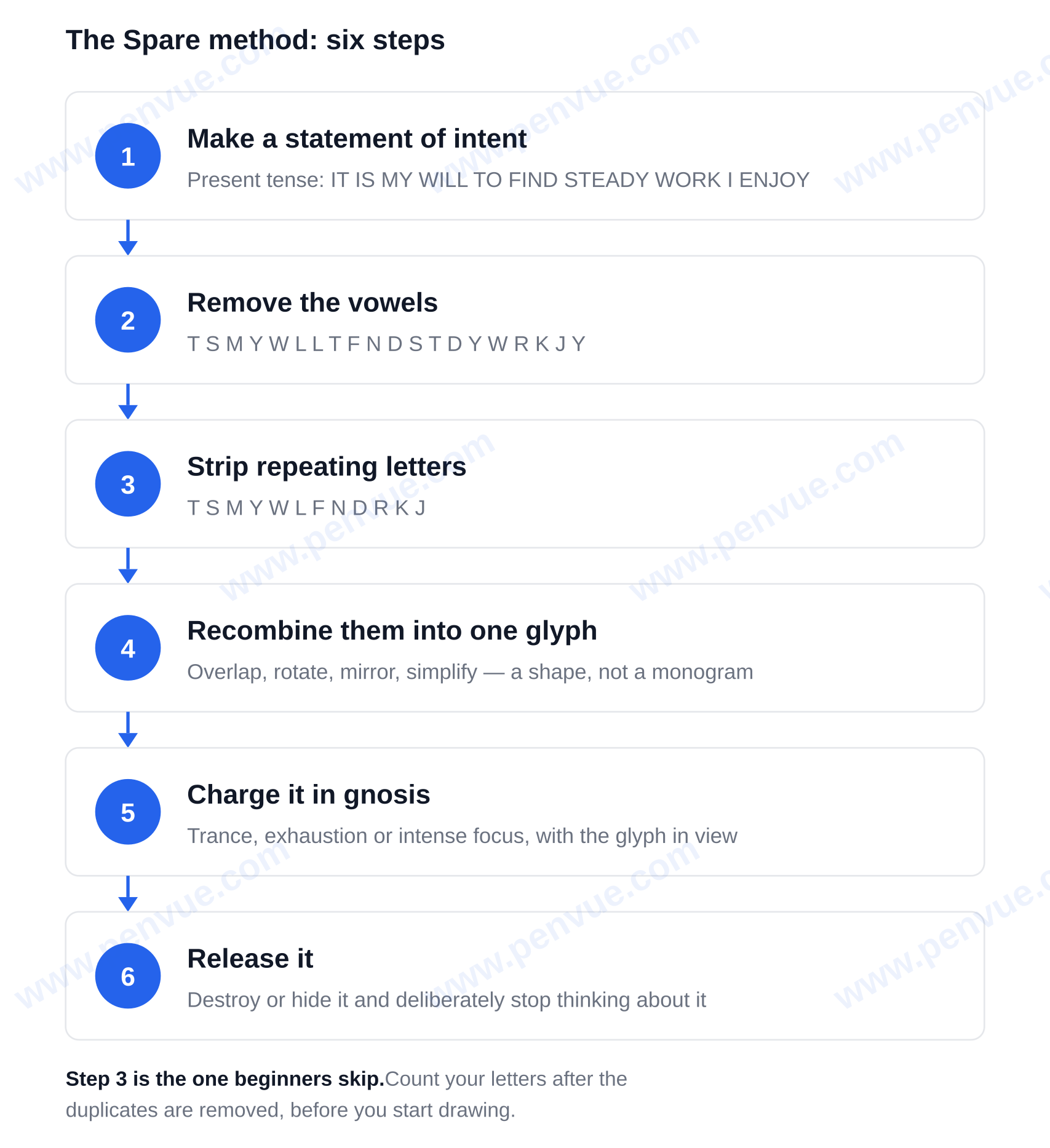
The Spare method requires a single statement carried through the whole process, so you’ve a reference output to check your work against. A worked example is in Juniper Divination’s step-by-step walkthrough of the Spare method.
- Make a statement of intent — present tense, affirmative, no “I want.” An example is IT IS MY WILL TO FIND STEADY WORK I ENJOY.
- Remove the vowels. That leaves T S M Y W L L T F N D S T D Y W R K J Y.
- Strip repeating letters. Thirteen remain: T S M Y W L F N D R K J.
- Recombine them into one glyph. Overlap, rotate, mirror and simplify until nothing reads as a letter. You want a shape, not a monogram.
- Charge it in gnosis — trance, exhaustion, intense focus, any state that quiets ordinary thought — while holding the glyph in view.
- Release it. Destroy or hide the sigil and deliberately stop thinking about it.
The step that beginners get wrong is step three. Many remove vowels, forget the duplicates, and then try to turn twenty-plus letters into a single shape, resulting in a mess. Count your letters before you start drawing.
Do you really have to forget a sigil?
“You must completely forget it or it won’t work” is the most repeated rule in sigil content, stated as an absolute almost everywhere. It is not universally held, even among practitioners.
In Spare’s writing, he is the most firm of all advocates of forgetting: destroy or hide the sigil and strive to forget it, because the very intent to obtain a result, the “lust of result,” is the attachment that creates the very resistance that the method aims to bypass. Against forgetting is the practical matter. Practitioner sources acknowledge that plenty of people find sigils work better kept visible, and treat remembering versus forgetting as a per-person preference rather than a mechanic.
Most importantly, hard-and-fast rules about forgetting silently dismiss the needs of anyone using a sigil as a focusing device. A tattoo, an engraved pendant, a glyph inked in a journal, a phone wallpaper — none of these can be forgotten by design. The standard rules about forgetting leave those readers thinking that they are doing it wrong. The most useful thing to consider is the job you want the sigil to do. A one-shot request: release it and forget it. A daily reminder of an intention: keep it where you will see it, and stop worrying about the rule.
Sigil, symbol, rune, talisman: what’s the difference?
- Symbol — the broad category. Any mark standing for something else, with a meaning that is usually shared and conventional, like the protective hamsa hand. Sigils are a type of symbol. Most symbols are not sigils.
- Rune — a character in a pre-determined alphabet (e.g. the Elder Futhark) with a traditional meaning shared by all practitioners. You do not create runes, you borrow them. A bindrune is a combination of two or more runes, which is why it is frequently confused for a sigil.
- Sigil — something created by an individual, or inherited from a grimoire, for a single intent or entity. The meaning is personal and typically unreadable by others.
- Talisman — something physical credited with power, such as a ring, a stone, a pendant, a charm. The power sits in the object, not in the shape.
A line explains all three: a sigil is a message, a talisman is the medium, and a rune is a word you borrow, not a sentence you create. That’s why a sigil can be engraved on a talisman and the two are not the same thing.
The two senses with no magic in them
What does the $ sigil mean in programming?
In computing, a sigil is a character affixed to a variable name (usually a prefix) that signifies the variable’s datatype or scope. Same Latin root, same “little sign,” and the sigil meaning in this context is strictly syntactic. BASIC popularised this method, where a trailing $ would indicate a string. Larry Wall borrowed this shell $ convention and carried it to Perl, which is where the majority of programmers are first exposed to the term.
- Perl:
$scalar,@array,%hash,&subroutine - PHP:
$on every variable - Ruby:
$global,@instance variable,@@class variable - BASIC:
$string
In code, sigils indicate scope or type at the point of use, and let the parser tell names apart without doing lookups. Because of this, many modern languages opt to use explicit declarations instead and drop sigils. If you are here from an error message containing a $ or @, then this is your sense and nothing is esoteric.
What does sigil mean in Game of Thrones?
In A Song of Ice and Fire and its adaptation, a sigil is the heraldic device of a noble house: the banner-and-shield device that identifies a family. For example, the Stark direwolf, the Lannister golden lion, the Targaryen three-headed dragon, the Baratheon stag. These are not occult objects — nobody in Westeros charges a house sigil to manifest anything. These are more like seals, carrying the same meaning as lineage, allegiance and authority, which puts it closer to the word’s original seal-and-signet sense than to the magical one. It’s apt rather than arbitrary to say sigils here, because real medieval seals carried exactly these heraldic devices, so “sigil” sits comfortably where a historian would say “arms.” Wider fantasy and gaming usage, from Elder Scrolls to Destiny, applies the term loosely to any emblem or glyph with implied power, blending the heraldic and occult senses together.
How are sigils used today?
Manifestation and intention-setting dominates, generally divorced from spirits and grimoires: a glyph for a goal, created and charged as a focusing ritual. Close behind is design for the body — personal sigils made for tattoos and jewellery, worn the way evil eye charms are worn, which is exactly the case the forget-it rule does not fit.
Grant Morrison took this concept into art and extended it with the “hypersigil”: an extended work charged with intention, the comic series The Invisibles conceived as a six-year example. Morrison also claims that the logos of big corporations such as McDonald’s and Nike function as viral sigils, replicating themselves through attention. That is the most interesting secular reading of the whole tradition — these logos are designed to lodge in minds and change behaviour, doing commercially what a sigil claims to do.
Do sigils actually work?
What can be said with any certainty is very narrow: writing an intention down, condensing it, and committing attention to it is a recognised focusing and commitment device. Claims beyond that — supernatural causation — are not demonstrable, and pretending otherwise would be dishonest in either direction. As for safety, making a personal intention sigil carries no inherent risk. Just be sensible, don’t let a glyph take the place of action on a health, money or legal problem.
The short version
There are three things to take away. First, the sigil meaning you need depends entirely on the context in which you met the word: a seal on a document, an occult sign, a character before a variable name, or a lion on a banner. Second, the four all ultimately derive from the Latin signum — a little sign representing a larger thing, whether a king’s authority, a demon’s name, a datatype or a house’s honour. Finally, the magical sense is the one that mutated: from somebody else’s signature, used to command them, to your own desire, encoded and released.
Next step: work out which of the four senses you actually came into contact with. If it was the magical one, state a single present-tense statement of intent and work it through the six steps above — and count your letters after the duplicates are removed before you start drawing.