


In late January, a client from last spring mails you an envelope. You open it to find a page with your name, their name, and a single number. There’s no tax calculated, no withholding. What is this number? A 1099 is an IRS information return reporting money you were paid outside regular employment. This money can be from contract work, interest, dividends, rent, a retirement withdrawal, or platform payouts. One copy is given to you and the other to the IRS.
I want to be upfront with my position and it puts this page at odds with most of what you will find elsewhere: if an article still tells you $600 is the number that triggers a contractor 1099, it is describing 2025. For 2026 payments, the number is $2,000. While some adjustments were made to the laws surrounding 1099s, that one change makes it more likely, not less, that you will owe tax on income no form ever documents.
What is 1099 reporting, in plain terms?
1099 reports. A 1099 does not calculate. Withholding does not happen by default, which is the reason the form catches people off guard — it arrives looking like a receipt and behaves like a bill you have not been shown yet.
The idea behind 1099s is simple. The payer files one copy with the Internal Revenue Service and furnishes another to you. The IRS gets a statement from a third party saying what somebody says they paid you. The IRS can use this to check your return against what a third party said they paid you. This check is the entire reason 1099s exist. The variations, thresholds, and deadlines are extra stuff attached to this single reason.
Why “1099 worker” is a mailbox fact, not a job title
Often when someone says “I’m 1099” it sounds like a job title to some. It’s a description of the paperwork they need to do. As Wikipedia’s Form 1099 entry puts it, these returns cover income other than wages, salaries and tips — so the term simply means a 1099 showed up where a Form W-2 used to. You can work the same job in the same capacity and change categories just based on how you are engaged.
Where the W-9 fits in before any 1099 is issued
The first payment in a 1099 relationship should be preceded by the payer requesting and you’re providing a Form W-9, carrying your name, address and taxpayer identification number. If that TIN is missing or does not match, backup withholding can kick in and the payer starts holding money back. In practice, almost every messy January I have seen traces back to a W-9 that was never collected — the payer scrambles in week four of the tax year to source information they should have had in week one. This causes untold stress on everyone.
Here is another straight-forward thing to say: a 1099 shows gross income, not proof that the full amount is taxable. Expenses you have in your business reduce the amount of income that is taxable to you, and they come off separately on your own return. The 1099 doesn’t know how much you spent to earn that money.
Where the 1099 came from — and what the digits don’t mean
This is what no commercial definition page covers and, in my opinion, that’s a mistake because the history shows the reasons for the behaviours.
The 1917 origin: $800 and a March 1 deadline
Reporting this type of information goes back to the War Revenue Act of 1917, which, according to Wikipedia, required an entity to report payments it made to another entity in a year of more than $800, along with the name and address of the recipient, to be filed by March 1 of the following year. Once again, notice how little things have changed. A dollar threshold. A name and address. A spring deadline. A hundred-plus years later, you are arguing over the same three things, but different numbers, and 22 distinct variants in the series instead of one.
What the digits actually mean (and what nobody can verify)
Absolutely nothing, at least in the publicly available information. The IRS does not make public their reasoning for the number 1099. It is a form series designation. There is no acronym and no tax code section associated with it. If you find a page that confidently has the answer, that page is just making an educated guess. I would rather tell you there is a void, rather than fill it.
As far as practicality is concerned, understanding the origin story helps us understand what the form is for. As noted earlier, the 1917 premise was to get third parties to do the verification work of the government. All of the threshold controversy since then (who is obligated to file, at what dollar amount, how often) is about shifting the verification burden to payers. After understanding it in this context, the 2026 changes become a little less random.
Which 1099 will you actually receive?
A lot of people never see anything beyond two or three of these. Know where you stand:
- 1099-NEC — nonemployee compensation. Freelancers and independent contractors.
- 1099-MISC — rent, awards and prizes, and other miscellaneous payments. Landlords live here. The IRS page on Form 1099-MISC is the authority on what belongs in which box.
- 1099-K — payment card and third-party settlement organization payouts: Stripe, PayPal, Uber, Etsy.
- 1099-INT — bank and bond interest.
- 1099-DIV — dividends and capital gain distributions.
- 1099-B — broker sales of securities.
- 1099-R — distributions from pensions, annuities and IRAs.
- 1099-S — proceeds from a real estate sale.
- SSA-1099 — Social Security benefits.
1099-NEC vs 1099-MISC: which should a contractor expect?
The NEC. Revived for tax year 2020 to capture nonemployee compensation previously reported on Box 7 of the 1099-MISC, the 1099-NEC has since sustained the split. A contractor should expect to receive a 1099-NEC, while a landlord who collected rent should expect to receive a 1099-MISC. If you get the wrong one, that is the payer’s error that should be brought to the payer’s attention, not a quirk to shrug at.
Receiving four different variations of a 1099 in one year is not unheard of, and should not be considered a red flag. It is possible to be a W-2 employee and a 1099 recipient in the same tax year. Both land on the same tax return.
How much do you have to earn to get a 1099 in 2026?
The rules governing 1099 reporting have diverged, and this is where the answer to what is 1099 reporting in 2026 genuinely splits apart. The One Big Beautiful Bill Act, enacted July 4, 2025, altered the limits and thresholds differently for various provisions, and a lot of pages have flattened that nuance into one wrong number.
| Form | 2026 filing trigger | What changed |
|---|---|---|
| 1099-NEC / 1099-MISC | $2,000 per payee per calendar year | Raised from $600 for payments made on or after January 1, 2026; inflation-indexed from 2027 (Patriot Software) |
| 1099-K | More than $20,000 and more than 200 transactions | OBBBA permanently and retroactively repealed the $600 phase-down, so $600, $2,500 and $5,000 never took legal effect (TaxBandits) |
| 1099-INT | $10 of interest | Unchanged |
Why $600 is now the wrong number to quote
There’s a reason $600 is historical. It controls payments up to and including 2025. It is still repeated on numerous websites as the live rule — you can check Avalara’s summary of the OBBBA threshold changes to confirm. I will go further. At least one top ranking website states the 1099-K threshold also rose to $2,000 for 2026. This is a direct conflict with the re-instated $20,000 and 200-transaction test. If a source has merged all three forms into one number, treat the rest of that source’s tax year figures with suspicion.
An alignment that matters is, beginning in 2027, backup withholding will be required once annual payments exceed the inflation-adjusted NEC/MISC threshold, per OnPay’s reporting on the updates.
The thing that matters most among the figures in that table is a threshold is the payer’s filing obligation. It has never been an income reporting floor for you.
Do you owe tax on 1099 income, even without the form?
Yes. The real question that people mean when they ask what is 1099 income is whether the paperwork creates the liability. It does not. The form documents income; the obligation to pay tax on that income exists regardless of the form.
Take a look at what the higher threshold does. In 2026, a freelancer who received $1,500 from each of three clients may not receive any 1099s for that $4,500 of income. That’s because each payer sits under the $2,000 threshold. Nothing was filed, nothing was mailed, and that income is fully reportable. I believe the 2026 coverage has poorly highlighted that raising the payer threshold did not raise anything on the recipient side. It just removed the reminder.
1099 vs W-2: who pays Social Security and Medicare?
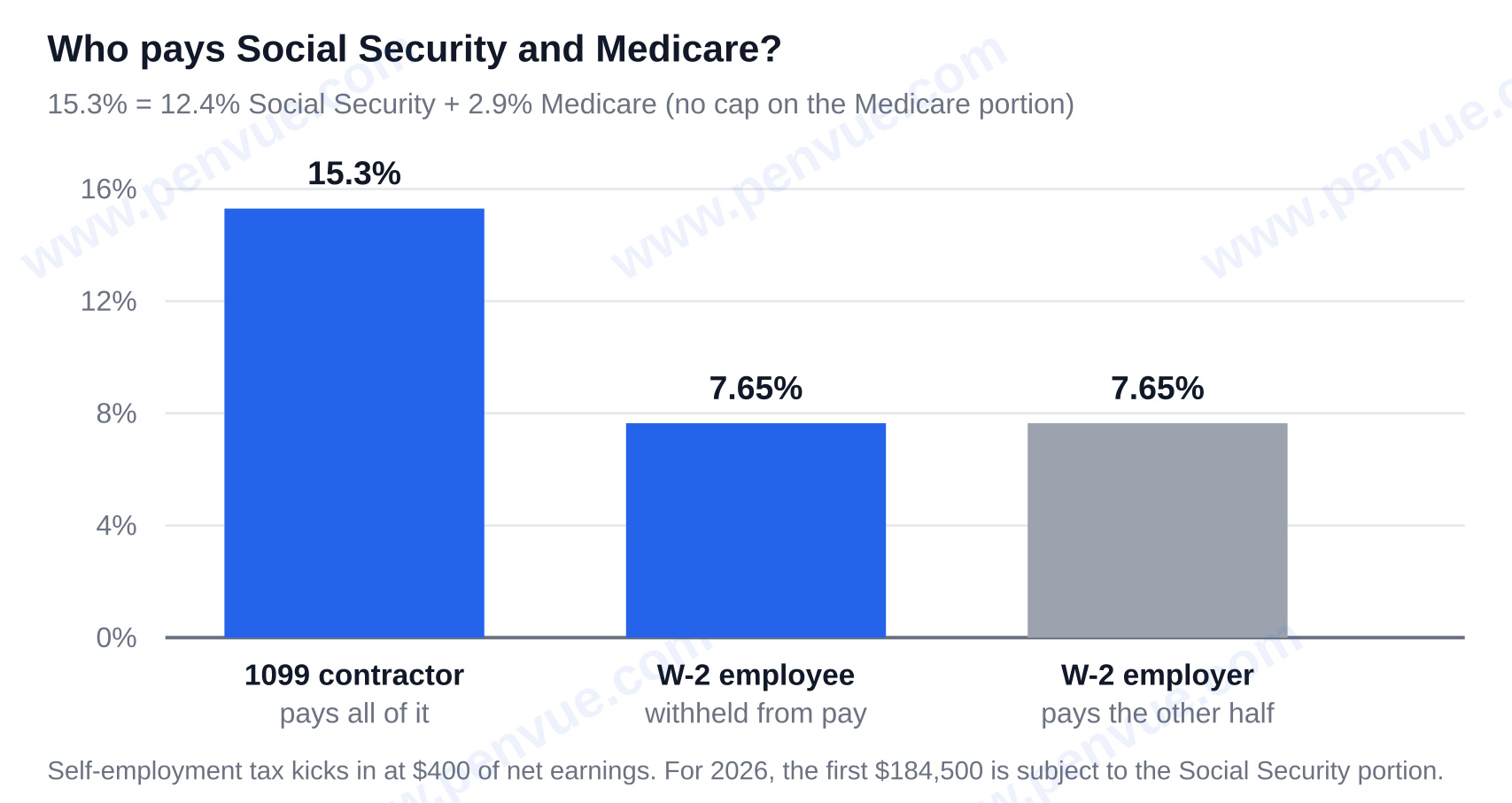
You do. All of it. Per the IRS guidance on self-employment tax, the self-employment tax is 15.3%. That includes a 12.4% tax for Social Security and a 2.9% tax for Medicare, and there is no cap on the Medicare portion. It kicks in at just $400 of net self-employment earnings. For 2026, the first $184,500 of combined wages, tips and net earnings is subject to the Social Security portion.
Compare that to W-2 work, where the employer pays half (7.65%), and withholds the rest. As Ramp’s comparison notes, contractors also forgo employer-sponsored benefits, as well as workers’ compensation and unemployment coverage. What you get in exchange is control over how the work gets done. So, whether that trade is worth 7.65% is a judgment call, but make it with the number in front of you, not after the fact.
There are two important effects this has. Because there is no withholding on 1099 income, it’s up to you to make quarterly estimated tax payments. Second, deductible business expenses reduce the net earnings the 15.3% applies to, so sloppy expense records cost more than people assume.
When a 1099 means you were misclassified
If you are handed a 1099 but managed like an employee — set hours, assigned methods, supervised day to day — that may be misclassification rather than contracting. OnPay points to Form SS-8, which asks the IRS for an official determination of worker status. It is not a casual filing, and it does change your relationship with the payer. Use it when the pattern is clear, not when one client is simply demanding.
If you’re the one paying, what are you on the hook for?
If you’re a business, bank, brokerage, or payment platform and you’ve paid a 1099 recipient past the threshold, you are required to file with the IRS and furnish that recipient a copy. Per Wikipedia’s deadline summary, most recipient copies are due January 31 following the tax year, the 1099-NEC is due to both recipients and the IRS by January 31, and other variants go to the IRS by the last day of February on paper or March 31 for electronic filers. Weekends shift things — Insureon notes that because January 31 fell on a Saturday, filers of the 1099-NEC for the 2025 tax year had until February 2, 2026 to file. Consult the IRS General Instructions for Certain Information Returns before taking secondhand dates at face value.
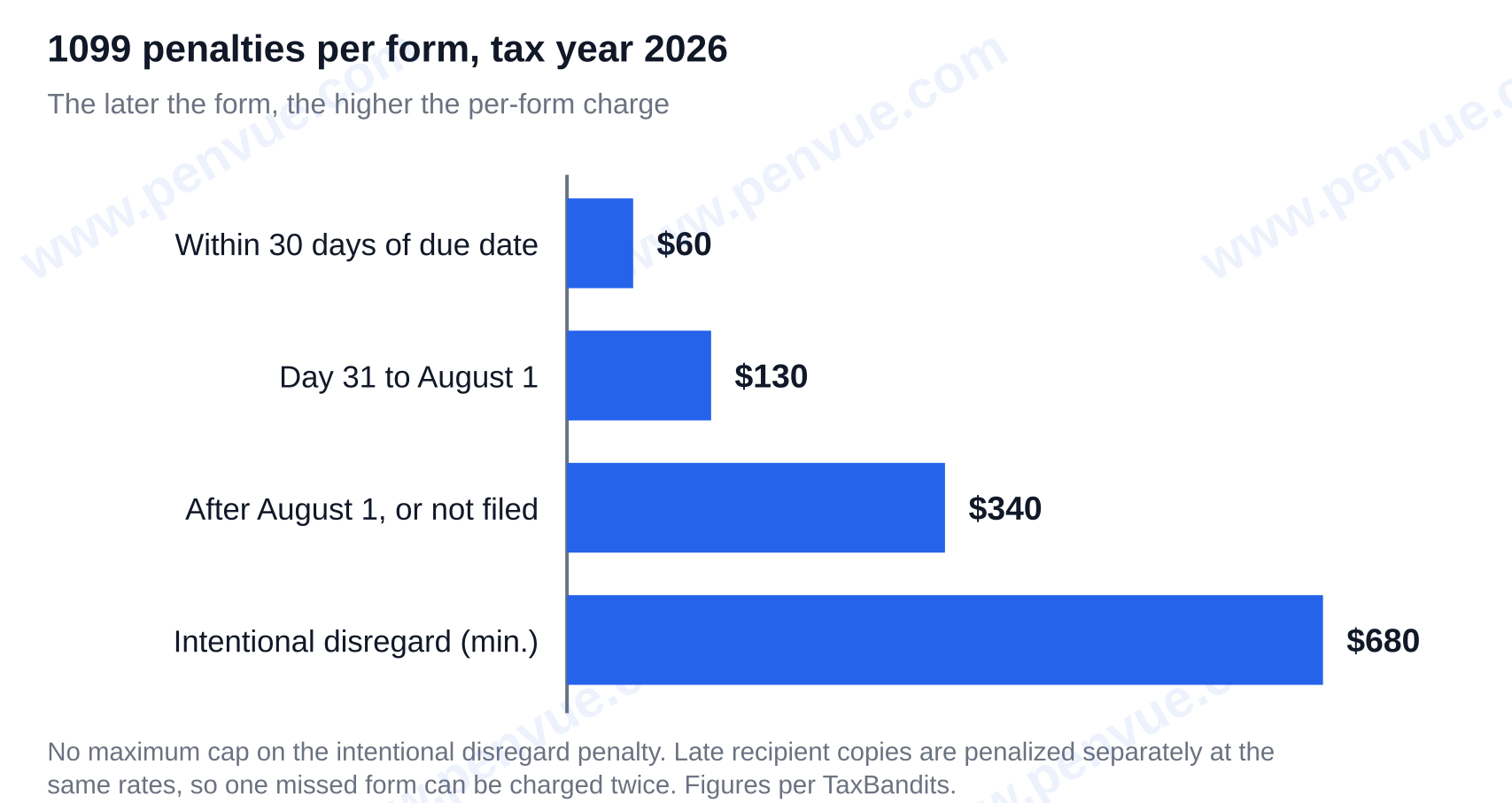
Vagueness in penalties hurts real people. Here are the TaxBandits penalty figures for tax year 2026: around $60 per form filed within 30 days of the due date, $130 per form filed between day 31 and August 1, $340 per form filed after August 1 or not filed at all, and a minimum of $680 per form for intentional disregard. There is no maximum cap on the intentional disregard penalty. The detail most pages omit: late recipient copies are penalized separately and are charged at the same rates. One missed form can be charged twice.
Corrections run both ways. The payer who got an amount wrong files a corrected return, and the recipient who spots a wrong figure or TIN should request the correction in writing before filing. Quietly reporting the lower number you believe is right leaves a mismatch sitting in the IRS’s matching system with your name on it.
The discipline that prevents all of this costs nothing: collect the W-9 before the first payment, not in January.
The bottom line
There’s nothing new in the following three points. First, if you can remember one number about what is 1099 reporting in 2026, let it be $2,000 for contractor payments — $600 is a historical figure, and 1099-K still runs on more than $20,000 and more than 200 transactions. Second, it is always the payer’s threshold, never yours. So net self-employment earnings of $400 or more mean you owe tax, regardless if the form was issued to you. Third, total your 2026 income by payer, compare it against the 1099s you actually received. Make quarterly estimated tax payments for anything with no withholding behind it. If you have just a single W-2 and a savings account, this does not change your year. If you invoice anyone, it changes your January. For more on this, see our Lifestyle coverage.
Frequently Asked Questions
Do I have to report 1099 income under $2,000?
Yes, the $2,000 figure that applies to 2026 payments is the payer’s threshold for filing, and not the threshold for you to report the income. A client who pays you $1,500 is not required to issue a 1099-NEC. In this case, the income is still fully reportable. Per the IRS, net self-employment earnings of $400 or more mean you are liable for self-employment tax of 15.3%, regardless of whether any form was issued.
What’s the difference between a 1099-NEC and a 1099-MISC?
A 1099-NEC reports nonemployee compensation — money paid to contractors and freelancers for their services. A 1099-MISC, on the other hand, covers rent, prizes, awards, and other miscellaneous payments. Nonemployee compensation moved off Box 7 of the 1099-MISC onto the revived 1099-NEC for tax year 2020, so a contractor should expect to receive a NEC and a landlord should expect to receive a MISC.
What should I do if I never receive a 1099 I expected?
You should file anyway, using your own records, and you should reach out to the payer in writing to find out whether a form was issued and to what address they mailed it. You should not, however, wait on it, as the income is reportable either way. With the 2026 contractor threshold set at $2,000, small payments that once generated paperwork now may not, so your invoices and bank deposits become the primary record rather than a backup to one.
When are 1099 forms due in 2026?
Most recipient copies are due by January 31 following the tax year, and the 1099-NEC is due to both recipients and the IRS by January 31. Other variants of the form go to the IRS by the last day of February if filed on paper, or on March 31 for electronic filers. Weekend shifts apply — Insureon notes 2025-year NEC filings could be made by February 2, 2026, since January 31 fell on a Saturday.