

Sometimes text messages can be as cryptic as you want them to be. A classic example? When someone sends “pizza or tacos?” and the response is simply wtv. The WTV meaning in text is simply “whatever.” It’s an initialism, so the letters are pronounced — you don’t say it as a word. “Wtv” can mean three things: you can go with the flow and be easygoing; you can genuinely have no preference; or you can dismiss a suggestion with an attitude, sort of like “whatever.” Context can distinguish between the three meanings. A more recent, secondary usage of WTV has been documented as “what’s the vibe?” — the newer sense of “wtv” originated in 2019.
With all that being said, in a pizza or taco situation, “wtv” usually means “you pick, I’m good with either one.” Change the setup to “so you’re saying I overreacted?” and the same three letters mean the conversation is basically over.
What does WTV mean in text?
WTV is short for whatever, and the vowels have been removed. The earliest known record of WTV in the dictionary was on May 9, 2018 — Dictionary.com logged it with the definition “not caring, being bored, or just being uninspired.” However, they add a disclaimer to the entry stating that it was an informal summary of a word, not a formal definition. WTV has never been promoted to a standard dictionary headword.
slang.net explains it differently, defining the same three letters as “carelessness, openness to anything, or ‘no matter what.'” One definition leads with indifference and the other definition leads with agreement.
That is the primary source of the linguistic ambiguity with WTV. It isn’t vague — both the cold reading and the warm reading are published, sourced definitions. There are extended forms of the phrase as well, recorded by Dictionary.com, including wtvtf and wtv pc.
Of course, you can expect to see it primarily in SMS and iMessage and online messaging apps, but also on Snapchat, TikTok comments, Instagram DMs, WhatsApp and Discord.
Is WTV an acronym or an abbreviation?
WTV is an abbreviation and an example of an initialism. Initialisms are letters you’d spell out like IDC and IDK. An example of an acronym is NASA, which forms a pronounceable word from its initials. Saying “wuh-tiv” makes no sense and people never say WTV out loud, it’s more of a written only thing.
WTV isn’t Gen Z slang — and “rude” has a number attached to it
The earliest documented use of WTV in Urban Dictionary is from 12/11/2004, where a user named “crack” said “short for Whatever.” Then, WTV was written about 22 years ago. AIM (AOL Instant Messenger) away messages were still around, 160-character SMS was the norm, and this was long before TikTok existed.
The oldest members of Gen Z were about seven years old then. Any ranking page that calls WTV “Gen Z slang” or “viral 2026 slang” in its title is technically wrong by a generation.
The phrase “Whatever” has been around a lot longer. Wikipedia documents a 1965 episode of Bewitched in which Endora answers Samantha Stephens with “All right, whatever,” and also cites it as a standard retort for Captain Manzini on My Mother the Car. The word later drifted from dismissing a specific statement to standing on its own as an interjection — what Wikipedia describes as a passive-aggressive conversational blocking tool.
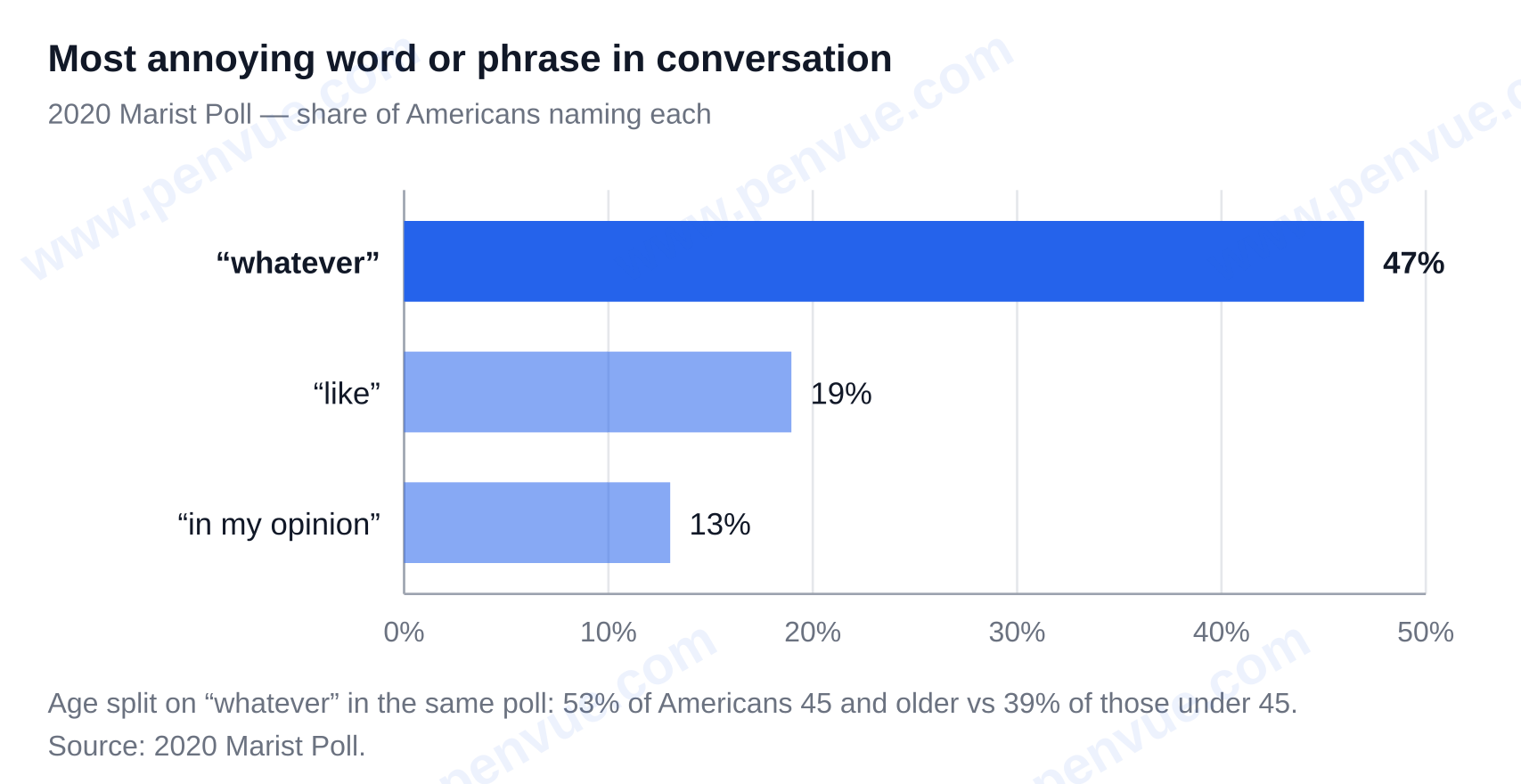
You don’t have to guess about tone. According to the 2020 Marist Poll, 47% of Americans listed “whatever” as the most annoying word or phrase in conversation. It was listed as the most annoying for the twelfth year in a row, with more than double the mentions of “like” (19%) and well ahead of “in my opinion” (13%). The 2017 Marist Poll, 1,074 adults surveyed by phone November 6–9, 2017, listed “whatever” as the most annoying phrase at 33%, with “fake news” at 23%, “no offense, but” at 20%, and “literally” and “you know what I mean” at 11% and 10%, respectively. Marist media director Mary Griffith said of “whatever,” it “can be very dismissive and rude” and it “can signal to the other person that what they are saying is not important.”
WTV is a contraction of a word a near-majority of the country already finds annoying at full length.
The age split nobody mentions: safe sideways, risky upward
The 2020 poll breaks down by age, and this is the part that most advice columns skip. 53% of Americans aged 45 or older listed “whatever” as the most annoying word or phrase, whereas only 39% of those under 45 listed it as such.
Therefore, the rule we can apply before hitting send is that WTV is safe sideways — friends, peers, group chats. It’s risky upward — a parent, a manager, a professor, a client. Same three letters, different odds of landing as a snub.
The one-word fix that converts dismissive into agreeable
It’s just a word. “Wtv works for me.” “Wtv you prefer.” “Wtv sounds good.” The entire technique is avoiding a bare WTV. Without that extra word, the reader gets to pick between the two published definitions, and the anxious reader almost always picks the cold one. One extra word removes the choice.
Is WTV rude, or just relaxed? How to read the tone you got
There are 3 tones, each with its own signals.
- Easygoing — comes with an offer, an emoji, or more words. slang.net’s own example is: “wtv. im down for anything. :)”
- Genuinely neutral — answers a menu-style question, e.g. “Pizza or tacos?” → “wtv”
- Dismissive — comes alone, ends the thread, follows a disagreement, or replaces an answer you actually asked for
Check this before you get too annoyed:
- Was your last message a question or a statement? A claim met with “wtv” is a shutdown.
- Was the previous message tense?
- Did they reply instantly, or after a long gap?
- Is the message alone, or is it part of a sentence?
- Do you know this person well, or are they someone above you?
From a 2023 Urban Dictionary entry, WTV also comes up when someone doesn’t want to admit you’re right. That’s not indifference, it’s a concession dressed as a shrug.
The way it’s expressed amplifies the problem. No voice, no face, and three letters standing in for a sentence. “Wtv” is still “whatever,” and typing four characters less doesn’t change the tone. It just gives the reader less to work with.
Does WTV change on Snapchat, TikTok, or in DMs?
The definition doesn’t change platform to platform, but the social stakes do.
- Snapchat — quick, low effort replies are the norm, so WTV here is usually just filler agreement rather than a snub.
- TikTok — WTV is often paired with a post, and serves as a shrug at discourse (“wtv, posting it anyway”) and as self-deprecating caption tone.
- Instagram DMs — more deliberate than Snapchat, so a bare WTV reads heavier. WTV is often paired with a plan.
- WhatsApp — usually paired with the agreeable “wtv works” sense in the context of group logistics.
- SMS and iMessage — read receipts and typing indicators mean a one-word “wtv” is a hard contrast after extended typing.
- Discord and gaming chat — agreeing to a call, ending an argument during a match are two of the few truly neutral uses of WTV.
Rule of thumb — the shorter and faster a platform’s norms, the less likely WTV is an insult.
People want to know what the WTV meaning in text is when it’s sent by a female versus a male. It’s really not about the gender of the person sending it. What predicts the meaning is how long have you and the person communicating WTV known each other? Is there an ongoing disagreement? Does the person normally communicate in full sentences? Did WTV come with a follow-up? Here are three actual exchanges. “Movie or dinner?” / “WTV you want” is agreeable, no action required. “So you’re saying I overreacted?” / “WTV” is a thread-ender, address it directly. “WTV, I liked it” as a caption is a self-aware shrug, aimed at no one.
How to reply when someone texts you WTV
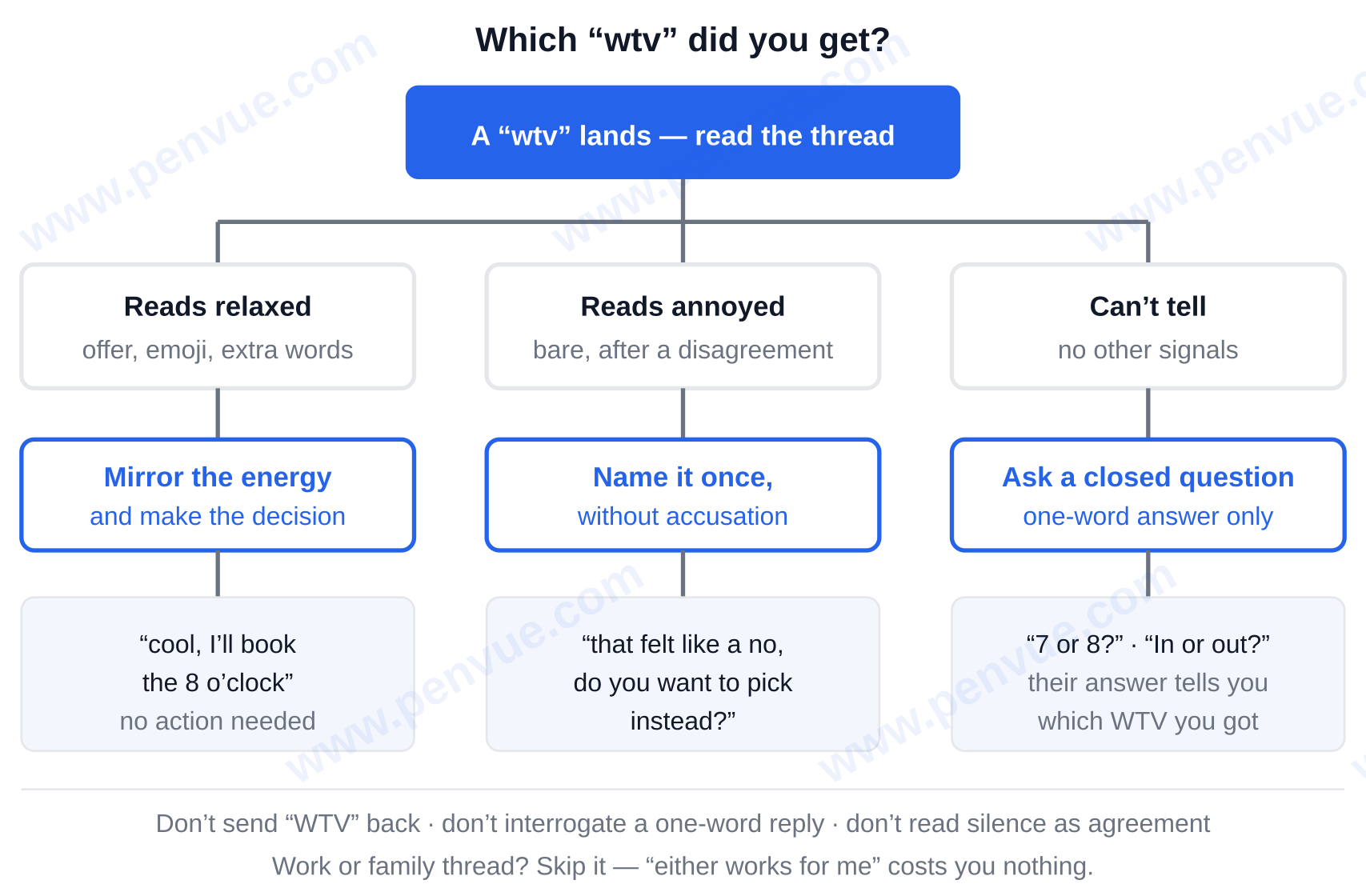
Read the situation and match your reply to your reading.
If you read it as relaxed — mirror the energy and make the decision:
- “cool, I’ll book the 8 o’clock”
- “sounds good, locking in tacos”
- “then I’ll pick”
If you read it as annoyed — name it once, without accusation:
- “that felt like a no, do you want to pick instead?”
- “I’d rather hear what you want to eat”
- “we can come back to this later if it’s not good now”
If you honestly can’t tell — you can ask a closed question that forces a one-word answer. “7 or 8?” “In or out?” Their answer will tell you which WTV you got.
Three things not to do: don’t send “WTV” back (it escalates), don’t interrogate a one-word reply, and don’t read silence after a WTV as agreement. If it’s a work or a family thread, skip it entirely — “either works for me” is good. It costs you nothing.
WTV vs w/e, IDC, IDK and the rest
| Abbreviation | Stands for | What it signals | Where it’s safe |
|---|---|---|---|
| WTV | whatever | Flexible, neutral or dismissive — context decides | Peers, group chats |
| w/e | whatever | Same meaning, older slash form, reads slightly dated | Peers |
| whatevs / evs / watev / weva / we / wei | whatever | Playful variants, almost always non-hostile | Friends |
| meh | — | Indifference toward the thing, not toward you | Low risk anywhere casual |
| IDC | I don’t care | Blunter and more clearly dismissive than WTV | Close friends only |
| IDK | I don’t know | Uncertainty, not indifference | Almost anywhere |
| WYM | what do you mean | Asks for clarification; often read as confrontational | Peers, with care |
| WYD | what are you doing | An opener, not a reply | Friends |
slang.net also lists WEML and YSW in the same group. The most common error readers make: IDC refuses the subject. WTV postpones the decision. IDK is not related to either. It is an admission, not a shrug.
The other WTV: the .wtv file format and TV stations
Outside messaging, .wtv is the file extension for Windows Recorded TV Show, a Windows video format. WTV also represents television broadcasters: West TV in Perth, the W Network in Canada, the W Channel in Australia, World Television, Wakayama Telecasting Corporation in Japan, and a regional channel in West-Flanders, Belgium. If WTV shows up in a file name as opposed to a text thread, that’s your answer.
When WTV doesn’t mean “whatever” at all
Urban Dictionary carries dated competing decodings. “What’s the vibe” was submitted on September 18, 2019. “What’s the vibe(s)? Basically means what’s up” (noted as originating in New York) was submitted on April 11, 2022. “What’s the verdict” — meaning what are you doing, what are your plans — was submitted November 1, 2019.
The disambiguation rule follows from grammar, not guesswork. “Whatever” appears as a standalone reply or as an adjective before a noun: “wtv you want.” “What’s the vibe” opens a message and expects an answer, usually with a question mark: “wtv tonight?”
One-line test: if the message is asking you something, it isn’t “whatever.”
This is more important than it appears. Answer “wtv tonight?” as though it meant “whatever” and you’ve misunderstood the message completely, and no top-ranking page on the WTV meaning in text will help with your misunderstanding.
Can you use WTV in email or at work?
No. Formal writing, client emails, work chats, cover letters, academic work, anything with a manager or professor in the thread — spell out “whatever,” or better yet, state your actual preference. It’s better to lose the three characters than to take a risk with an interpretation you can’t control. The same applies for any shorthand whose interpretation changes with the reader, which is why plain language is better for writing that’s meant to be long-lasting, the kind of care that’s shown in words like humility and what it actually means.
The one thing to remember
WTV has always meant “whatever” — documented in writing since December 2004, two decades before the Gen Z label most pages hang on it. While the definition remains constant, the tone does not, and the Marist numbers show why: the word it shortens annoyed 47% of Americans, rising to 53% of the 45 and up crowd. Send it sideways to peers, never upward to a manager, parent or client, and check for a question mark before you assume it means “whatever” at all. So next time a WTV lands and you can’t make out the tone, don’t guess — reply with a closed, two-option question and let their answer decide it for you.
Common Questions
Why do people type WTV instead of just typing “whatever”?
Speed and habit. In the early 2000s, 160-character SMS and AIM were the norm, so 160 characters felt long. Every character had to count, and WTV became commonplace — the oldest Urban Dictionary entry for it was submitted on December 11, 2004. People got used to using it, and the habit stuck long after the constraint went away. Today it’s mostly about tone: three letters read as casual and low-effort, which is exactly why they can also be perceived as dismissive. The shortening does not smooth out the word at all.
Can WTV ever be positive, or does it always sound negative?
Yes, it can absolutely be positive. slang.net’s published definition includes “openness to anything,” and its own example is “wtv. im down for anything. :)” The reliable way to land the positive reading is the addition of one word — “wtv works for me,” “wtv you prefer,” or “wtv sounds good.” The bare form leaves the reader choosing between the agreeable and indifferent senses, and most people do take the colder interpretation.
Is it rude to leave a WTV message on read?
It depends on the context — on what the WTV was doing. If it was a sincere “no preference” answer to a menu-style question, then it’s okay to leave it on read after you make your selection; just say what you decided. If it arrived mid-disagreement, not answering generally confirms the other person’s suspicion that the conversation is over, and that compounds the problem. In that case, one short message is better than no message: name it once, or ask a closed question that gives them an easy way back in.