
Genesis 4 gives the cain and abel story in just 16 verses — two brothers, two offerings, one murder — and in all of them it never once states why God rejected Cain’s gift. Everything you have heard about faith, blood sacrifice, or Cain holding back his best is inference layered on top of a text that stays silent.
That silence is the single most-misreported thing about this passage. Most retellings move straight from “God had no regard for Cain’s offering” to a confident explanation, in the same tone of voice as the narrative itself. Here is what the chapter says, what later tradition supplies, and how to tell them apart.
Why did God reject Cain’s offering?
Genesis does not say. That is the honest answer, and it is worth sitting with before you accept any of the popular ones.
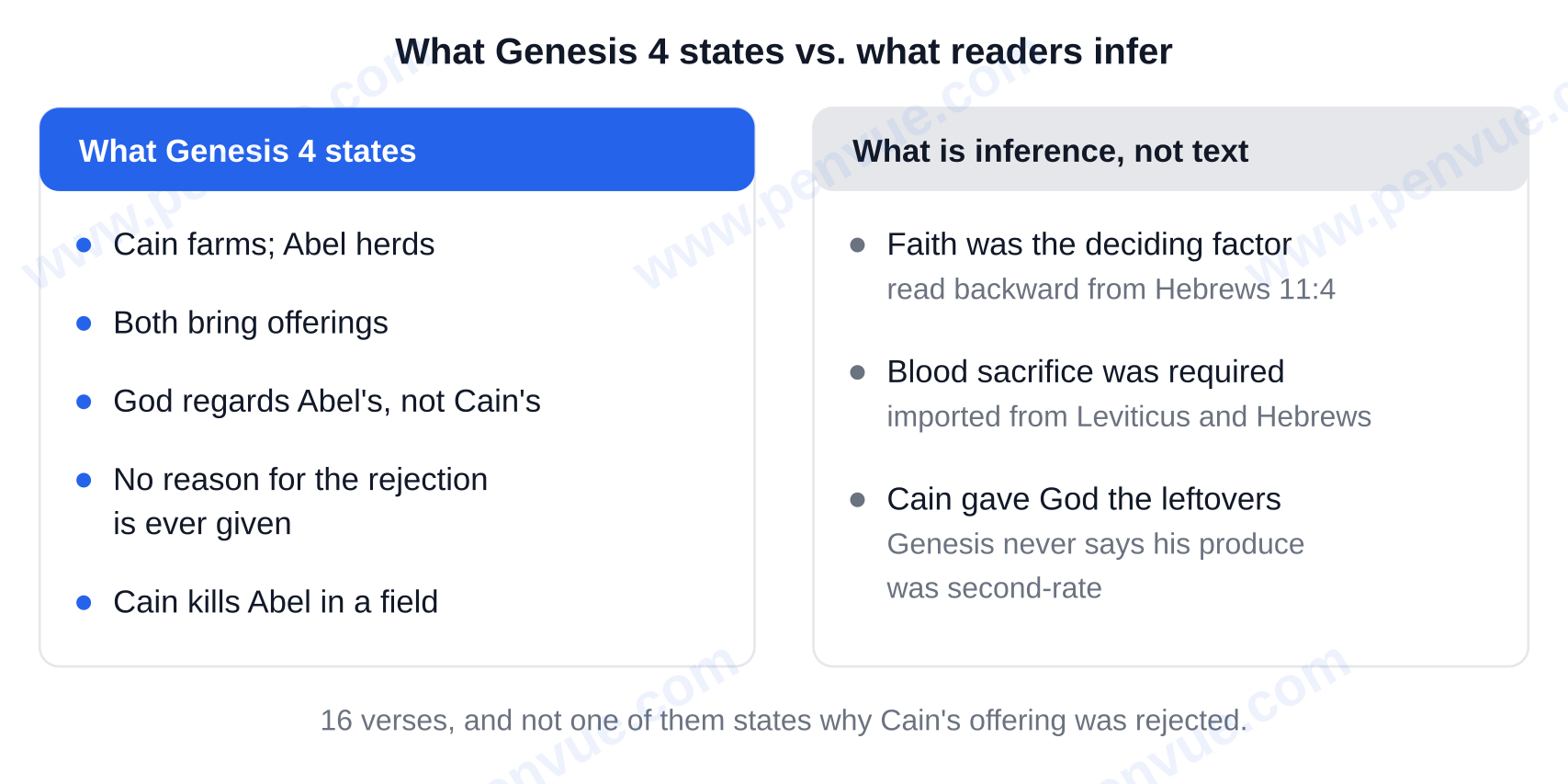
The text reports the facts flatly. Cain, who worked the ground, brought produce. Abel, who kept flocks, brought from his flock. God had regard for Abel’s offering and not for Cain’s. No reason given, no complaint about the wheat, no instruction either brother had broken. You can read the whole chapter in interlinear Hebrew and parallel translations at Bible Hub and the gap stays open.
So here is the division most pages skip:
What Genesis 4 states:
- Cain farms; Abel herds.
- Both bring offerings; God regards Abel’s, not Cain’s.
- Cain’s face falls, and God warns him directly.
- Cain kills Abel in a field.
- Cain answers God with a question of his own.
- The ground is cursed for him and will no longer yield.
- Cain is made a wanderer.
- He fears being killed.
- God promises sevenfold vengeance on anyone who kills him.
- God puts a mark on him.
- He settles east of Eden in the land of Nod and later builds a city.
What is inference, not text:
- That faith was the deciding factor — read backward from Hebrews 11:4, written centuries later.
- That an animal offering was required because blood was required — a theological framework imported from Leviticus and the letter to the Hebrews.
- That Cain kept his best and gave God the leftovers — a reasonable guess, since Abel’s offering is described as from the firstborn of his flock, but Genesis never says Cain’s produce was second-rate.
Those readings may be right. They are still readings. Bible Hub’s own treatment of the question concedes the point: the Bible never specifies why Abel’s offering was favoured, so the theological explanations rest on inference from Scripture and commentary. Notice that no popular retelling leads with that.
What did Cain actually say to Abel?
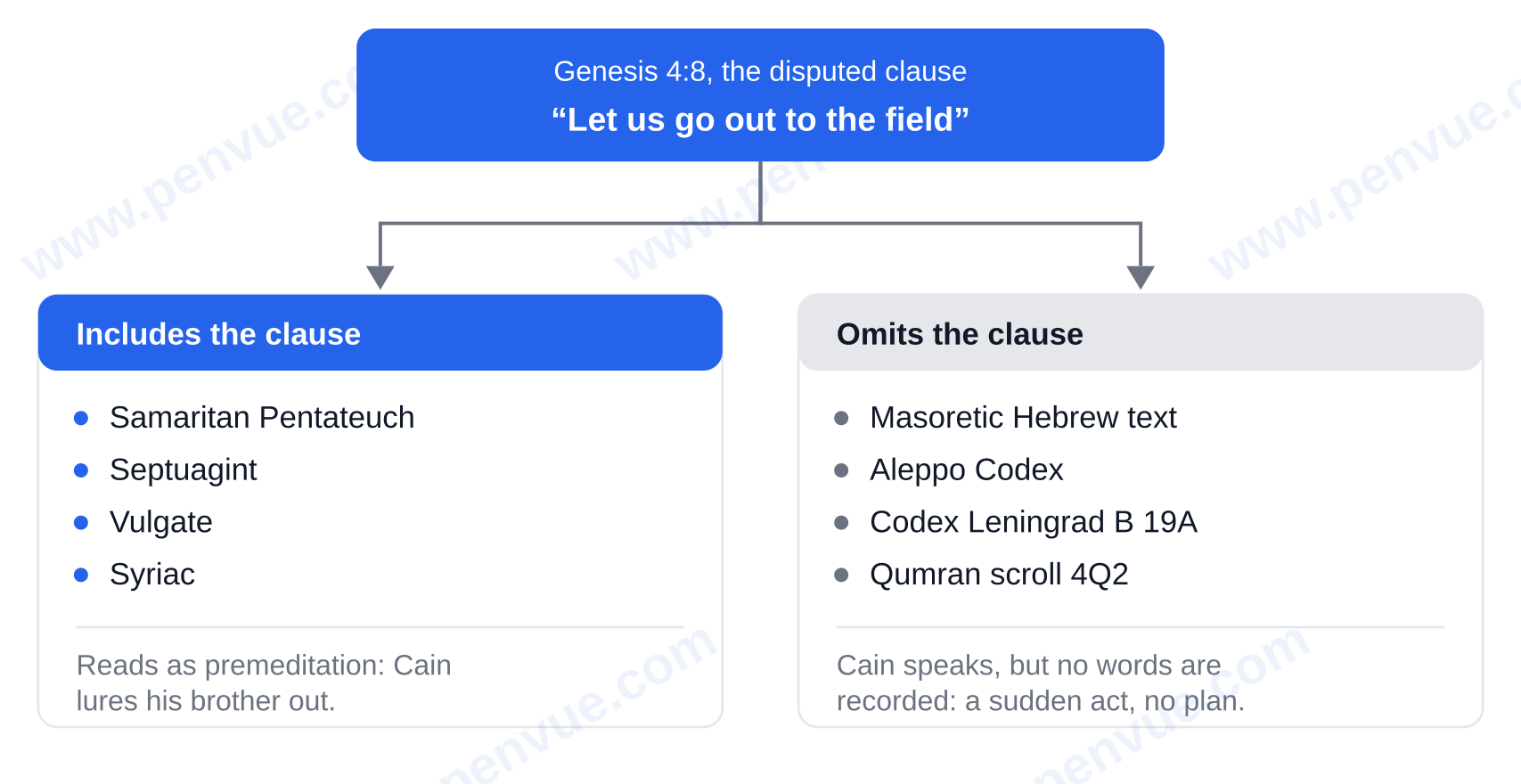
In the Hebrew most English Bibles translate from, he says nothing. The Masoretic text of Genesis 4:8 reports only that Cain spoke to his brother — and then moves to the field and the killing without recording a single word.
This is why your Bible and your friend’s Bible may not match. Some print “Let us go out to the field”; others leave the line blank. The clause comes from the Samaritan Pentateuch, the Septuagint, the Vulgate, and the Syriac. It is absent from the Aleppo Codex, from Codex Leningrad B 19A, and from the Qumran scroll 4Q2. Translators have to pick, and they pick differently.
It matters for how the murder reads. With the clause, Cain lures his brother out — premeditation, a setup. Without it, the text gives you a sudden act and no stated plan. Readers argue about Cain’s state of mind constantly without knowing the argument is partly about a manuscript variant.
What does “sin is crouching at your door” mean?
It is the language of a predator or a threshold demon waiting outside — and in the same breath God tells Cain he can master it.
Genesis 4:6-7 is the hinge of the whole chapter. Cain’s face has fallen. God asks why, then says that doing right brings acceptance, and that if he does not, sin is crouching at his door. As Wikipedia’s treatment of the passage notes, the imagery connects to the Akkadian rabisu, a demon that lurks at an entrance.
The crouching is only half of it. The verse also hands Cain the capacity to rule over the thing at the door. That makes the warning an offered choice rather than a forecast of doom. God is not narrating Cain’s fate — God is telling him he can win.
Was the mark of Cain a punishment?
No. It was protection, and it was given because Cain asked for it.
This is the most durable misreading of the chapter. The popular version treats the mark as a brand of shame — a visible stigma, sometimes imagined as a horn in the forehead, sometimes as a disfigurement. The text’s logic runs the other way. Cain says he will be a wanderer and that whoever finds him will kill him. God answers with the sevenfold-vengeance warning and then sets the mark on him so that no one who finds him will kill him. It is a safeguard, issued in direct response to his fear.
And Genesis never describes what it looked like. Not a letter, not a scar, not a colour, not a horn. Every physical description you have heard is later speculation. Some read it as a divine imprint shielding him from enemies rather than labelling him an outcast — a reading that reference treatments now treat as standard rather than as a clever alternative.
Who did Cain marry, and where did other people come from?
Genesis does not tell you. It mentions that Cain had a wife and never says who she was or where she came from.
Later tradition fills the hole, and the fillings are specific enough to trace. Genesis Rabbah has Cain marry one of Abel’s twin sisters. The Book of Jubilees names Cain’s wife Awan, a daughter of Eve. Neither name nor relationship appears anywhere in the biblical text — the Biblical Archaeology Society’s treatment of Cain’s wife lays out exactly which claims come from Genesis and which are supplied from outside it.
The same gap explains the city. Cain builds one and names it after his son Enoch, and his line runs through Irad to Lamech. A reader notices immediately that cities need populations the text has not accounted for. Genesis is simply not interested in that bookkeeping.
Who added what: Genesis, the Quran, and Jewish tradition
If you have heard conflicting versions of this account, it is because three traditions contribute different pieces. Nobody puts them side by side, so here they are.
| Element | Genesis 4 | Quran 5:27-31 | Later Jewish tradition |
|---|---|---|---|
| Brothers named | Cain and Abel | Unnamed; Qabil and Habil come from later Muslim commentary | Uses the Genesis names |
| Reason the offering is accepted | Not stated | Stated: God accepts from the righteous | Various explanations offered |
| Sin crouching at the door | Yes (4:7) | Absent | — |
| “Am I my brother’s keeper?” | Yes (4:9) | Absent | — |
| Burial instruction | Absent | A raven scratches the ground to show the killer how to bury his brother | — |
| Mark of Cain | Yes, undescribed | Absent | Physical descriptions added |
| Land of Nod | Yes, east of Eden | Absent | — |
| City and genealogy | Enoch, Irad, Lamech | Absent | — |
| Cain’s wife | Mentioned, unnamed | Absent | Genesis Rabbah: Abel’s twin sister; Jubilees: Awan |
The striking row is the second one. The exact sentence Genesis withholds — why one offering was accepted — is the sentence the Quran supplies. If you grew up hearing a confident reason, it may have reached you through a tradition that actually states one.
What do the Hebrew names tell you?
They carry the theme, and English hides it completely.
Cain is Qayin, from a verb meaning “to acquire” — Eve’s own wordplay at his birth — with a proposed secondary sense of “smith,” which sits interestingly beside his descendants’ metalworking. Abel is Hevel: breath, or vapour. The name of the brother whose life lasts a handful of verses means the thing that disappears as you exhale.
Nod works the same way. It is not simply a place on a map. The Hebrew means wandering or vagrancy, so “the land of Nod” reads as “the land of wandering” — which is why some scholars take it as a description of Cain’s condition rather than a locatable territory. He is sentenced to wander, then he goes to live in Wandering.
Is the Cain and Abel story meant as history?
That depends on who you ask, and the mainstream scholarly answer is different from the devotional one.
Current academic framing treats the passage as etiological — a narrative explaining origins rather than a report of a datable event. The names’ transparent meanings are part of the case. So is James Kugel’s reading of the brothers as a conflict between itinerant herders and settled farmers, a tension old as agriculture. So is the Sumerian parallel of Emesh and Enten, the shepherd-and-farmer dispute Samuel Noah Kramer discusses in History Begins at Sumer.
None of that settles the theological question, and it is not meant to. It does tell you that readers outside your tradition are reading the same 16 verses as a story about how the world came to be the way it is.
How the New Testament reads it
Four passages pick the story up, and each one takes a side the Genesis narrator never takes.
Hebrews 11:4 makes Abel’s offering an act of faith — the verse behind nearly every modern explanation of the rejection. 1 John 3:12 reads Cain as the type of the murderer who hates his brother. Matthew 23:35 counts Abel as the first of the righteous killed, which is where the idea of Abel as the first martyr comes from. Jude 11 uses Cain as a warning. Wikipedia’s overview of Cain and Abel collects these references alongside the Hebrew and manuscript detail.
These are interpretations, written long after Genesis 4 and carrying real authority for Christian readers. They are also, importantly, not the Genesis text. When a retelling says “Cain lacked faith,” it is quoting Hebrews, not Genesis — and that distinction is the whole point of reading carefully. There’s more to read under Lifestyle.
Get it right: the three-point recap
- Genesis never gives the reason. Two offerings, one regarded and one not, and no explanation. Faith, blood, and withheld-best are all inferences, two of them read backward from Hebrews 11:4.
- The mark protects, it does not shame. It answers Cain’s fear of being killed, and the text never describes what it looked like. Every horn, scar and brand is later invention.
- Four things come from outside the text. The mark’s appearance, the murder weapon, Cain’s wife’s identity, and the motive for the rejection — none is in Genesis 4. Hold them loosely and the chapter reads straight.
FAQ
Why doesn’t the Bible say why God rejected Cain’s offering?
Genesis 4 simply does not address it. The chapter reports that God had regard for Abel’s offering and not for Cain’s, then moves directly to God’s warning. Even Bible Hub’s discussion of the question notes that the Bible never specifies the reason, so the familiar explanations — faith, a required blood offering, Cain holding back his best — all rest on inference from other passages and from commentary rather than on anything Genesis states.
Did Cain say “let us go out to the field” before killing Abel?
It depends on your Bible. The Masoretic Hebrew of Genesis 4:8 records that Cain spoke to Abel but never gives his words. The clause “let us go out to the field” appears in the Samaritan Pentateuch, Septuagint, Vulgate and Syriac, but is absent from the Aleppo Codex, Codex Leningrad B 19A and the Qumran scroll 4Q2. That split is why some English translations print the line and others leave it out.
What does the Quran add that Genesis leaves out?
The Quran tells the account at 5:27-31 without naming the brothers — Qabil and Habil come from later Muslim commentary — and it states the reason Genesis withholds: God accepts from the righteous. It also adds a raven that scratches the ground to show the killer how to bury his brother. It contains no sin crouching at the door, no “Am I my brother’s keeper?”, no mark, no land of Nod, and no Cainite city or genealogy.