
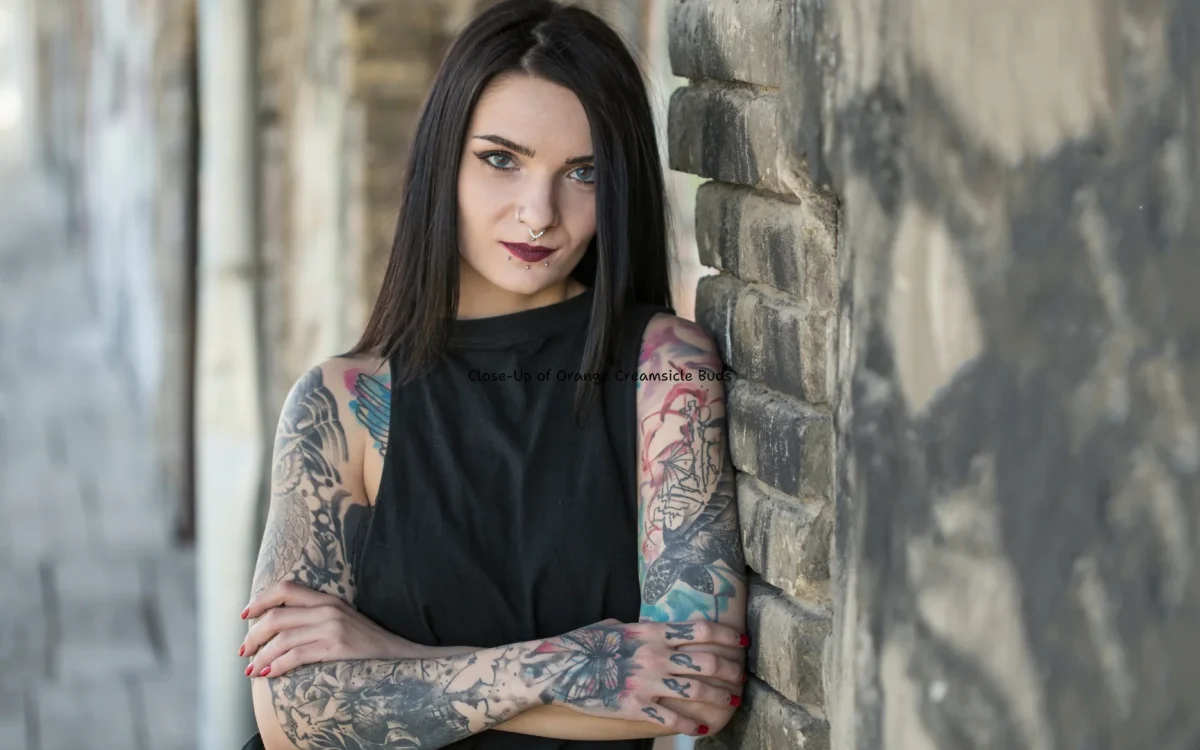
Turn your arm up to the mirror, slowly. There it is. That naked space you never noticed as the parts healed. Tattoo filler ideas are represented by tiny designs — stars, dots, smoke, vines, little traditional motifs, etc. These ideas are used to connect separate tattoos, to fill bare spaces and to add depth so a collection reads as one sleeve. Choosing the right filler idea depends on the size of the area to be filled, the surrounding design and how committed you want to be.
All the other pages on this topic are galleries: forty-odd motifs in a numbered row, presented as if they all cost the same. This one ranks the same motifs by what each actually costs you in chair time, money and pain. If you only have one small space to fill and a shop minimum to spend, this ranking is the only one that helps.
What is a filler tattoo, and what job is it actually doing?
Filler is connective tissue, not a standalone design. A site called tattoobuild.com explains that filler elements bridge separate tattoos within a sleeve, fill negative space, and add depth and texture so a collection reads as one cohesive piece. The job is predominantly compositional. Without it, an arm of good individual tattoos reads as a scrapbook rather than a sleeve.
It is important to acknowledge three different jobs, because they call for different motifs:
- Bridging two finished pieces that sit close together but do not talk to each other.
- Filling an isolated hole — one patch of skin surrounded by finished work.
- Laying a continuous background behind everything, which is a different project entirely.
Most people decide this late. You only see the gaps once the big pieces are healed and you look at the whole arm at once. The single planning advantage available to you: discuss the background with your artist before the sleeve is finished, so they can leave room for it rather than squeeze it in.
Which tattoo filler ideas are worth the time, money and pain?
Prioritize motifs by effort and the hardest decisions are made for you. In practice, nobody walks into a shop asking “what are my options” — they ask “what can I get done today, for the minimum, that I won’t regret.” That is an effort question, not an aesthetics question.
The effort ladder, from a ten-minute dot to a full shaded background
| Motif group | Gap size it suits | Chair time | Cost basis | Pain profile | Easy to extend later? |
|---|---|---|---|---|---|
| Dots, dot clusters, micro stars and sparkles, tiny moons, arrows, lightning bolts | Under about 3cm | Minutes each; several in one sitting | Shop minimum | Driven by placement, not size | Yes — fully open-ended |
| Small traditional motifs, fine-line geometric shapes, short vine and leaf runs, small florals | Awkward medium gaps | Part of a sitting to a full sitting | Minimum or short hourly | Longer exposure in one spot | Mostly — vines especially |
| Smoke, cloud and whip-shaded backgrounds, black-and-grey gradient fills, large mandalas | Wide gaps and whole-arm unification | Hours, often multiple sessions | Hourly, budgeted in sessions | Sustained; worst over thin skin | No — this fixes the composition |
If you only have one small gap, start here
Work from the top of that table. If you only have one small gap and are working with a tight budget, you should prioritize tier one, likely completed in a single visit. If instead you want the arm to look finished rather than filled, you are buying from the bottom row — and you’d have to price it by the hour, not by the motif.
What are the best filler tattoos for small gaps in a sleeve?
Under about 3cm, small and simple wins. According to tattoofillerideas.com, when the space is less than 3cm, the best fillers are tiny stars and sparkles, single dots or dot clusters, mini crosses or daggers, and micro symbols like arrows, moons and lightning bolts.
Stars, sparkles and celestial fillers
Stars are the most consistently requested filler motif for one unglamorous reason: they scale. A star can be 4mm or 4cm, it sits naturally in an irregular shape, and it does not fight whatever is next to it. They are also neutral and versatile with other design elements. Across almost every style, celestial motifs are the default.
Dots, dotwork and constellation clusters
For low commitment coverage, try dotwork or stipple shading. Dots, when grouped, can represent constellations. When following the natural shape of the space to be filled, dot clusters follow the shape of the gap rather than force a symmetrical design into an asymmetrical space.
Tiny traditional motifs
If the surrounding work is bold-line American traditional, match it. The old-school filler vocabulary is small daggers, skulls, lightning bolts, stars, dice, hearts, swallows, flames, crosses and webs. Small traditional fillers work best because they disappear into the arm; mismatched filler reads as an afterthought.
The limit to respect: micro symbols scattered across a wide gap look sparse, not finished. When a design requires six tiny stars to cover one area, that is a sign that you’ve outgrown this band.
How do you fill medium and large gaps without starting over?
Gaps wider than a few centimetres need mass, not more symbols. This is where background work takes over, and where the cost comes in.
Smoke, clouds and shaded backgrounds
Clouds, smoke and shaded backgrounds are probably the most compositionally effective answer for medium-to-large gaps. It flows around existing pieces, and smoke shading follows the curvature of the arm and is what gives a sleeve its unity and flow rather than reading as a set. Whip shading and black-and-grey gradient fades handle soft transitions; hard-outlined elements give punch. If done carelessly, mixing the two in different weights and densities is what gives a sleeve a “busy” look instead of a full one.
Florals, vines and botanicals
Botanical filler is the diplomatic option. Roses, cherry blossoms, peonies, olive branches, vines and leaves adapt to gaps of varying sizes and bridge two neighbouring tattoos that are otherwise stylistically discordant. Vines in particular earn their place on the commitment ladder — they can be placed to extend over years without collapsing the plan.
Geometric and fine-line filler
For structured, fine-line sleeves: mandalas, triangles, diamonds, hexagons, tiny grids, line bursts. One warning attached to the biggest of these — a large mandala planted mid-gap does not just fill space, it permanently anchors the composition.
Be sure to evaluate the trade-off before you commit. Large background work is probably the most expensive filler you can buy, and also the hardest to undo.
What filler works for a patchwork sleeve without ruining the patchwork look?
Here the gaps are the point. The patchwork rule inverts the sleeve rule: a continuous background erases the exact style you want to showcase. Keep the skin breathing. Fill in the negative space with small standalone motifs instead of connecting everything with shading.
When it comes to patchwork, choice of subject takes second place to choice of style — line weight, ink palette and style first, subject second. Filler drawn in a lighter or heavier weight than the surrounding lines reads as an afterthought, no matter how nice the design is. Repetition and echoes rather than background should tie a patchwork together: the same three or four small motifs echoed across the arm leave the negative space intact. The same logic applies to dense, high-visibility placements like hand tattoo designs, where leaving skin unoccupied is part of the design rather than a mistake.
Sometimes the answer is to add nothing. Bare skin between pieces of artwork is a good, completed look. A good test: if the arm already looks crowded rather than empty, adding filler will only make it worse.
What does filler cost, how much does it hurt, and what should you ask the artist?
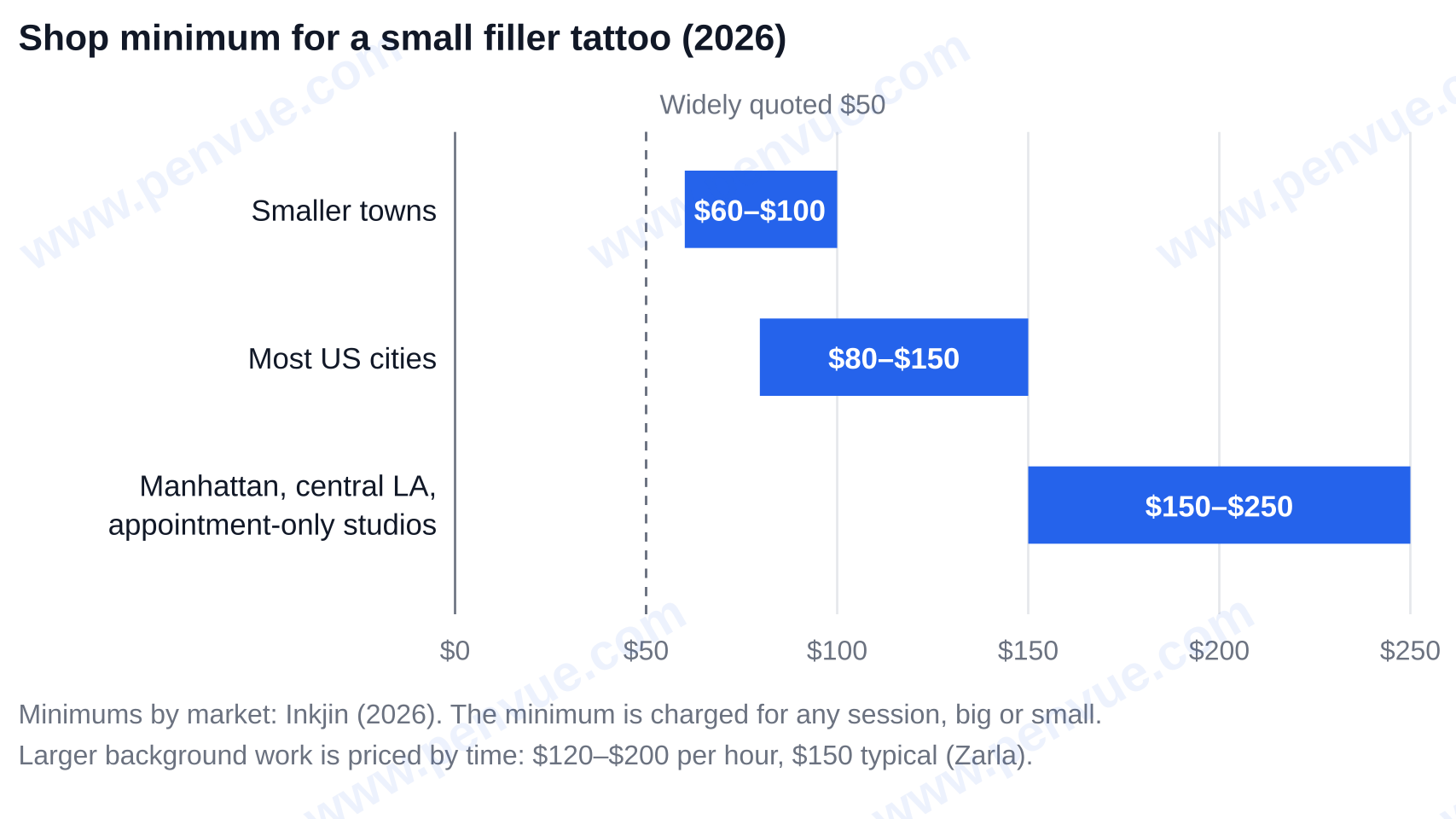
A shop minimum is charged for a small filler — this is not a quote based on how tiny it is. This is where the rest of the internet is out of date. The most visible ranking page still quotes $50 and up. As of 2026, Inkjin puts the shop minimum at $80–$150 in most US cities, $60–$100 in smaller towns and $150–$250 in Manhattan, central Los Angeles or appointment-only studios. The $50 figure is below the floor almost everywhere.
What a filler tattoo really costs in 2026
According to Zarla, US rates are $120–$200 per hour with $150 typical, and a shop minimum of $80–$200 across most markets — the floor is charged for any session, big or small, because it covers setup, materials and the artist’s time.
So the math is simple, and nobody assembles it for you. The minimum covers a whole session regardless of how little work you book. So save up every gap and have several micro-fillers done in one sitting. One star across three visits costs three minimums. The same three stars in one appointment costs one. Large background work is charged differently — it is priced by time, so budget it in sessions at the hourly rate.
Why your gap’s location decides the pain
Filler is said to hurt less because it is small. That reasoning becomes flawed exactly where sleeve gaps live. The placement of the tattoo is what dictates pain — thin skin, nerve density and lack of padding — as Healthline’s tattoo pain chart sets out, and inner-arm skin is specifically thinner and more sensitive than the outer arm. Leftover gaps cluster on the inner arm, around the elbow and near the armpit. A 20-minute inner-bicep filler can hurt more than an hour on the outer forearm. Order your gaps accordingly: do the tender ones first, while your tolerance is fresh.
Questions to ask before the needle touches healed ink
Filler carries one technical risk unique to it, and no gallery page mentions it: depth control. Tattooing directly against healed ink requires careful depth control, because if the needle goes too deep the ink lands in the subcutaneous fat layer and causes a blowout. So ask: how will you handle the edge where this meets the healed piece? That question alone tells you whether you are talking to someone experienced in background work or just the cheapest chair available.
Then brief them properly. Proper briefing includes bringing saved references, allowing the artist too freehand to the shape of your body rather than forcing a flat stencil onto a curved arm, and declaring out loud whether you want the sleeve kept editable or closed out. Scattered dots, stars, smoke outlines and vines stay extendable for years. A solid background fill or a large mandala turns the sleeve from editable to fixed — that is the real price of those options, and it is not stated on any quote.
The one pick for most people
The reader who has one tiny gap and one shop minimum to spend should get a dot cluster or a small star. It takes only a couple of minutes in the chair, it is priced at the minimum, and it keeps every future option available.
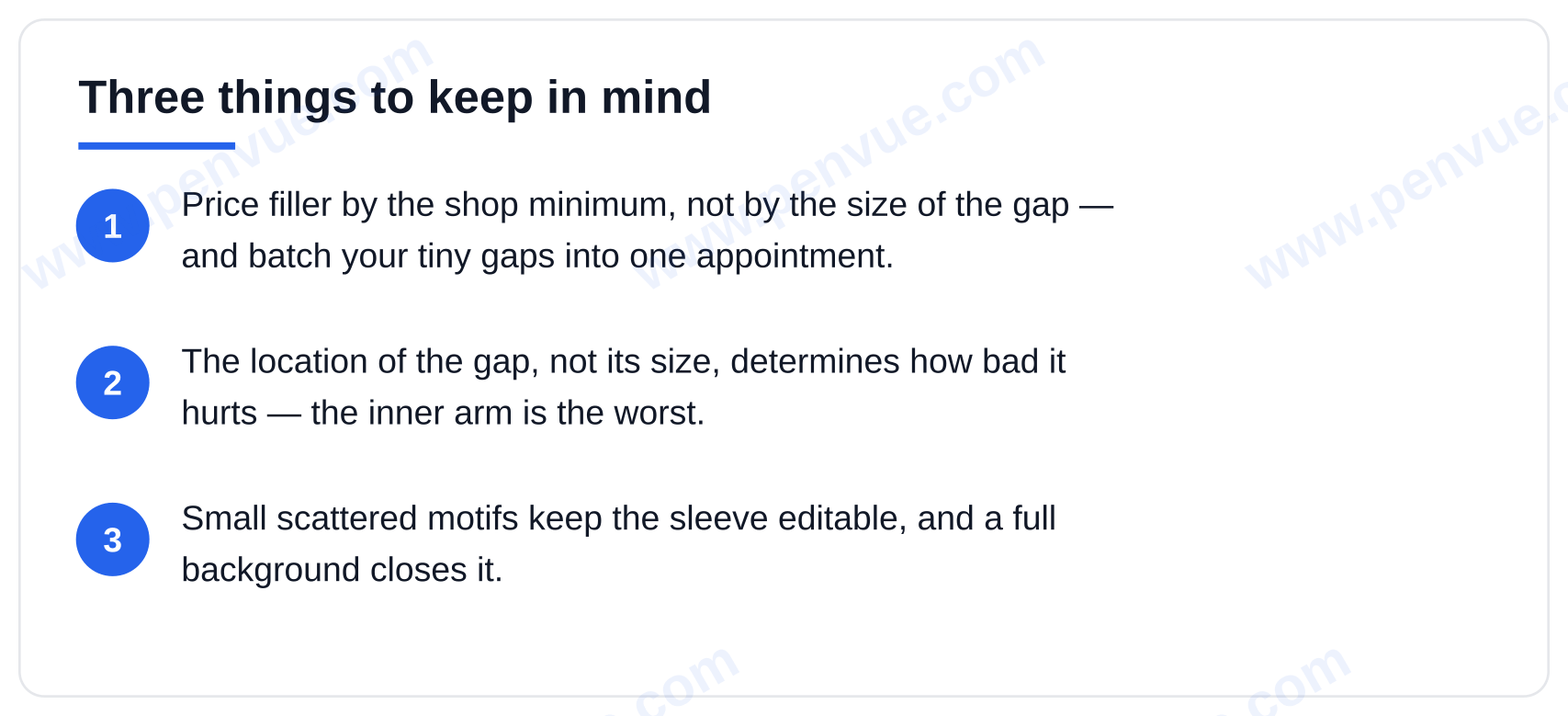
Three things to keep in mind. One: price filler by the shop minimum, not by the size of the gap, and batch your tiny gaps into one appointment. Two: the location of the gap, not its size, determines how bad it hurts — the inner arm is the worst. Three: small scattered motifs keep the sleeve editable, and a full background closes it. Take a photo of your arm, fully exposed, to show every remaining gap and roughly how big it is, and take that one picture to a consultation with an artist who does background work.
Common Questions
Can you add filler or background to a tattoo that has already healed?
Yes — filler is usually added to healed work, because that’s when the gaps become apparent, once everything has settled. The technical catch is the boundary: tattooing directly against healed ink needs careful depth control, since ink placed too deep reaches the subcutaneous fat and causes a blowout. Ask the artist about edge control before you book.
What filler tattoo is easiest to add to later or least likely to be regretted?
Vines, smoke outlines, and scattered dots and stars. They can all easily be added to over time without collapsing the overall plan, so the arm stays open to whatever you add next. The terminal choices are solid background fills and a large mandala planted in the middle of a gap — both fix the composition in place and turn the sleeve from editable to fixed.
Do you have to fill the gaps in a tattoo sleeve, or can you leave negative space?
Negative space can definitely be left. Leaving bare skin between tattoos is a finished look, not an unfinished one, and on a patchwork sleeve the gaps are the whole point of the style. Use this test: if the arm looks crowded rather than empty, adding filler will make it worse, not better.
How long does it take to fill the gaps in a full sleeve?
It depends entirely on which tier you are buying. Small gaps of under 3cm — dots, micro stars, tiny symbols — take just a few minutes each, and multiple can be done in the same sitting. On the other hand, a continuous smoke or black-and-grey background behind a whole sleeve is hours of chair time, usually spread across multiple sessions, and should be charged at the hourly rate rather than by the design.
Can a different artist add filler around someone else’s work?
Yes, and it happens all the time. The biggest concern should be matching line weight, shading style and ink palette to the existing pieces — filler in a different weight is noticeable and reads as an afterthought regardless of how well it is drawn. Choose someone experienced specifically in background and gap work, and show them the whole arm rather than just the one gap.
Does filler need to match the colour of the surrounding tattoos?
Matching the exact colours isn’t necessary, but it needs to match the overall palette and style. Black-and-grey filler such as whip shading, smoke and dotwork goes well with just about anything, which is part of why it is the default. Colour filler should follow the existing scheme — if the surrounding pieces are bold-line American traditional, match that vocabulary and saturation rather than introducing a new one.