
This guide covers the entire onion growing season. It includes information on day length classes, seed vs. sets vs. transplants, planting depth and spacing, feeding, failure diagnosis and onion bulb curing. Here is the short version. For the best results, grow the day length class onion that corresponds with your latitude. In the Southern states, this would be short day onions, and in the Northern states, long day onions. Plant the sets 1 inch deep, 4–6 inches apart in full sun, 2–4 weeks before your average last frost. Onion plants require about an inch of water a week and a regular supply of nitrogen while the leaves are still forming. Cure the bulbs before storing for the winter.
Start with one number, because it explains nearly everything else: each onion leaf becomes one ring of the finished bulb. Dixondale Farms, a long-running onion plant grower, puts it in counts — about 13 leaves produces the largest onions, about 9 produces a medium one, and the 9th leaf is the biggest leaf of all, the point where the plant’s demand for nitrogen peaks. That single fact reframes the job. You are not growing a bulb. You are growing leaves, and the bulb is whatever those leaves can pay for when day length flips the switch.
Which onion type actually bulbs where you live?
Onions (Allium cepa) are members of the allium (or onion) family that are photoperiodic. Bulbing on onions is not decided by how well you take care of the plant, by plant size, or by soil quality — it is triggered by day length. Onions, like any other crop, have different classifications, and it is decided at the point of purchase based on the classification printed on the seed packet.
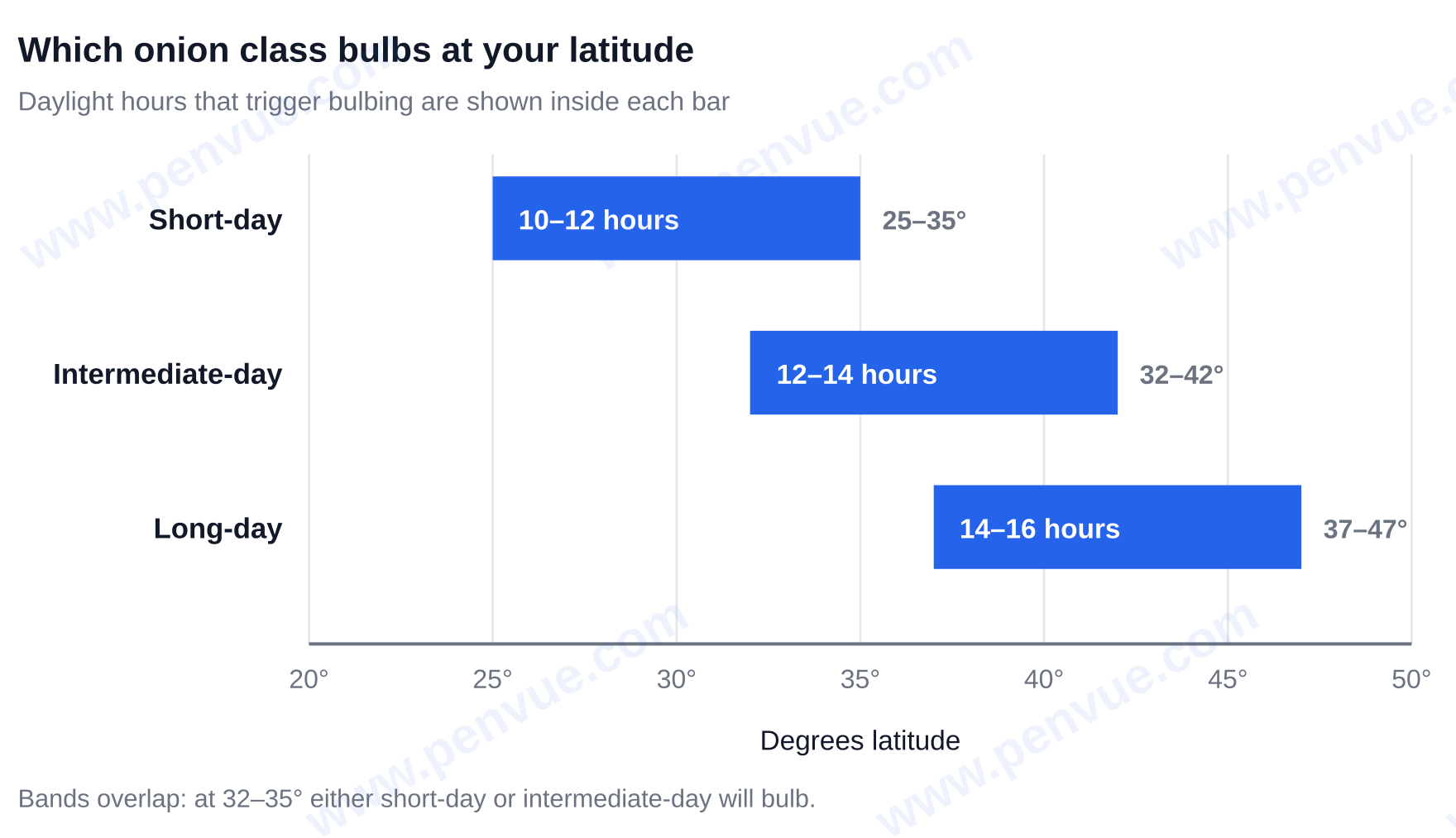
Day-length class by latitude: short-day, intermediate-day, long-day
There are thresholds that define the three classes, and Harvest to Table provides the corresponding latitudes that are in alignment with Oregon State University’s sustainable onion production guide to onion types and varieties, which uses the same three-class system. Once you put the various latitudes, onion classes, and varieties, in one place, the decision becomes a purchase decision as compared to continued searching.
| Class | Bulbing starts at | Suits roughly | Varieties worth buying |
|---|---|---|---|
| Short-day | 10–12 hours of daylight | 25–35° latitude | Texas 1015Y, Yellow Granex (sold as Vidalia), Red Burgundy, White Bermuda |
| Intermediate-day | 12–14 hours | 32–42° latitude | Candy, Superstar, Utah Sweet Yellow Spanish |
| Long-day | 14–16 hours | 37–47° latitude | Walla Walla, Copra, Ailsa Craig |
The long and short of it, a short day variety planted in the North will result in the bulb forming while the plant is still very small, and you harvest a golf ball. A long day variety planted in the South will result in a long, lush green plant that will never form a bulb, because the day length there never reaches 14 hours to trigger it. Both cases are a purchase decision as neither is a care problem.
Where sweet onions, scallions and shallots fit
Scallions and green onions can be any class because you pull them before they’re able to bulb. Shallots and multiplier (potato) onions are different. They are grown as dividing clumps, not single bulbs. Sweet is not just a tag on an onion. Soil chemistry has a vote. We’ll come back to this for troubleshooting.
Seed, sets or transplants — which route should you choose?
There are three ways to go, and three honest trade-offs. Seed is the cheapest and most variety, but it adds 8–10 weeks of indoor time before you plant anything. Sets are the easiest and fastest, and they bolt far more readily than seed-grown plants. Transplants are the sweet spot for big bulbs — they arrive with a head start on leaves.
How long each route takes
The Utah State University Extension’s guide on growing onions in the garden, mentions that bulb onions take 100–120 days to mature. Seeds take about 2–3 weeks to emerge, and transplants take about 8 weeks of growing to be ready to go out. For onions grown for green onions, the guide mentions you can harvest them at about 50 days after seeding.
Buying sets: the diameter number that prevents bolting
Here is the spec most guides leave out, and it is the one thing you control at the garden centre. The diameter number is the number you should be looking for when deciding what size sets to buy. Sets under about ¾ inch in diameter — ideally under ½ inch — are the sets that should be bought. Sets that are larger than this have usually sat in cold storage long enough to be partly vernalized, which means they are already committed to flowering and are likely to bolt rather than bulb if planted in the ground.
If big sets have already been bought, there is a grower-side fix: the vernalization process can be reversed by holding them above about 80°F for two to three weeks before planting.
What a good transplant looks like
Dixondale Farms states that a good transplant is slightly slimmer than a pencil, and no thicker. If a transplant is large and lush, it means it has been held too long and will sulk or most likely bolt. Slim and firm beats big and lush.
One last thing to cover, because it prevents disappointment at harvest. A standard bulb onion will give you one and only one onion per set, per seed, per transplant. Every time. Shallots and multiplier onions are the only varieties that will give you a cluster.
The three decisions that lock in your bulb size before the plants are three weeks old
Most plant guides tell you what you need to do. Very few tell you that before your plants even look like anything, you have made three irreversible decisions that will set your ceiling.
Decision one: class for your latitude. This isn’t something you can correct with more watering, feeding or patience. The action is in the calendar and the position of the sun relative to the earth, not with the plant.
Decision two: set size. Vernalization makes a set partly pointed at flowering. The plant puts its energy into a seed stalk, leaving you a small, soft, poorly keeping bulb with a woody core running through it.
Decision three: planting date. This is where the leaf to ring mechanism comes into play. Each leaf becomes one ring, so the number and size of the leaves standing when bulbing starts determines the maximum possible size of the bulb. Thirteen leaves for the largest onions; nine for a medium one.
Why extra feeding in June can’t fix a late start
Bulb initiation fires on a fixed day-length schedule, regardless of whether the plant is ready. This means fertilizer and water applied in June only grow leaves the plant no longer has time to convert into rings. The leaves are converted to rings on the sun’s schedule, not the plant’s; late leaves arrive after the deadline.
This means there are a few changes to how you garden. The first is to plant as early as the soil allows. The second is to focus the nitrogen feeding in the leaf-building window rather than spreading it evenly across the season. The last change is to treat spacing as a leaf-size decision, not a tidiness one — crowded onions shade each other’s leaves, and small leaves mean small rings. The University of New Hampshire Extension’s answer to how to get onions to grow bigger lands in the same place from the extension side.
How to grow onions step by step, from soil prep to planting
Here is what to do once you’ve made the 3 major decisions. Here is a breakdown of how to grow onions from bare soil to the week before harvest.
Soil, sun and pH
Onions grow best in full sun, 6–8 hours of direct light minimum. A fertile soil rich in organic matter with good drainage is essential. A pH of 6.0 to 6.8 is perfect. Work some compost in the soil before planting, but not too much. Utah State Extension says no more than about 1 inch of well-composted material per 100 square feet.
When to plant: sets, seed and the fall option
Sets go in 2–4 weeks before your average last spring frost. Seed starts indoors 8–10 weeks before that date. Short day onions can go in the ground in fall in mild-winter regions for an early-summer harvest.
Depth and spacing, and what spacing really controls
- Seed: ¼–½ inch deep.
- Sets: about 1 inch deep, pointed end up. Planting sets too deep can prevent them from bulbing — a quiet, common cause of failure.
- Full-size bulbs: 4–6 inches apart, in rows 12–18 inches apart.
- Scallions: down to about 2 inches apart — you are harvesting leaves, not rings.
Water, nitrogen and shallow-root weeding
Give roughly 1 inch of water a week, and water whenever the top inch of soil is dry. Onions are shallow-rooted and cannot tolerate a dry spell the way a tomato can.
Side dress with nitrogen during leaf growth. The Utah State Extension Service recommends using about ½ lb of 21-0-0 per 100 square feet in mid-May and again in late June, and then stopping fertilization as bulbing begins, so the plant stops making leaves and starts filling rings.
Weed shallowly and by hand. Onions lose to weeds more than almost any other vegetable, because they have no canopy to shade weeds out. Hoeing too deep tears the roots you need. Sulfate-based fertilizers such as ammonium sulfate should be avoided for sweet onions, and apply no fertilizer at all within 30 days of harvest.
Why aren’t my onions bulbing — and what else goes wrong?
Onions that never bulbed
Work through it as a diagnosis, in rough order of likelihood: wrong day-length class for your latitude; sets planted too deep; planted too late, cutting the window for leaf growth; overcrowding; too much nitrogen pushing leaves at the bulb’s expense; or inconsistent water. If none of those apply and the onions were simply small, the answer is the leaf-count ceiling — look back at the three locked-in decisions for the reason.
Onions that bolted
If a flower stalk is present, the plant is trying to produce seeds and reproducing, which is usually the result of an unexpected cool snap, sometimes heat and drought stress — and far more often from sets than from seed-grown plants. A bolted onion will not store, but it is edible. Pull and use within a few days. Cut around the woody central stalk.
As we speak, do not cut or bend over growing onions in an attempt to force bulbing. Every leaf you remove is a ring you give up, and bending tops early damages the plant without hastening maturity.
Thrips, maggots, white rot and neck rot
Onion thrips are a serious pest — they rasp silvery streaks into the leaves and can lead to serious damage. Onion maggots lay their eggs at the soil line and once hatched, the larvae tunnel into the bulb to feed. White rot is a fungal infection that can remain in the soil for years. For a healthy crop, allium rotation is a must — the University of Wisconsin Extension’s bulletin on growing onions, garlic, leeks and other alliums covers northern culture and rotation in detail. Botrytis (Gray Mold) neck rot gets in through green neck tissue cut at harvest. That is a curing problem, and we will handle it in the next section.
The sweet variety that tastes sharp
Pungency increases with the presence of sulfur in the soil. That’s why Vidalia’s fame rests with the Granex onion genetics as well as the naturally low-sulfur sandy soils of the Coastal Plain of southern Georgia. Growing a certified sweet cultivar in a sulfur-rich soil, or feeding it ammonium sulfate, can still result in a sharp onion. This is not folklore, either — University of Georgia Extension researchers are actively studying how soil variability drives pungency, with the aim of developing soil-specific management practices. Any recommendation that treats “sweetness” of onions as purely a variety attribute is behind the science. The same is true with historical, social, and regional issues with people. Precise language is important in gardening and in the labels we give people.
When and how do you harvest, cure and store onions?
The harvest signal for eating now vs storing all winter
The duration for bulbing onions is between 100 to 120 days. Green onions are pulled at the 50 day mark as scallions. Most references state that the signal to harvest is when the tops have yellowed and fallen over, and the skin has become papery. For keepers there is a sharper one: UMass Extension’s fact sheet on harvesting and curing onions recommends pulling storage onions while roughly 30–40% of the tops are still erect.
The key is to weigh the trade-off, stated honestly. Waiting until every top is down and dry adds 30–40% more yield, but shortens storage time. Eat-soon onions and keep-all-winter onions come off the bed at different moments. The important thing to remember either way is to stop watering as the tops begin to yellow and the necks soften, so the bulbs dry down instead of continuing to drink.
Curing: temperature, humidity, time and the weight-loss check
Forget “dry them for a week or two” — focus on real numbers. UMass says 2 to 4 weeks at temperatures between 75–90°F, with relative humidity around 80%, and good airflow. Then, make sure that temps stay below 85°F undercover, because temperatures in the 90s will cause sunscald. The Iowa State University Extension and Outreach consumer-scale answer to how to harvest, dry and store onions puts it at 2–3 weeks, until the tops and necks are thoroughly dry and the outer scales rustle when handled.
The check to see if they have cured: weigh them. They should lose about 3–5% of their weight. Leave the tops on during curing. To cut the tops, slice dry neck tissue only. Slicing through green neck tissue provides an entry point for Botrytis gray mold neck rot.
Storage temperature, containers and how long each type keeps
There is some conflict here worth naming. The Old Farmer’s Almanac says 40–60°F, but UMass and Utah State Extension say to store at 32°F with 65–70% relative humidity. Follow the extension figure — bulbs stored above 40°F break dormancy and sprout.
Use a ventilated container: a mesh bag, wire basket, or crate in a cold storage area like a cellar, basement or garage. Or use an old nylon stocking for smaller amounts. Expectations should be set based on type. Hard yellow storage onions, like Copra, will store longest. Varieties like Walla Walla and Granex should be eaten first, since they are a matter of weeks, not months.
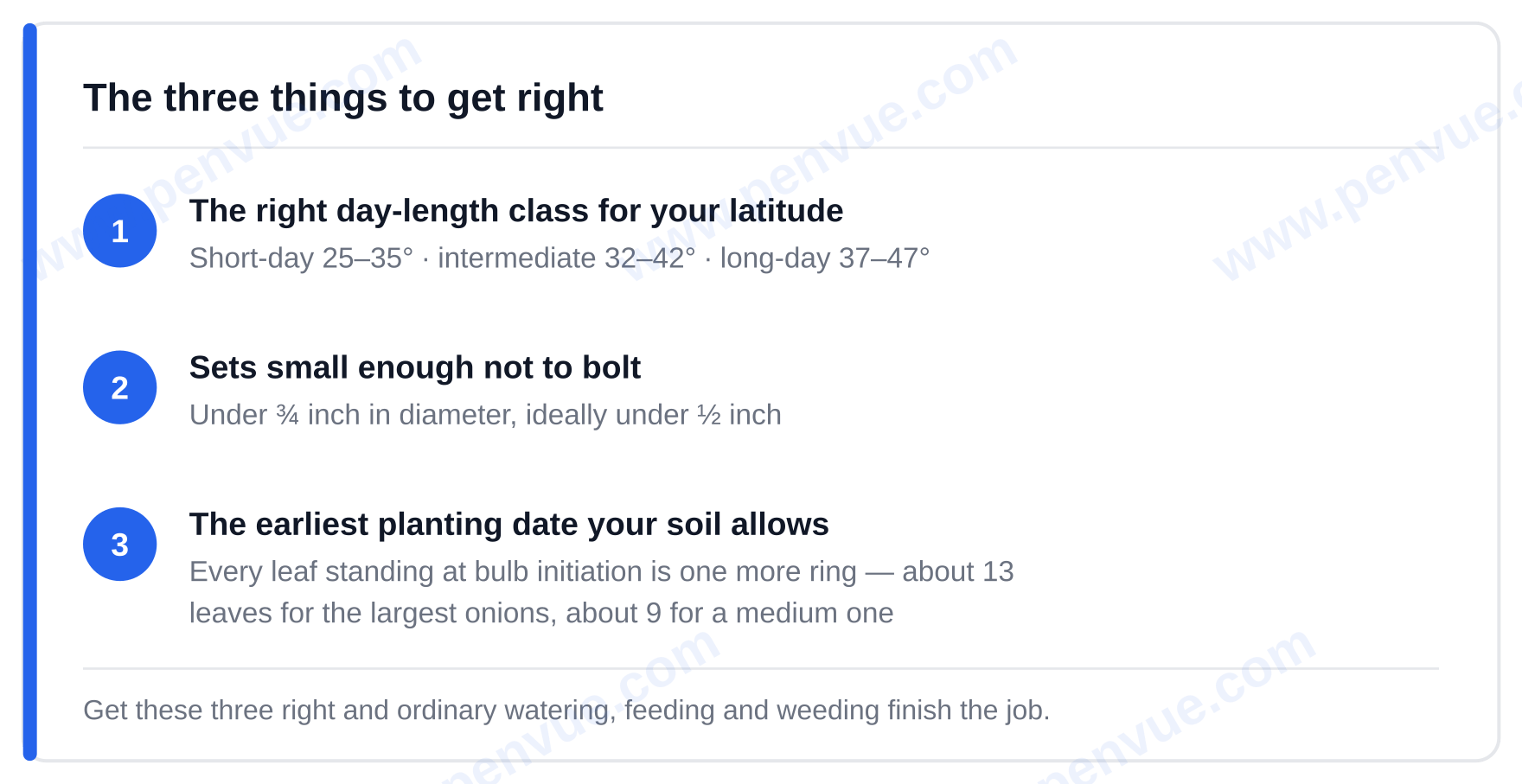
The three things to get right
Caring for onions during the season generally isn’t as important as the three main decisions in the beginning.
- The right day-length class for your latitude — short-day at 25–35°, intermediate at 32–42°, long-day at 37–47°.
- Sets small enough not to bolt — under ¾ inch, ideally under ½ inch.
- The earliest planting date your soil allows — because every leaf standing at bulb initiation is one more ring.
Get the three right and ordinary watering, feeding and weeding will finish the job. Pay attention to the general care tips through the season, but don’t expect miracles in June if you messed up the big three at the start. Based on your latitude decide what class of onion you want to grow, find the matching class from the table above, and order small sets or seed now. This should allow you to plant 2–4 weeks before your average last frost date.
Frequently Asked Questions
Is it better to grow onions from seed or from sets?
Onion sets are easy and fast, but you can’t get the variety you want with sets. Seed is cheaper and gives you a longer range, but the downside is you have to grow the seed indoors for 8–10 weeks prior to planting out. Sets are easier, and they bolt far more readily than seed-grown plants. Transplants take the middle ground and are the way to go if you want bigger bulbs — they arrive with a head start on leaves, and leaves are what become rings. Utah State Extension puts bulb onions at 100 to 120 days to maturity, so count back from your frost date to help figure out the best time to plant.
How many onions grow from one bulb or one set?
Exactly one. A standard bulb onion produces one onion from each set, transplant, or seed — there is no multiplication underground. Shallots are the exception, as are multiplier (potato) onions, which do divide and produce a cluster below the soil from a single planted bulb. You’re not likely to get a bumper crop from onion sets. Plant 100 sets and you get 100 onions at most, and fewer if some bolted.
Should I cut or bend the tops of my onions while they’re growing?
Neither. Each onion leaf becomes a ring of the finished onion bulb, so cutting a leaf means cutting a ring from the onion. Bending the tops early doesn’t help and can damage the plant without hastening maturity — it does not force bulbing, because bulbing is triggered by day length, not by the state of the foliage. Leave the tops alone until the plant yellows and falls over on its own schedule.
When should I stop watering onions before harvest?
Stop as the tops start turning yellow and the necks begin to soften. At this point the onions are done and you want the bulb to dry down rather than keep drinking. Continuing to water pushes moisture into necks and scales that need to be dry, which makes curing slower and rot more likely. If you’re growing a sweet onion, also apply no fertilizer within 30 days of harvest.
Can I eat an onion that has bolted?
Yes, an onion that flowers is completely edible — it just will not store. The flower stalk means the onion plant has switched to reproducing, usually after an unexpected cold spell or heat and drought stress, and the bulb that results is small, soft and built around a woody central stalk. Pull the onion, cut around that core, and use it within a few days rather than putting it in with your keepers.