

For most, the definition of errands is the following: an errand is a short trip to complete a minor task. This can be picking up a prescription or delivering a package or stopping by the bank. Errands are countable and usually refer to several trips. You run errands, and an errand almost always means leaving the house.
Let’s test this with an example. Say you drive to the pharmacy to pick up your prescription and then come back home. That was an errand. Now, let’s say you stay at home and do the dishes, that was not an errand, and was a chore. The difference here is travel.
What does “errands” mean?
Errands are short trips to complete minor, often small tasks. In real speech, the plural form errands are used because people rarely do only one errand. Usually, people do several errands in a single, long trip.
The hinge most dictionaries hide is the travel. The framing Wikipedia uses for errands is one of the clearest tests: “a task of no great consequence, typically concerning household or business affairs, which requires the person undertaking it to travel to a place where it can be accomplished.” If travel is not required, it’s not an errand.
American English has a more complicated version of “errand” on Dictionary.com. The first sense is “a short and quick trip to accomplish a specific purpose” — the trip itself. The second sense is the purpose of that trip. Lastly, the third sense is “a special mission or function entrusted to a messenger.” This sense is the ghost of the word’s past, and we will cover this later.
Is “errand” singular or plural?
It is really both. Errand is a countable noun and so a singular errand or a plurality of errands is acceptable: one errand, three errands, a dozen errands. People mainly prefer the plural form. People say “I have errands to run” and “I have an errand” just sounds stuffy.
How do you pronounce “errand”?
Most say it as two syllables with the first being stressed and the second reduced to a schwa. Wiktionary records it as /ˈɛɹənd/ in standard British, General American and Canadian English. People of the southern hemisphere — Australian and New Zealand English — say it is /ˈeɹənd/, and the only difference is the vowel of the first syllable is tighter.
What does it mean to run errands?
The main verb phrases are “run an errand” or “run errands” in that order. As Dictionary.com points out, the word appears especially in that exact phrase in its British English entry. You run errands, you don’t make or take errands.
The dictionaries often dodge this question. “Run errands” and “do errands” are idiomatic in American English. They mean the same thing. However, “run errands” is more common and, therefore, is a safer default when learning the phrase. Most people understand “do errands,” but it does sound less native.
Additionally, there are older definitions that often lead people astray. Because the definitions include “for someone else” and “entrusted to a messenger,” people often think that an errand has to be done for someone else. It doesn’t. Often, when an errand is done, it’s done for the person who is doing the errand, and most errands people run today are their own. These definitions describe the history of the word, but not the modern day use.
“Run errands” vs “do errands”: which is correct?
Both are idiomatic, and, generally, you should use “run errands.”
How to use “errand” in a sentence
There are some preposition patterns that you should learn, as the definition isn’t that hard.
- “I have a few errands to run before lunch.”
- “She’s out on an errand. Back in twenty.”
- “He sent me on an errand to the hardware store.”
- “Could you run an errand for me on your way home?”
- “Saturday morning is when I do all my errands.”
You’ll also learn the slightly outdated “make an errand” which means to go someplace for a made up reason.
What counts as an errand?
The familiar list: grocery shopping, bank runs, pharmacy pick-ups, post office runs, dry cleaning, store returns, DMV visits, donation drop-offs, hardware store runs, car washes. All small, outbound and, by definition, finishable.
What makes something an errand? There are three key aspects. For one, it takes you out of the house. Two, an errand has a clear ‘finish’ line — you know the moment it’s done. And three, they mostly occur within the boundaries of other people’s hours, so they tend to clump into a single Saturday-morning loop instead of spreading out across the week.
Against its near neighbours: an assignment is something given to you to complete. A task is of any size, and an errand is specifically a short outbound trip for a small purpose.
Errand vs chore: what’s the difference?
A chore is anything done to help around the house — dishes, laundry, mowing the lawn. An errand requires going out. The clearest illustration is one activity split two ways: washing the car at home? A chore. Taking the car through a car wash? An errand. Same car, same dirt, different category, because one of them involves travel.
How much time do people actually spend running errands?
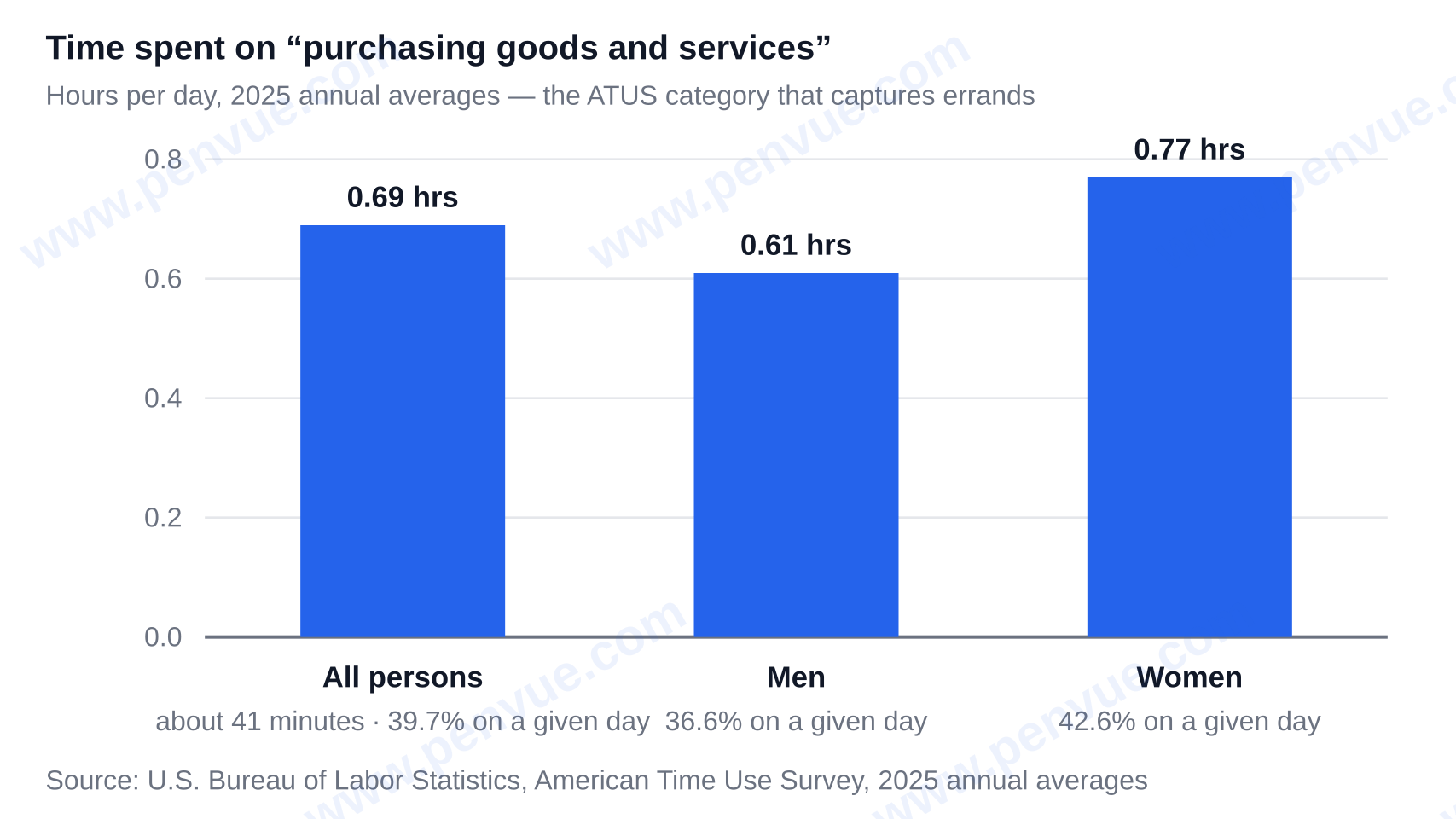
No dictionary page gives a number for this, but the government does. The U.S. Bureau of Labor Statistics’ American Time Use Survey (2025 annual averages) states that on average, Americans spent 0.69 hours a day, or about 41 minutes, “purchasing goods and services,” the ATUS category that captures errand-type activity. On a given day, 39.7% of the civilian population engaged in this activity. The average for men was 0.61 hours, 36.6% participation, women 0.77 hours, 42.6% participation. The average for consumer goods purchases was 0.30 hours a day.
Where does the word “errand” come from?
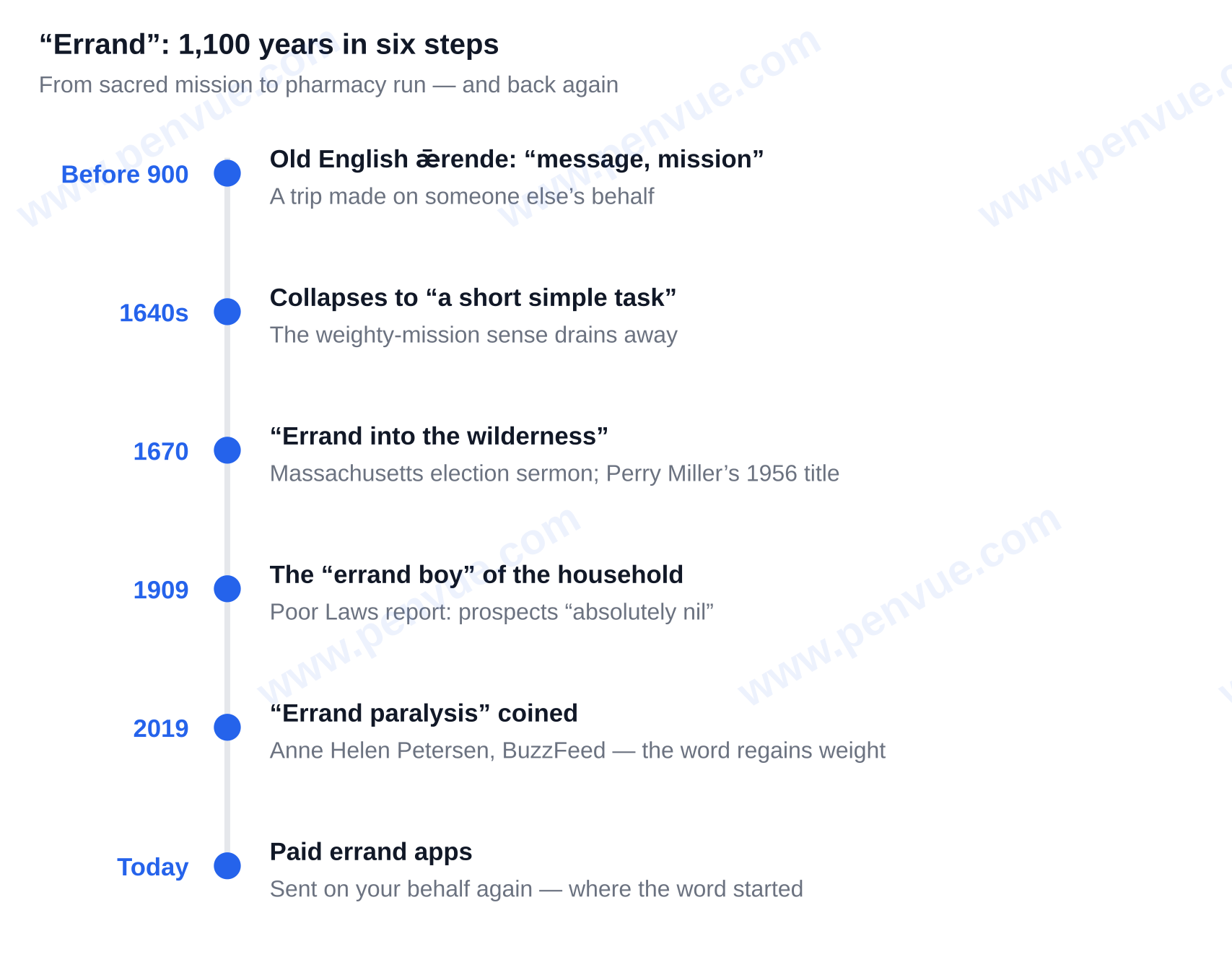
The line runs clean and long. “Errand” is derived from Middle English erande or erende, from the Old English ǣrende, which means “message, mission,” from Proto-West Germanic *ārundī. Dictionary.com dates it to first recorded use before 900 — which makes this an unbroken English word roughly 1,100 years old.
The Germanic cognates confirm the root: Old Norse eyrindi, Danish ærinde, Swedish ärende, Old High German āruntī. It is also related to Old English ār (“messenger”) and Gothic airus. Every one of them alludes to message-carrying, not shopping.
What did “errand” originally mean?
An errand initially was a mission or a quest. An errand also meant delivering an oral message entrusted to a person. Both of these meanings are now archaic or literary. In the fifteenth century work of Malory (Le Morte d’Arthur) King Arthur is seen asking his knights about their errands, and he’s asking them about their quests.
The semantic hinge is datable: by the 1640s the word had collapsed from “weighty mission” to “a short simple task.” A 1871 dictionary, which is cited by Wikipedia, catches the two senses sitting side by side, conceding that “an errand may be not of this kind, as an errand to buy something at the market.” In this case, the lexicographer admits that the sense of “errand” referring to a task to go and buy something had won.
What does “errand boy” mean?
“Errand boy” or “errand girl” refers to a person employed by a wealthy household to do the running. It is not a means to an end, as a 1909 report on the English Poor Laws judged the prospects of such a position “absolutely nil” for advancement or for acquiring a skill. The word has a labour history behind it, and therefore its faintly menial connotation is not an accident.
How one word went from sacred mission to pharmacy run — and back again
There is something page ranking for this keyword fails to address. The results either define the term “errand” or explain “running errands”. No result provides a description of the entire journey the term has taken: Old English sacred mission, 1640s trivial task, 2019 “errand paralysis,” paid errand apps. It is the description of this journey that provides more insight into how people perceive the term today compared to a definition.
The collision of the two senses produced one famous book. Perry Miller’s Errand into the Wilderness (1956) takes its title from a Massachusetts election sermon of 1670, and the whole argument turns on the word’s double meaning — an errand as “a task done by an inferior for a superior,” versus the errand as the task alone, the very action itself. The Puritans crossed the Atlantic on an errand in the older, literal sense. They were on a mission, and the word “errand” was still large enough to carry it.
Why did the demotion happen? Read plainly, the word was always about being sent somewhere on someone’s behalf. What changed was the. The word “errand” became smaller when the senders were no longer the kings and congregations but shopkeepers and households. The grandeur drained out, but the structure of the errand — Go there, do the one thing, come back — stayed perfectly intact. That is the same shape whether you are carrying a message to a monarch or collecting dry cleaning.
“Errand paralysis”: the word’s newest sense
In January 2019, Anne Helen Petersen coined the phrase “errand paralysis” in the BuzzFeed essay “How Millennials Became the Burnout Generation.” It describes the inability to finish simple tasks whose “primary beneficiary is me, but not in a way that would actually drastically improve my life” — mailing a letter, going to the dry cleaner. The reason the phrase ‘errand paralysis’ became famous is because it named a feeling that was universally understood.
Symmetry is striking. After four centuries of being the lightest word in English for a thing you have to do, “errand” reclaimed its weight — psychologically rather than spiritually. A trip to the post office is trivial on paper, but in people’s minds it can be heavy. That gap is the totality of the phrase.
From errand boy to errand app
The commercial re-inflation completes the circle. Now, gig-economy services run errands for a fee, typically covering donation drop-offs, returns and shopping, and other random pick-up and drop-off services including runs to the pharmacy and food pick-ups. The errand boy of the 1900s household is back, this time in the form of an app, and once again the errand is something you send someone to do on your behalf, which is where the word started.
Also, consider how differently this is handled elsewhere. Old Enough!, the Japanese series which documents children roughly one to six years old running errands on their own, is a good example — it reflects a cultural emphasis on building independence early. The same small outbound trip reads as a milestone in one place and a chore to outsource in another.
What is a fool’s errand — and the other idioms built on the word?
A fool’s errand is a trip or effort made for nothing — chasing after something that doesn’t exist or can’t be had. Dictionary.com and Wiktionary offer bare cross-references, which is a disservice, as the living version is far more specific than the definition suggests.
It survives as a workplace hazing prank: send the new guy to find nonexistent items and see how long they look. The catalogue is remarkably consistent by trade: blinker fluid or a lot stretcher in automotive, a board stretcher, left-handed screwdriver or glass hammer in construction, a bacon stretcher or dough repair kit in food service, a gallon of prop wash or an ID-10-T form in the military, and a bucket of steam or a long weight in the general trades.
The gag has legs, too. Czech apprentices are sent for a replacement “bubble” for a spirit level. Dutch workers are sent for square-hole drills. One item, however, escaped the gag entirely: polka-dot paint became real during the 1950s via polychromatic paint, so the fake errand turned into a product.
The wider family of derived terms includes errand boy and errand girl, idiot’s errand, lost errand, “make an errand,” and the obsolete term sleeveless errand — a pointless or futile mission, where “sleeveless” meant “without result.”
Synonyms for “errand” and what each one implies
Each near-synonym sits at a different point on the same scale. A chore happens at home. A task can be of any size. An assignment is given to you. A mission is large and purposeful. A commission is formally entrusted. A job is paid, or just generic. An errand is the smallest and most specific of the set: short, outbound, one purpose. If you like the idea of compressing a large body of history into a small space, look into how karma came to mean what it means now.
The rule of thumb worth keeping
An errand is a short, outbound trip that has one small task — the pharmacy, the post office, the bank — and the term has been in use in English for over 1,100 years. It’s been demoted along the way from a sacred mission to a Saturday-morning loop, then quietly re-weighted by burnout culture and the apps that will now run them for you.
So if you want one line to remember about the errands meaning, the oldest sense is worth keeping, because it still applies today: if you have to go somewhere to finish it, it’s an errand — go there, do the one thing, come back.