
Most assume that a hand tattoo is a single design. This is not the case. There are hand tattoo ideas for men split across four zones: the back of the hand, the knuckles, fingers and palm. Each zone has a different pain level, how quickly it fades and the price. Blackwork suits the knuckles and fingers best, while line work and realism are better on the back of the hand.
This list is not in order of style, but of how well it is kept up. Each design is listed by the zone it is actually kept on with that zone’s pain, how long it takes to heal, how long until it needs touching up and the price stated first. Once you can afford to maintain the zone, pick a design.
Which Hand Zone Should You Tattoo? Pain, Healing, Touch-Ups and Cost Compared
Pick the zone first. The hand is really four different canvasses. Each requires a different financial commitment and has a different maintenance burden. This is why two men who say “I have a hand tattoo” describe completely different experiences.
Hand Tattoo Zones at a Glance: Pain, Fade Rate and Price
| Zone | Pain | Surface heal | Realistic touch-up interval | Typical price |
|---|---|---|---|---|
| Back of hand | 4-6/10 | 14–21 days | 3-7 years | $150-$300 small to medium |
| Knuckles | 6-8/10 | 14–21 days | 2-4 years | $100-$250 single knuckle; $200-$500+ across four |
| Fingers | 6-8/10 | 14–21 days | First visible fade at 6-12 months | $100-$250 |
| Palm | 8-9/10 | Slowest and patchiest of the four | Re-lining is ongoing | Budget it as a recurring job, not a one-off |
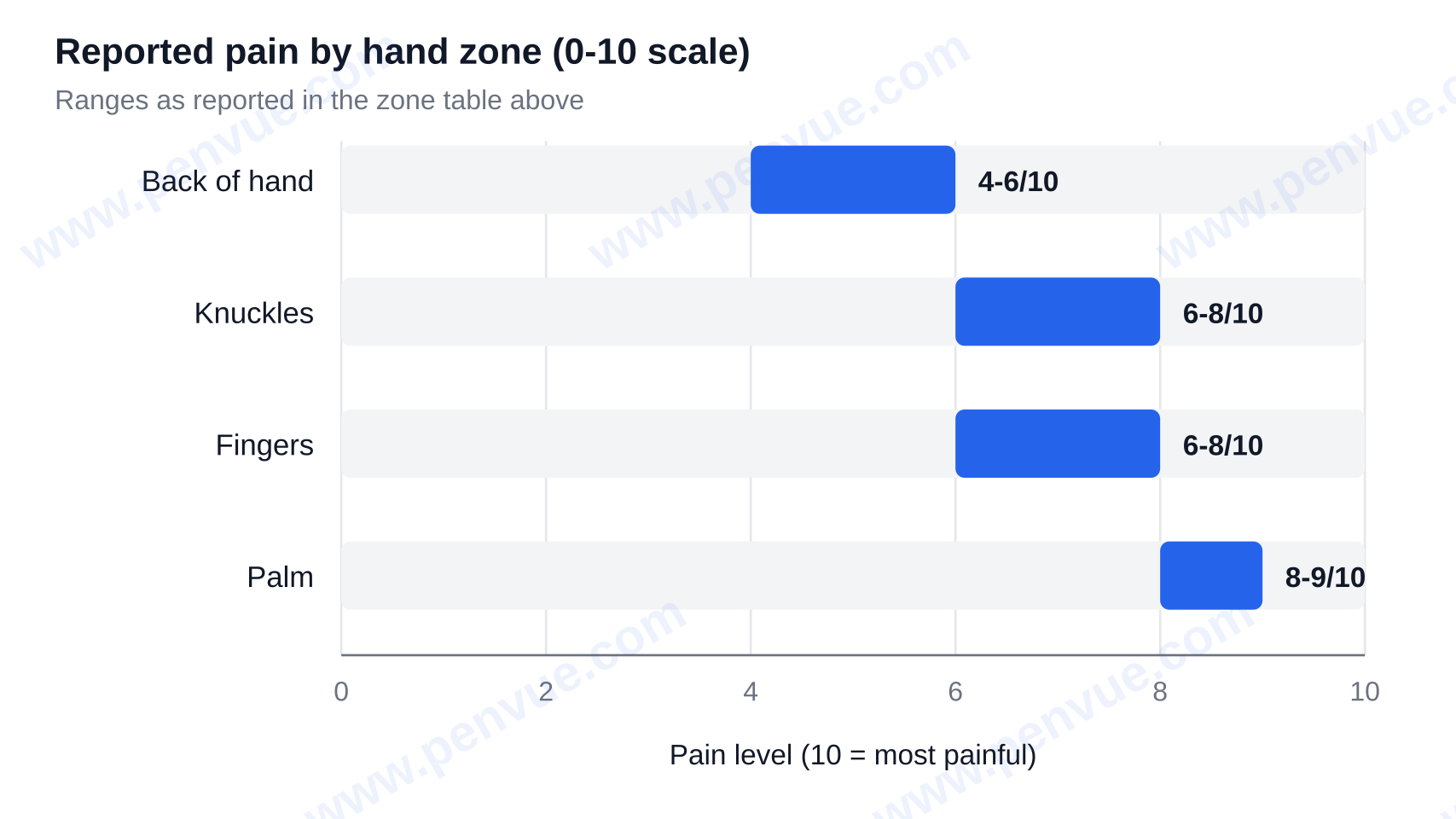
Anatomy dictates pain, not toughness. Thin skin stretched tight over tendons and bone gives the needle nothing to push against and the palm has the most nerve supply of the four zones. Monolith Studio’s per-zone pain breakdown puts the pain of the back of the hand at roughly 4-6 out of 10, fingers and knuckles at 6-8, and the palm at 8-9.
Bigfoot Tattoo Products puts hand tattoos at 14 to 21 days to reach surface healing and 6 to 8 weeks for complete healing. Peeling will occur as the tattoo begins to heal; this is to be expected. However, the peeling on a hand tattoo will be patchier than elsewhere due to the nature of the hand and the fact that a person cannot really ‘rest’ their hand and take it easy the way they can with other body parts.
“Touch-ups” in other articles may seem conflicting, but upon closer examination, one will notice they are dealing with completely different areas of the hand. Monolith Studio quotes every 3–7 years. Igla Tattoo quotes 2–4 years for hands and fingers. Oracle Tattoo Gallery puts first visible finger fading at 6–12 months. Those are not conflicting answers. Those answers pertain to completely different areas of the hand.
Why the Palm Belongs in a Category of Its Own
As far as the palm goes, it’s not a harder version of the back of the hand. It’s a different purchase. Sortra attributes palm fading to the ink not breaking through to the layer of skin it needs to settle in to be permanent, rapid cell turnover, friction, and sun exposure, all of which are compounded by constant washing and the fact that the skin is not covered by clothing. Treat a palm piece as a subscription.
There’s a fifth, lower-friction option worth knowing: the side of the hand wrapping toward the wrist. It behaves much more like the back of the hand, and it’s easier to keep out of view.
What Design Traits Actually Survive on a Hand?
When it comes to hand tattoos, there are certain design traits that predict how long a piece will last. Line weight and detail density are better predictors than the subject matter of a piece. The same skull can hold for a decade or blur inside a year depending entirely on how it was drawn and where it was put.
The Line-Weight Rule: Bold Survives, Delicate Migrates
There’s a rule galleries never state: fine line, micro-realism, and black-and-grey realism should be left on the back of the hand. Anything on the fingers or knuckles requires thick outlines and obvious negative space. The point of Oracle Tattoo Gallery is where the magic happens. The friction and limited surface area of fingers mean fine lines spread, small gaps fill in and crisp edges soften, so intricate work loses legibility within a year or two. Bold, simple designs with thick lines and obvious negative space hold up the longest.
Watch for this hypocrisy in competing roundups. They lump fine line and ornamental work with blackwork in the same category and then discuss fading in the following section with no relation to the previous.
Here’s your checklist for the consultation:
- Heavy outlines on fingers and knuckles. The artist must be willing to commit to thick outlines on fingers and knuckles. If they can’t, then the design is wrong for that zone.
- Visible gaps between elements. There must be obvious negative space between elements. Anything that looks like a cluster will end up as a blob.
- A size floor on lettering. Thin and serif letterforms will fade faster than thick and blocky letterforms.
- No shading gradients on fingers. Fingers have very high friction skin and are constantly in contact with something, so soft transitions have nothing to hold onto.
- Solid blackwork and American Traditional motifs age best. Bold line and limited palette with strong silhouettes.
In reality, the proper question is not ‘will this fade,’ but ‘how fast, and can it be re-lined cheaply’? A simple symbol gets refreshed in one short sitting. A detailed scene can’t.
Designs Worth Putting on a Palm (and What to Skip)
A simple, bold, re-linable symbol on a palm is a good idea. Portraits, scenes and anything with fine internal detail is a bad idea. Tattooing 101 notes that palm skin is heavily textured, so healing the tattoo well and the longevity of the tattoo is an issue with palms. Design for the refresh and not the photo on day one.
Back-of-Hand Tattoo Ideas for Men: The Zone That Holds Detail
This is the largest, flattest, lowest-friction area of the hand, and the only zone where detail is a reasonable bet. Most of the hand tattoo ideas for men that look good years later live here.
Geometric, Ornamental and Fine Line Ideas
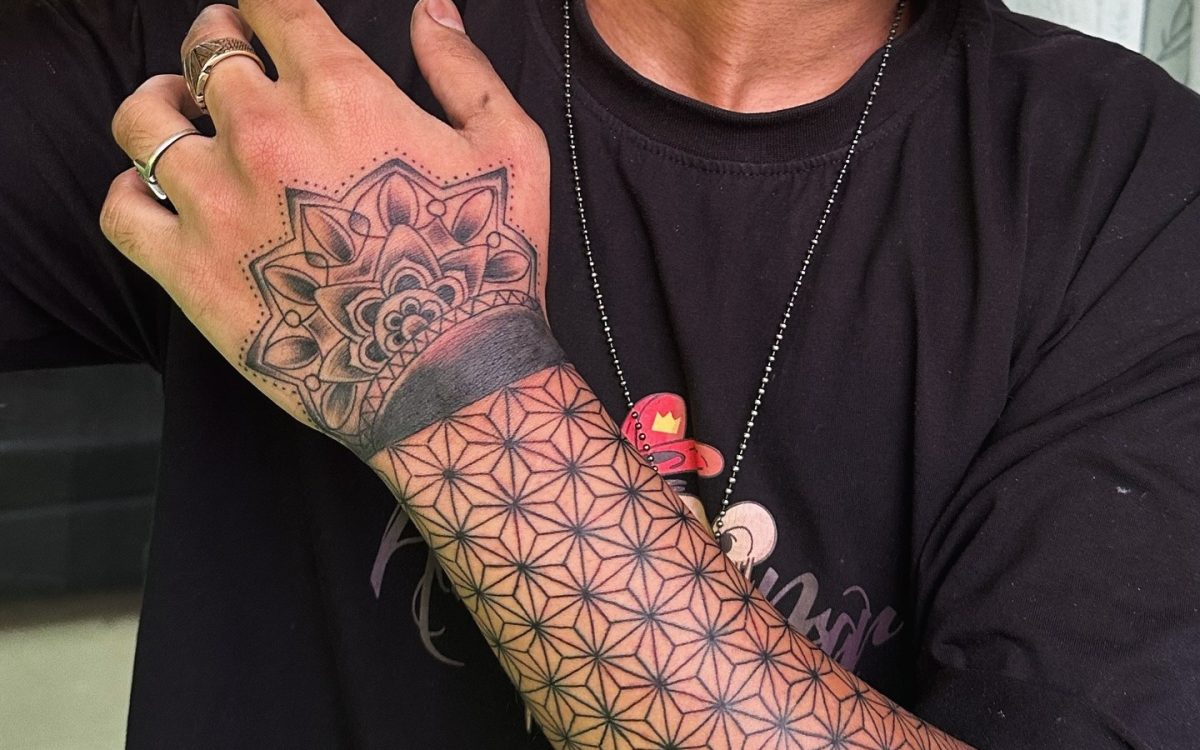
- Mandalas and sacred geometry built around the metacarpal lines
- Line work, grids, compasses and concentric patterns
- Ornamental filigree and chandelier patterns that wrap the hand like a cuff
- Dot-work shading as a jewelry-style accent
Blackwork, Realism and American Traditional Ideas
- Black-and-grey realism: a portrait fragment; a pair of clasped hands; an eye; a clock face, using the full width of the hand
- Solid-fill blackwork panels, neo-tribal spikes and blackout accents that read from across a room
- Old school designs at full scale: a panther, eagle, dagger, rose, swallow, anchor
Symbolic Subjects: Skulls, Animals, Faith and Florals
- Skull and spirit animal designs: a wolf, lion, raven or a snake coiling toward the wrist
- Faith designs: praying hands and a rosary; a cross; the Sacred Heart; a short line of scripture
- Floral and thorny designs: rose and skull; peony and dagger; chrysanthemum and snake
- Script and lettering at a size fingers can’t support: a single word, a surname, a date in blackletter
To keep ink visible longest without full visibility, place the design along the side of your hand and ending at your wrist.
What Are the Best Knuckle and Finger Tattoo Ideas?
This is the fastest-fading real estate on the body. Treat every idea here as something you will refresh, and design for legibility before beauty.
Knuckle Lettering and Word Splits
- Four letters, high contrast and blocky, across four knuckles
- An eight-letter word split between two hands. If you only get one hand done now, agree the spacing for both up front or the spacing will never be right
Single-Icon Knuckle Designs
- Simple, small icons per knuckle: a cross, crown, dagger, diamond, star, zodiac glyph or playing-card suit
Finger and Ring-Finger Band Ideas
- A plain solid band on the ring finger, which is the most forgiving design on the entire hand, because there is no detail to lose
- Double-line wedding bands
- Single-letter initials or small symbols on the side of the finger rather than the front
Small and Simple Hand Tattoo Ideas for Men Starting Out
- A small symbol on the side of the hand
- A thin band
- A dot-work accent near the thumb
One honest note on stick and poke work on fingers: deposits tend to sit shallower, fading comes sooner, patchy healing is common, and plenty of artists won’t take on repairing someone else’s. Whatever you choose here, plan on a touch-up conversation inside the first two years.
Will an Artist Even Tattoo Your Hands, and What Will It Cost?
Here’s the exception nobody puts next to the designs. Traditionally, tattoos on the face, neck and hands are earned. Old Dragon’s hand-tattoo guide states that a client with untattooed arms asking for a hand piece as a first tattoo is turned away in roughly 90 percent of cases at reputable studios.
The “Earn Your Hands” Rule and How to Get Around It
Artists have multiple reasons for turning away clients who want to get hand tattoos. LiveAbout explains why artists decline hand work: it is very difficult to tattoo the hand well, fading is close to guaranteed, and the finished piece is a walking advertisement they get blamed for when it ages badly. The workaround is a plan, not an argument. Get a forearm or upper-arm piece first to learn how your own skin heals and holds ink, then come back for the hand with a design the artist can stand behind.
When you are ready to get hand tattoos, ask for healed hand photos rather than fresh ones, ask what they’d change about your design for that exact placement, and walk away if the artist won’t discuss their touch-up policy.
Hand, Knuckle and Finger Tattoo Prices
Prices for hand tattoos vary a good deal. According to Ink Studio AI, the standard rate is $150-$250 per hour for hand work, with many studios adding a placement premium as routine practice. ThePricer states a small single-knuckle or single-finger design is between $100 and $250 and lettering or symbols spanning across four knuckles is between $200 and $500+. Small-to-medium finger or back-of-hand designs are between $150 and $300, and full hand coverage wrapping to the wrist runs $500-$1,500+.
Now calculate a realistic budget. Touch-ups are usually charged at a reduced rate by the original artist, so multiply your zone’s refresh cadence from the table above across ten years and add it to the sticker price. A finger band at 6–12 months to first fade and a back-of-hand piece at 3–7 years are not the same purchase, even at the same price.
Is a Hand Tattoo a Job Stopper?
Visible ink on your hands will still limit your options if you want to work in client-facing or uniformed roles, especially in the hospitality industry and corporate roles that are more conservative. The hedges are placement, not luck: an ink design on the side of the hand, the inner finger, or underneath a watch or a cuff.
Healing and Aftercare When You Can’t Rest Your Hands
- Wash often, and re-moisturise after every wash
- Don’t wear gloves and don’t do grip work during surface healing
- Expect more patchy peeling than you’d get on your arm
- Use SPF on it indefinitely, because the hand is never covered
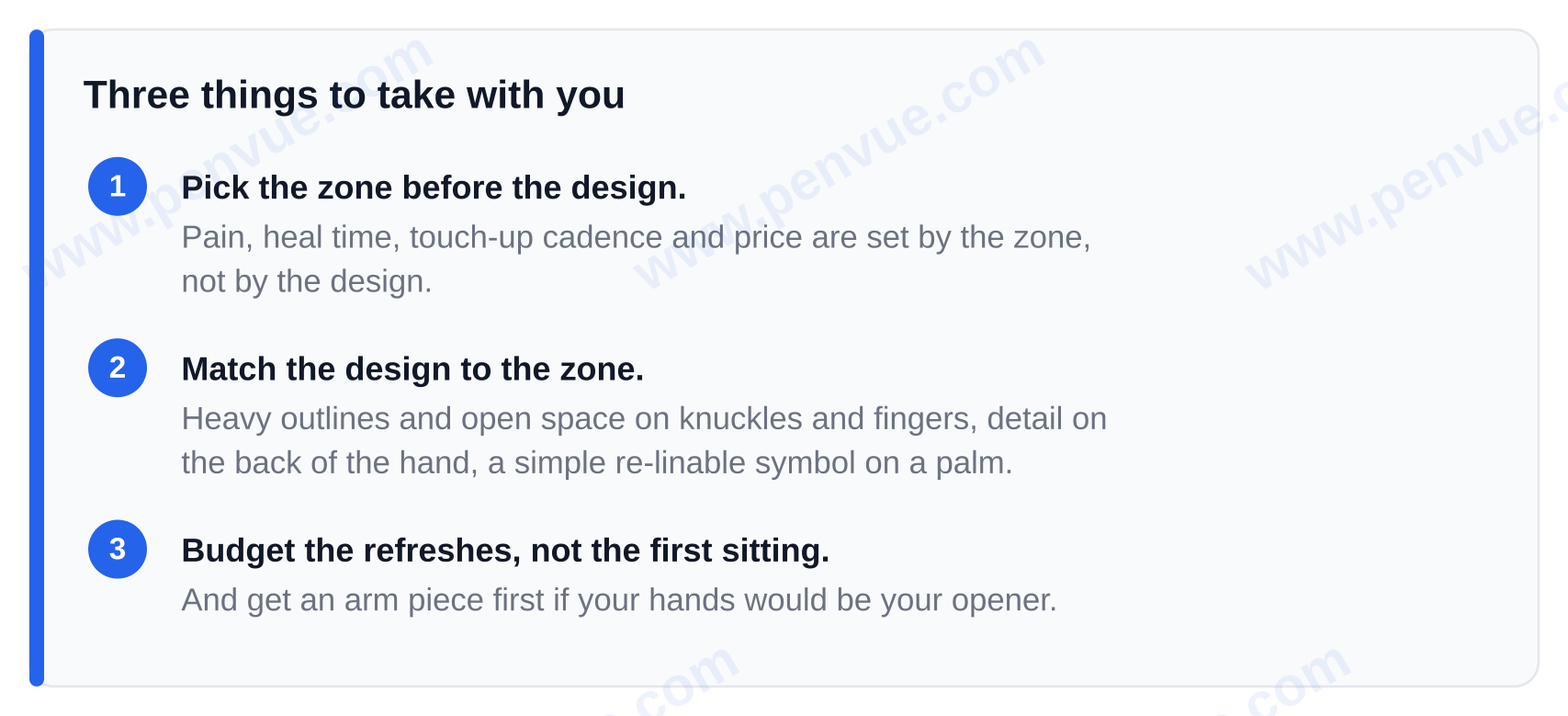
There’s three things to take with you. First, pick the zone before the design, because pain, heal time, touch up cadence and price are determined by the zone and not by the design. Second, match the design to the zone. Heavy outlines and open spaces are best reserved for knuckles and fingers, and details are best saved for the back of the hand. If it’s going on a palm, make sure it’s a symbol that’s simple and re-linable. Lastly, budget the refreshes, not the first sitting, and get an arm piece first if your hands would be your opener. Screen shot the zone table, pick a couple designs and message an artist whose portfolio shows healed hand work to see what they would change for that placement. You’ll find related pieces under Lifestyle.
Frequently Asked Questions
Can you get a hand tattoo as your first tattoo?
Usually not at a reputable studio. Traditional tattoo culture considers the neck, face and hands as earned areas, and Old Dragon’s hand-tattoo guide states that a client with untattooed arms, asking for a hand piece as their first tattoo, is turned away roughly 90 percent of the time. Get a forearm or upper-arm piece, learn how your skin heals, and then come back for your hands.
How long does a hand tattoo take to heal?
Bigfoot Tattoo Products puts surface healing at 14 to 21 days and complete healing at 6 to 8 weeks. Expect more patchy and uneven peeling than on an arm because of how much you use your hands. Wash often and be sure to re-moisturise after washing. Try to avoid gloves and grip work until the surface has closed.
Do knuckle tattoos fade faster than back-of-hand tattoos?
Yes, and here’s the data to back it up. Monolith Studio quotes touch-ups every 3–7 years for maintaining clarity. Igla Tattoo quotes 2–4 years for hands and fingers. Finally, Oracle Tattoo Gallery puts first visible finger fading at 6–12 months. Friction and limited surface area are what separate knuckles and fingers from the flatter back of the hand.
Can a faded hand or finger tattoo be fixed or covered up?
It depends on how it was drawn. Something simple like a bold symbol or a solid band can be re-lined in one short sitting, usually at a reduced rate by the original artist. However, something with more detail, like a scene, or a fine line piece, is much harder to restore, because once small gaps have filled in and edges have softened there’s no clean line left to follow. Design for the refresh from the start.
Can hand tattoos be removed by laser?
Laser removal is an option, but it isn’t a clean undo, and the results, especially on hands and fingers, vary a lot from person to person. Because hand ink often sits shallow and heals patchily, a lot of artists will discuss a re-line or a bolder cover-up before removal. Take the existing tattoo to both a reputable removal clinic and an artist, and compare what each one says is realistic for your skin.