

How to sell a car is really two questions: how to get a fair price, and how to end your legal tie to the vehicle. Choose a channel, verify your title, price against Kelley Blue Book and local listings, photograph it honestly, screen buyers, take irreversible payment at a bank, sign the title, then file your state’s release of liability.
Work through this guide, and you will have a sale that is genuinely finished — not just a car that drove away. Budget an hour of research up front, an afternoon of cleaning and photography, a week or two of listing time for a private sale, and about twenty minutes of paperwork afterward. The paperwork is the part most guides skip, and it is the part that decides whether a parking ticket next month is your problem or the buyer’s.
Before you start: what has to be in your hands
Do not list anything until you have these five items. A missing one stops the sale at the counter, and a replacement title takes weeks.
- The certificate of title, in your exact legal name. A misspelling, a maiden name, or a second owner joined by “and” instead of “or” will block the transfer. Order a duplicate now if the original is lost, damaged, or sitting with your lender.
- A written payoff quote from the lienholder if the car is financed — usually valid about ten days.
- Service records, the owner’s manual, and both sets of keys. Dated maintenance receipts do more for your price than any adjective in the ad.
- Your state’s actual requirements. Edmunds and state DMV pages make the spread clear: a signed title is enough in some states, while others want a notarized title, a separate odometer disclosure statement, an emissions, or safety certificate, or a bill of sale.
- A bill of sale you drafted yourself — year, make, model, VIN, mileage, both names and addresses, date, price, and an “as-is, no warranty” line. Write one even where it is optional.
Should you sell privately, trade it in, or take an instant cash offer?
This is the first real decision, because it determines every step after it. A private sale means you handle pricing, screening, payment and paperwork. An instant offer means the buyer handles nearly all of it and pays you less for the convenience.
| Channel | What you get paid | Speed | Who carries the work and the risk |
|---|---|---|---|
| Private party sale | Highest | Slowest — weeks | You: pricing, scam risk, test drives, title, filings |
| Dealer trade-in | Usually the lowest | Same day | Dealer; can roll in a loan payoff and may reduce sales tax on the replacement car in many states |
| Instant online cash offer (Carvana, CarMax, Cars.com, KBB Instant Cash Offer) | Between the two | Days | Buyer handles payoff, lien release and most paperwork. |
Published 2026 comparisons from secondary sites such as CarEdge and CarWhere report instant cash offers landing roughly 10–15% below private-party value and generally above dealer trade-in. Treat that as a reported range, not a promise for your specific car. The practical move now is to collect offers from several instant buyers on the same day rather than trusting a brand reputation — individual quotes on one car swing several hundred dollars either way, and the old CarMax-beats-Carvana rule of thumb is no longer stable enough to plan around.
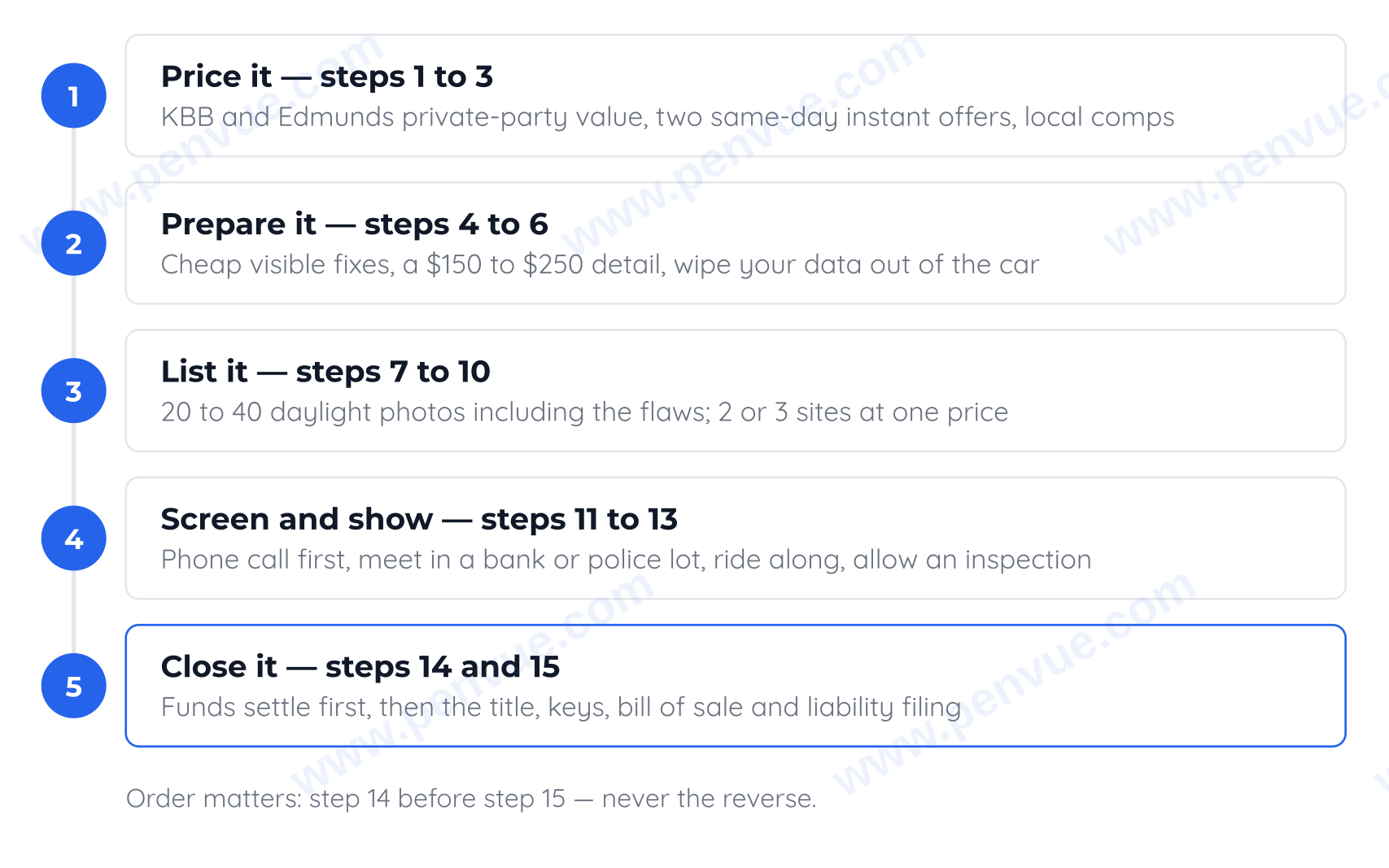
How to sell a car, step by step
- Pull the private-party value from Kelley Blue Book and Edmunds, then request two instant cash offers the same day. That is your floor, in under an hour.
- Check life comparable listings — same year, trim, mileage band and region — on Autotrader, Cars.com and CarGurus. What local buyers are paying beats any national estimate.
- Set your asking price against trim and options, not just year and model, leave a few hundred dollars of negotiating room, and write down your walk-away floor before the first inquiry arrives.
- Fix what is cheap and visible: bulbs, wiper blades, a dead key fob battery, tire pressure, a missing hubcap. Leave the transmission and the paint alone — you rarely recover that money on resale.
- Detail it properly. Wash and wax, shampoo the mats, clean the glass inside and out, pull every personal item. A $150–250 detail routinely returns several times that in perceived value.
- Wipe your data out of the car before anyone sits in it: unpair every phone, delete saved navigation addresses including home and work, clear garage door codes, remove the toll transponder, factory-reset the infotainment system, and delete the vehicle from the manufacturer’s connected-car app and your account.
- Shoot 20–40 photos in daylight — overcast morning or the hour before sunset — against a plain background: four corners, straight-on front and rear, both profiles, wheels, engine bay, trunk, both rows of seats, the dash with the odometer readable, and the VIN plate.
- Photograph the flaws on purpose: the door ding, the curb-rashed wheel, the torn bolster. A buyer who finds a hidden flaw stops trusting the whole ad; one who saw it photographed arrives ready to buy.
- Write the listing title as year, make, model, trim, then mileage, condition, and price. In the description, answer the questions you would ask — ownership history, how it was used, maintenance with dates and mileage, what is included, known issues stated plainly — and include the VIN and your terms.
- Post in two or three places at once (Facebook Marketplace for volume, Craigslist for free local reach, Autotrader or Cars.com for committed shoppers) at an identical price everywhere. Buyers cross-reference, and a mismatch reads as a seller who will keep dropping.
- Screen before you meet. Ask one specific question about the car in your first reply and insist on a phone call. Discard anyone writing about “the item,” anyone routing you through a shipping agent or third-party inspector, and anyone who agrees to full asking price sight unseen — Kelley Blue Book flags that last one as a scam signal, not a win.
- Meet in daylight in a bank or police station lot, never at your home, with another adult present. Photograph the buyer’s licence, confirm the name matches and that they are insured, set the route, and ride along. Never let a buyer drive off alone.
- Let a serious buyer’s mechanic inspect it while you go along. When findings come back, answer with the number you decided in step 3 rather than a reaction.
- Take payment that cannot be reversed: cash counted by a teller inside your own bank, a wire your bank confirms as received and settled, or a licensed escrow service. With a cashier’s check, meet at the issuing branch and have the bank verify and cash it in front of both of you. Refuse personal checks, emailed wire confirmations, and peer-to-peer apps — Zelle, Venmo, Cash App and PayPal can all be frozen, disputed or decided in the payer’s favour after the car is gone.
- Only then sign the title, hand over the keys and the bill of sale, and file your state’s release of liability.
The one mistake that costs sellers the most
It is step 14 and 15 in the wrong order: handing over the signed title and the keys before the money is irreversibly in your account, because the buyer seemed decent. Every major private-sale fraud pattern depends on that gap — the counterfeit cashier’s check that clears provisionally and bounces days later, the fake wire confirmation, and the overpayment script where the buyer “accidentally” sends too much and asks you to refund the difference. The refund leaves; the original payment vanishes. In practice there is one rule that defeats all of it: the funds settle first, inside a bank, with a teller confirming it out loud.
What happens after the money changes hands
Here is the gap. Nearly every popular guide on how to sell a car covers pricing, cleaning, listing, and the handshake, then goes quiet exactly where liability, the lien, the plates, the odometer form and the tax question are still sitting on your side of the table.
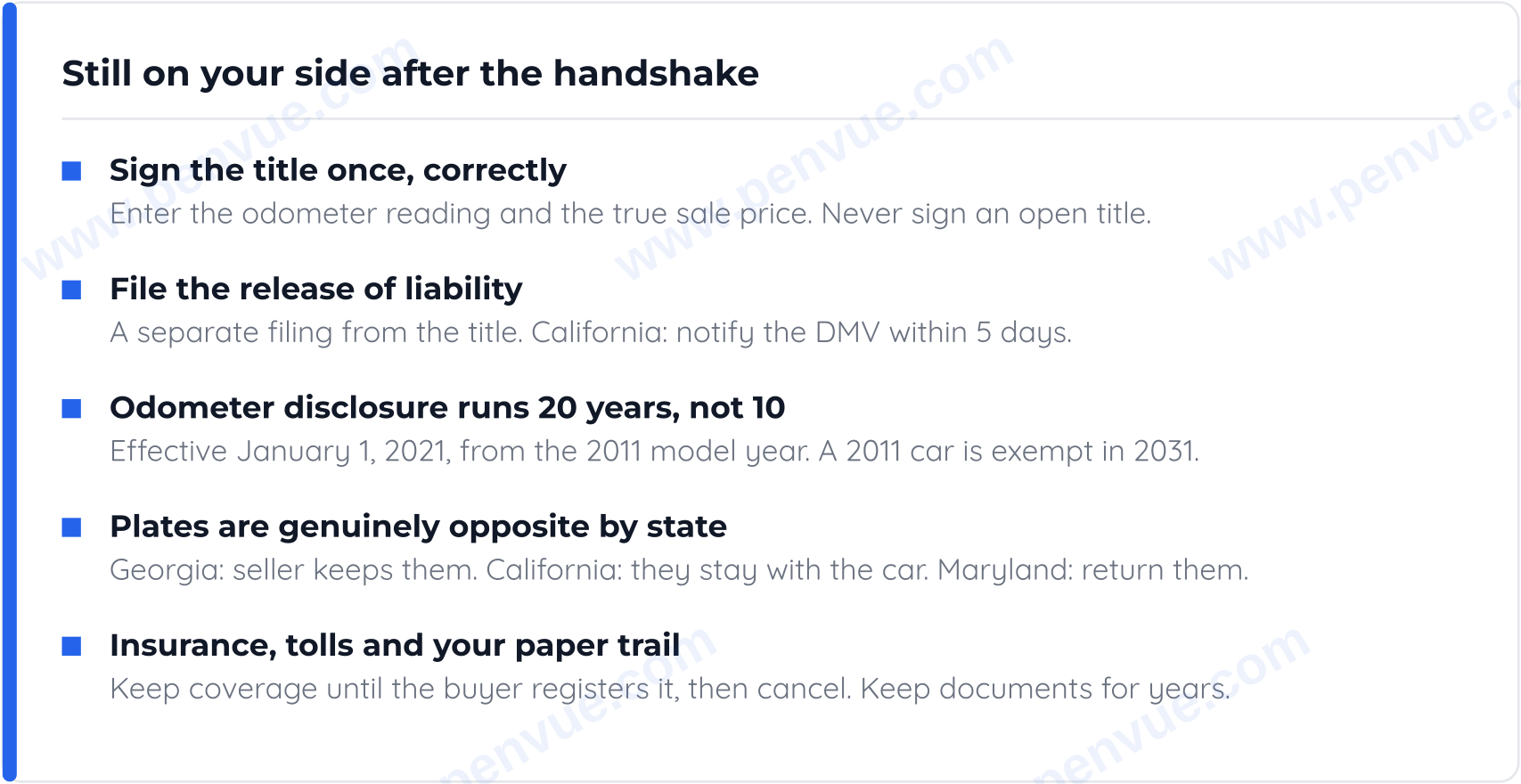
Sign the title once, correctly
Complete the transfer section exactly as your state prints it, enter the odometer reading and the true sale price, and have the buyer sign where required. Never sign an open title and hand it over blank. A scratch-out or correction can void the document and force a duplicate.
File the release of liability — and know your clock
This is a separate document from the title transfer, and signing the title does not accomplish it. California requires the seller to notify the DMV within 5 calendar days of selling or transferring the vehicle and delivering possession, using the Notice of Transfer and Release of Liability. Once the DMV has it, parking violations, traffic violations and civil litigation dated after the sale become the new owner’s responsibility. Every state has a version of this filing with its own name and its own deadline — find yours before you list.
The odometer rule that changed in 2021
The stale advice says ten years. NHTSA’s final rule extended the federal odometer disclosure exemption from ten years to twenty, effective January 1, 2021, applied beginning with the 2011 model year. So a 2011 vehicle is not exempt until January 1, 2031, and a seller with a 2012 or 2014 car who assumes it is too old to need odometer paperwork is wrong. Only 2010-and-older model years remain under the old ten-year exemption. NHTSA cited longer vehicle lifespans and how easily modern digital odometers can be rolled back.
Who keeps the plates: genuinely opposite by state
| State | What happens to the plates | Why it matters |
|---|---|---|
| Georgia | The previous owner keeps the plate and tags | They do not transfer with the vehicle |
| California | Standard sequential plates stay with the car | They transfer to the new owner |
| Maryland | The seller returns the plates to the MVA | Returning them is what ends the insurance and registration obligation and avoids fees |
Look up your own state’s motor vehicle agency before you hand over the keys — guessing from another state’s rule is how sellers end up still registered to a car they no longer own.
Insurance, tolls, and your paper trail
Keep coverage active until the title is signed over, and the buyer has registered the car in their own name, then cancel and ask for the prorated refund. Cancelling in the parking lot leaves an uninsured gap on a vehicle still legally tied to you. The same week, delete the plate from your toll account, cancel any connected-car subscription, and store copies of the signed title, bill of sale, odometer statement and liability filing confirmation for several years.
Can you sell a car you still owe money on?
Yes — but the title cannot legally transfer until the lien is paid in full and the lienholder releases it, so sequence the payoff before you price anything. Subtract the written payoff quote from the car’s realistic market value, and you have your equity in one line of arithmetic.
With positive equity it is simple: the proceeds clear the loan, the lender releases the lien and either mails the title or signs off at a bank, and you keep the difference. Negative equity is where the standard advice on how to sell a car — do it privately, you’ll make more — quietly fails. If the payoff exceeds the value, a private sale hands you a bill rather than a cheque. You cover the shortfall with cash or savings, a personal loan, a refinancing, or by rolling it into your next car loan, which increases total debt and starts the next car underwater.
That arithmetic can reshape the channel decision outright. A dealer or online buyer processes the payoff inside the transaction and treats the lien release as routine; a private buyer generally cannot and will not wait weeks for a title. Where the lender holds the physical title, close at the lender’s branch or a bank that can confirm the payoff in person, and put a written title timeline in the bill of sale.
Do you owe taxes when you sell your personal car?
For almost every private seller: nothing to report. The IRS taxes a car sale only if it produced a capital gain — a price above your cost basis, meaning what you paid plus qualifying improvements — and cars depreciate. A loss on a personal-use vehicle is not deductible, so the ordinary outcome creates no filing and no write-off.
The live exception is the car that went up: a collectible, a limited-run model, or an in-demand vehicle sold above its original cost. That gain is reported on IRS Form 1040, Schedule D, and your holding period affects the rate. Keep the purchase paperwork and improvement receipts if a gain is even possible, because basis is yours to prove. Sales tax on a private sale is generally the buyer’s obligation, collected by the state at registration — not something you collect at the curb.
How to check the sale actually closed
The last question in how to sell a car is how you know you are done. Four quick checks, in the week after:
- Your bank shows the funds settled and available — not pending, not “provisional credit.”
- You have a confirmation number or stamped copy of the release-of-liability filing.
- Your lender confirms the loan is closed, and the lien released, in writing.
- Your state’s online record no longer shows the vehicle registered to you, or your plates are logged as returned.
Rule of thumb: the sale is not over when the car leaves — it is over when the state knows it left. You’ll find related pieces under Lifestyle.
Quick Answers
Do I need a bill of sale if the buyer already has the signed title?
Write one anyway. The title proves ownership changed; the bill of sale proves what you agreed, when, and for how much. It records the year, make, model, VIN, mileage, both names and addresses, the date, the price and an as-is line — which is what protects you if the buyer later claims you promised something, or if a dispute lands on the sale date. Some states require it; in the rest it costs you five minutes.
How long should I keep copies of the sale paperwork?
Keep the signed title copy, bill of sale, odometer statement and release-of-liability confirmation for several years. Tickets, toll charges and registration errors tied to the car can surface months later, and the filing confirmation is the single document that ends the argument. If there is any chance the car sold for more than you paid, keep the original purchase paperwork and improvement receipts too — that is your cost basis for Schedule D.
Can I sell a car that fails inspection or has a check engine light on?
Usually yes, but disclose it plainly in the ad and in the bill of sale. Some states require a current safety or emissions certificate before the sale can be completed, so check your own DMV rules first. Where it is allowed, an as-is sale with the fault stated openly filters out buyers who would have walked at the inspection anyway. Hiding it is what turns a price negotiation into a fraud claim.
Is it safe to let a buyer’s mechanic inspect the car before they pay?
Yes, and it is a good sign — buyers who pay for an inspection are buyers who intend to purchase. Go along rather than handing over the keys, let them choose the shop, and stay with the car. Decide your response in advance: when the report comes back with a list, answer with the walk-away floor you already wrote down instead of negotiating on the spot. A clean pre-sale inspection of your own can defuse the whole conversation before it starts.