
The question behind “3 meaning” is almost always narrower than it looks. You got a bare “3” and are wondering if it was affection or arithmetic. Literally, “3” is the cardinal number that is the sum of one and one and one—one more than two. In texting, a lone “3” is informal shorthand for affection, a more informal “<3” or a sideways heart that is made with a less-than sign and the number 3.
A concrete example is a friend texting you “had the best time tonight 3.” In that case, they are using a sideways heart because they are leaving out the “<.” Another example is a friend texting you “how many tickets do you need? 3.” In that case, the person is being literal and using the number 3, and it’s awkward to find a deeper meaning to it.
Which “3” are you actually looking at?
Find the form first. Meaning is secondary to it. This is the step that is skipped over on every page about this topic because the pages that talk about texting ignore the dictionary sense and the plain number, and the spirituality pages and texting pages ignore each other. The four senses of the number “3” come from genuinely different lineages and that’s why Wikipedia maintains a standing disambiguation page for “3” at all times.
| Form | What it means | Where it came from | Context cue | Right response |
|---|---|---|---|---|
| 3 | Affectionate shorthand — not standardised | A clipped “<3” | Sits at the end of a message, no numbers nearby | Send “<3” back |
| <3 | Heart, love or affection | Less-than sign plus numeral 3, spreading from the 1980s | Any casual message, any warm relationship | Mirror it |
| :3 | Cat face — cute, playful, not romantic | Japanese emoticon, imageboards including 2channel, early 2000s | Attached to a joke, a request or mild mischief | Send “:3” back, or just laugh |
| <33 | The same heart, louder | Amplified “<3” | Excitement, usually platonic and giddy | Match the energy |
| </3 | Broken heart | A slash through the “<3” | Bad news, a breakup, sympathy | Ask what happened |
| 3 (numeral) | The cardinal number that is the sum of one and one and one | Brahmi numerals | Answers how many, what time, what score | Read it literally |
| 3 (numerology) | Creativity, self-expression, communication | Numerological tradition | Readings, “angel number” content | Treat as belief, not fact |
| 3 (biblical) | Completeness; the Trinity | Scripture and Christian theology | Sermons, symbolism, study notes | Read in that context only |
If identification was all you needed, you can stop here. The remainder of the page interprets each sense.
What does a 3 at the end of a text mean?
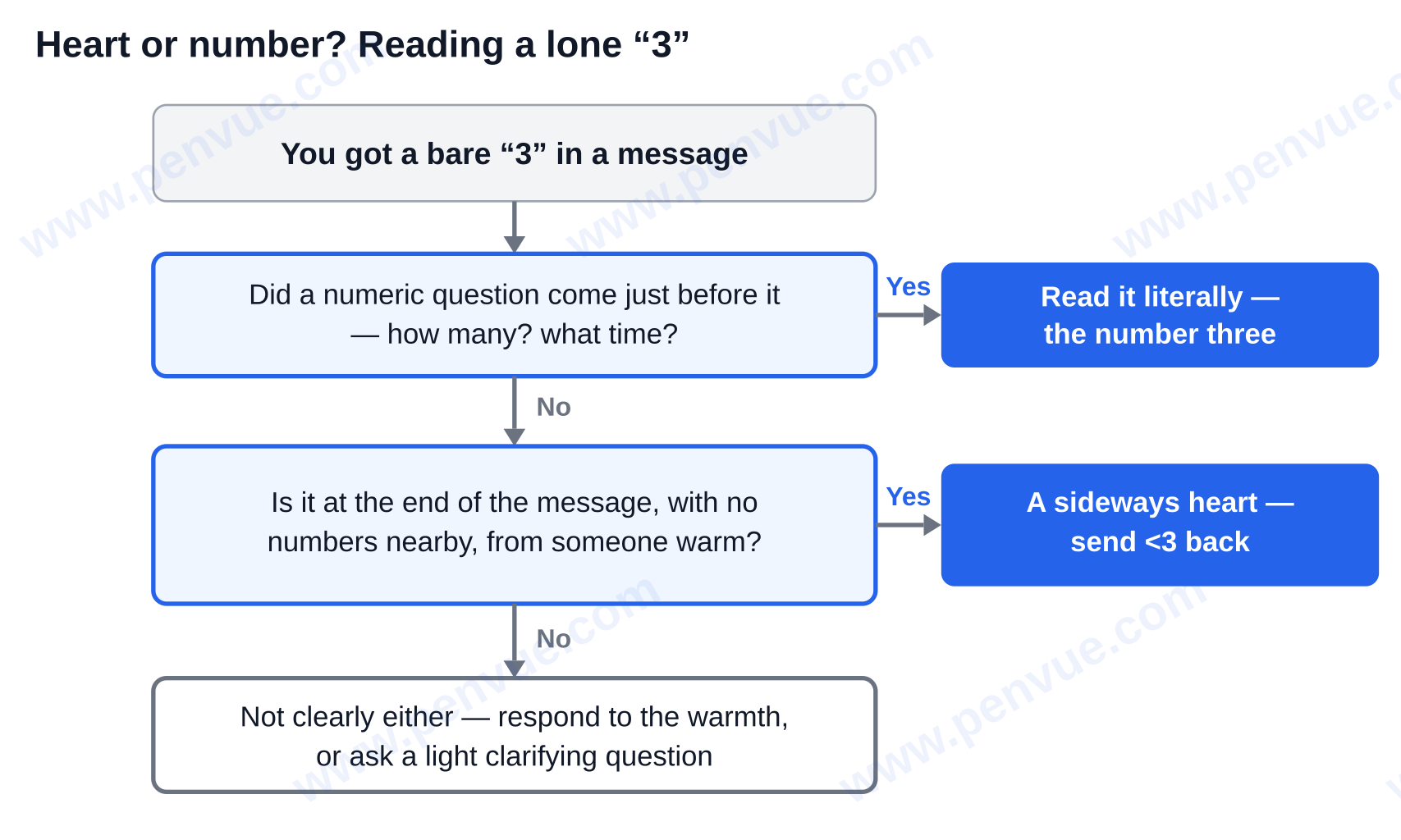
A lone 3 at the end of a text from someone who is warm towards you can usually be taken as a shorthand for a heart. The “<” is often hurried or purposely omitted to sound less formal. That is the working answer, and it is usually correct.
But truthfully, the status of “3” as a shorthand for heart is not as defined as “<3.” As discussion on Quora notes, “3” has no single universal slang definition. It is more of an agreed upon convention than a definition.
When “3” is just the number three
A “3” in conversational speech is literally a “3.” Answering a “how many?” or “what time?” with a “3” is not indicating love; that is an unfortunate misunderstanding. Watch out for a “3” in reference to a time, like “3pm”, a “3rd”, a sports result, a count after a list, or a “3” that is not at the end of a message and is placed randomly in the middle of the sentence.
How to tell affection from a count
There are four criteria that can help decide: position in the message, whether a numeric question preceded it, the platform, and the relationship. A “3” at the end of a message to someone you are very close to, and especially if no numbers appear before it, is a heart. A “3” anywhere near a quantity — how many tickets, for example — is the number three. When it is not clearly love, you can respond to the warmth without naming it. That costs you nothing if you guessed wrong.
Where did “<3” and “:3” come from?
The “<3” timeline, from BBS to emoji
Users combined the mathematical less-than sign with the number 3 to draw a heart lying on its side, and Dictionary.com dates its spread through email, text messaging, instant messaging and online forums to the 1980s. One reason for its popularity is that this heart lent itself to be more easily drawn using the symbols available on a computer keyboard. Bulletin Board Systems and early Instant Messenger programs rewarded users for communicating with only the symbols they could type without leaving the keyboard, and therefore this heart was built using arithmetic.
Unicode 6.0 added emoji support in 2010, and with that most users switched to representing hearts using the red heart emoji. However, “<3” has remained, for two reasons Dictionary.com names: it can be faster to type than hunting for an emoji, and it deliberately reads as cuter, more innocent, more earnest or more nostalgic. Saying “less than three” out loud makes a clear claim to internet fluency of the 1980s–90s.
“:3” and the Japanese imageboard route
A variant of this emoticon, “:3” as it is written here, is entirely distinct in its history, as it is a horizontal variant of the Japanese emoticon for a cat-like or “moe” expression. Know Your Meme traces its spread through Japanese text and image boards, 2channel included, from the early 2000s. Its first English-language definition was submitted to Urban Dictionary on 28 September 2003 as “a Japanese emoticon for the anime cat face”, with a 17 December 2006 entry reframing it around cuteness and affection.
The general consensus is that “:3” is more aligned with animal cuteness, not romance. Mistaking it for a heart is the most common error with this symbol.
What’s the difference between 3, <3, :3 and the stacked variants?
- <3 — This is a quick way to express affection, be it romantic, platonic, or familial. It does not by itself prove romantic interest, as the heart can be interpreted in different ways.
- <33, <333 — More enthusiasm. Usually giddy and Platonic.
- </3 — Broken heart. Used in expressing sadness and disappointment. A breakup, or sympathy for someone else’s bad news.
- :3 — Cat face. Often used to express playfulness and mischief or sass, often paired with a joke or a request.
- =:3, >:3 — More facial expressions involving different eyes or brows, shading toward smug or scheming.
- 3 — The unstable one. Context does all the work.
On the question that keeps coming back: “<3” means love in the broader sense. To really know how it lands — romantic or simply affectionate — you have to know the tone, history and relationship.
How should you reply to a “3” or “<3”?
Replies that match the tone
Responding with the same thing is the default and will keep it warm — “<3” back, or “:3” back if that is what arrived. It reads as warm without escalating. To warm it up a step, you can send a full sentence plus the symbol, or “<33”. If you want to keep it clearly friendly, you can send a thank you, or a joke with an emoji nobody could read as romantic. If you think a message was sent by mistake, or a stray number, you can ask a light clarifying question instead of guessing. Responding in kind is the safest bet, and a very long emotional reply to a casual “<3” is the classic over-read, and it lands awkwardly.
Where “<3” and “:3” don’t belong
Fine in informal chat, DMs, and social posts. Not in work emails, client messages, academic writing, or anything with a paper trail. The audience matters, too. To younger users who default to emoji, “<3” reads retro, and “:3” is popular on Discord, with the gaming and fandom communities, and in general, is read differently by different people. It can be read either sincerely or ironically.
What does the number 3 mean spiritually, in numerology and in the Bible?
Angel number 3 and numerology
In numerology, the number 3 is reflected as creativity, self-expression, communication, joy, optimism and social connection. “Angel number 3” is commonly read as encouragement toward creative expression, growth and manifestation. That is what practitioners hold, and it is generally viewed on belief rather than established fact, similar to other symbolic practices, for example, the evil eye, or a drawn sigil.
Three in the Bible, by the numbers
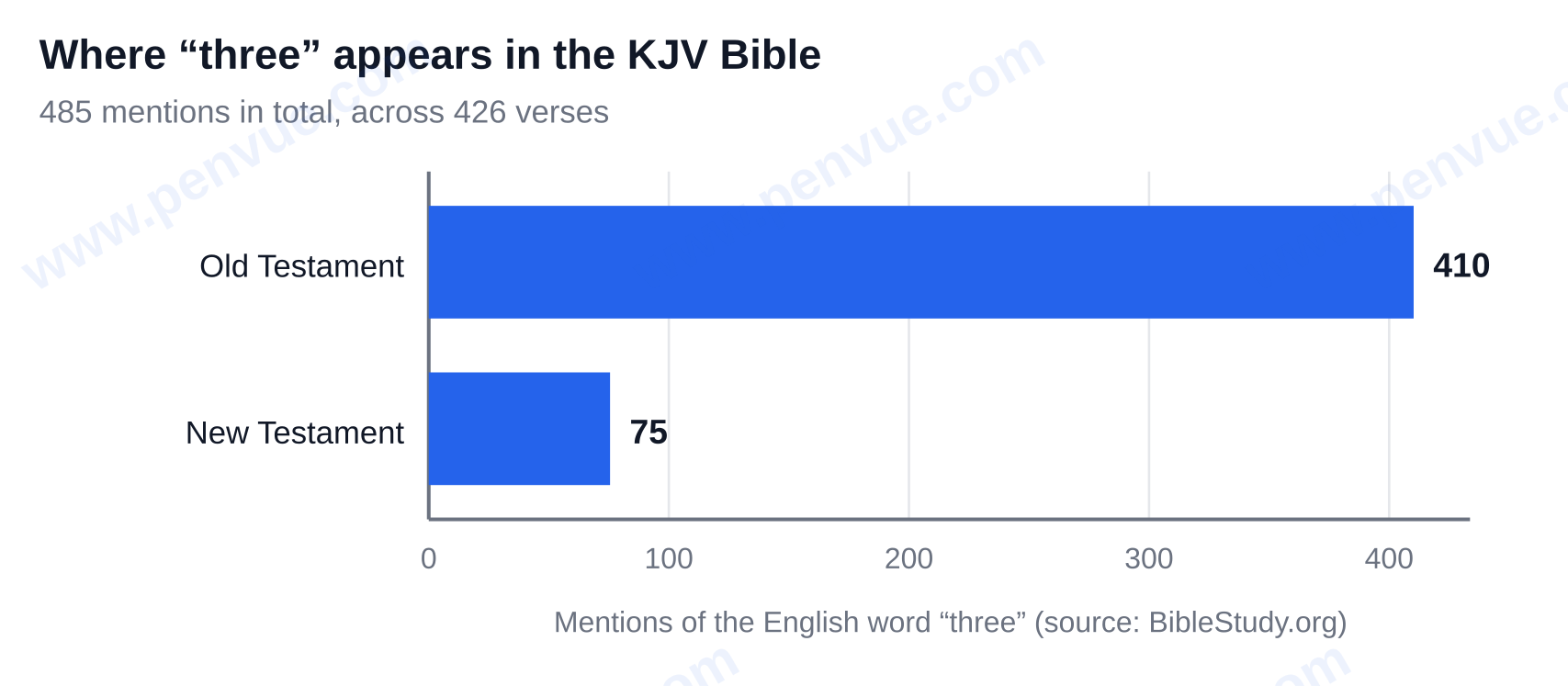
Of the two, the specific takes precedence over the vague. BibleStudy.org reports that the English word “three” appears 485 times across 426 verses in the King James Bible. 410 of those are in the Old Testament, and 75 are in the New Testament. The New Testament’s 27 books are 3 cubed. The significant triads in the Bible outweigh the generalized meaning of threeness and completeness, for example, the Holy Trinity, the three days before the resurrection, the three temptations, the three apostles at the transfiguration (Peter, James and John), the three hours of darkness at the crucifixion, and the three prayers at Gethsemane.
Symbolisms of three abound well beyond Christianity. There is the Hindu Trimurti and Tridevi, the Buddhist Three Jewels, and many other triads. In Chinese culture 3 is considered fortunate, as it sounds like the word for “alive.”
None of these relate to “3” in a text thread. These senses live in readings, sermons, and symbolism, not in chat.
Why does “three” keep showing up everywhere?
Many of the symbolism pages say 3 is special. No page says why threeness itself keeps attracting meaning. There are two unrelated answers to this on different pages, which ought to be jointly addressed.
The first is structural: three is the smallest group that forms a pattern. One is read as incomplete. Two is read as a coincidence. Three is read as rhythm. The pattern is set by the first two and the third completes or subverts it, and that is the engine of the rule of three in writing and the comedic triple.
The second is mathematical: 3 is quite foundational. Per Wikipedia’s entry on the number, it is the smallest odd prime, the first Mersenne prime, the first of five known Fermat primes, and the second and only prime triangular number. A base-10 number is divisible by 3 when its digits’ sum is a multiple of 3. Three also has a story in number glyphs: it descends from Brahmi numerals, where three lines denoted 3, with curves added during the Gupta period and the bottom stroke dropped in the western Caliphate around the 10th century.
It seems more honest to read the order as running backwards from how the spiritual pages tell it. Three was rhetorically pleasing first, the smallest shape a human mind easily recognizes as a pattern, and mystical meanings were layered on top of a form that people already found pleasing. This doesn’t void the symbolism. It means the significance was read into the number rather than discovered inside it, which is also the reason that so many unrelated traditions ended up with the same digit independently.
The rule of thumb
There are 4 iterations of “3”: a plain number, a keyboard-era heart, a Japanese cat face, and a symbol of completeness. The context it is in determines which form it takes. Go back to the message you came here about, check whether a numeric question preceded the “3” and look at where it is in the sentence — and the full 3 meaning resolves itself. End of message from someone warm means heart. When it appears in a quantitative context, that means three.