

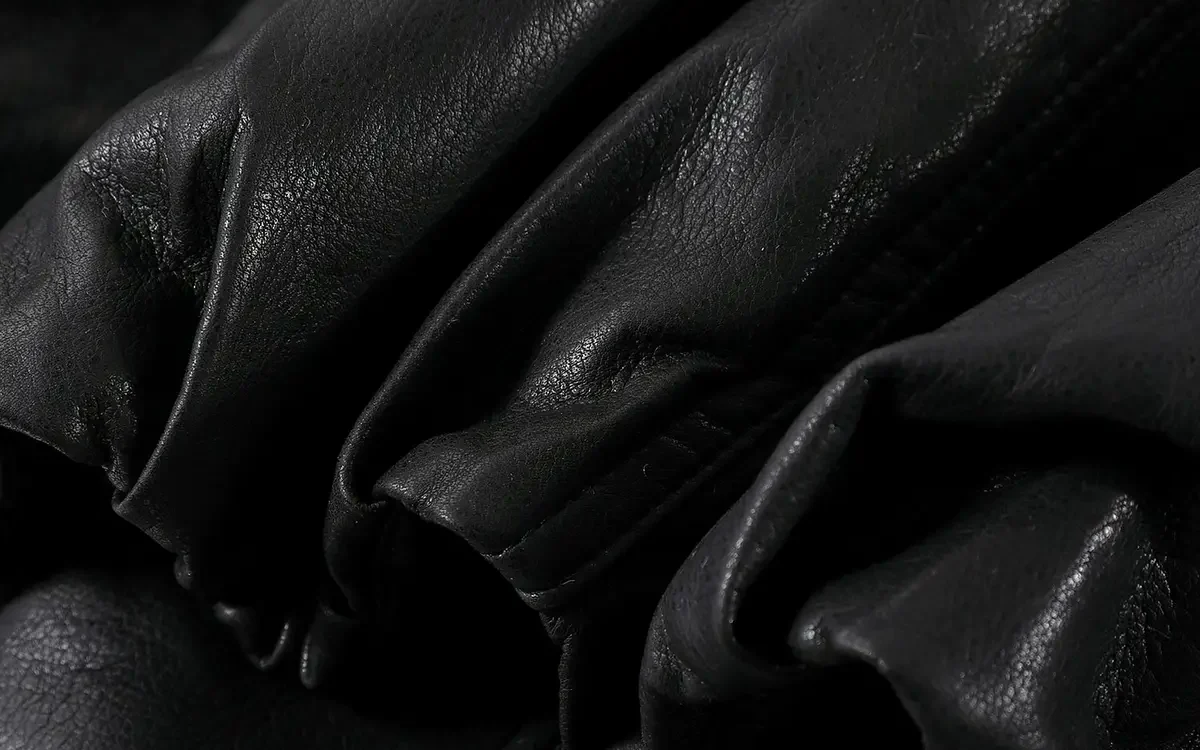
Flipping over a jacket label and reading “faux leather” doesn’t really explain anything, does it? So, what is faux leather? Faux leather is a fabric-like material with a polymer coating that resembles animal hide, containing no animal skin at all. Generally the backing is made of polyester fabric and the coating is PU (polyurethane) or PVC (polyvinyl chloride) plastic which is embossed with a grain and dyed.
That’s the reason for this page. The word “faux” doesn’t actually describe the material itself — it’s a marketing word, not a regulated material name — hence two different products with the same label can vary drastically, with entirely different lifespans.
What Is Faux Leather, Exactly?
One important distinction to make, as it is applied broadly, is that faux leather is not a single fabric. In fact there are many different materials grouped under this term. Wikipedia’s entry on artificial leather lists the same category sold as synthetic leather, vegan leather, artificial leather, leatherette, pseudoleather and pleather — whichever word flatters the product best.
What faux leather is made of
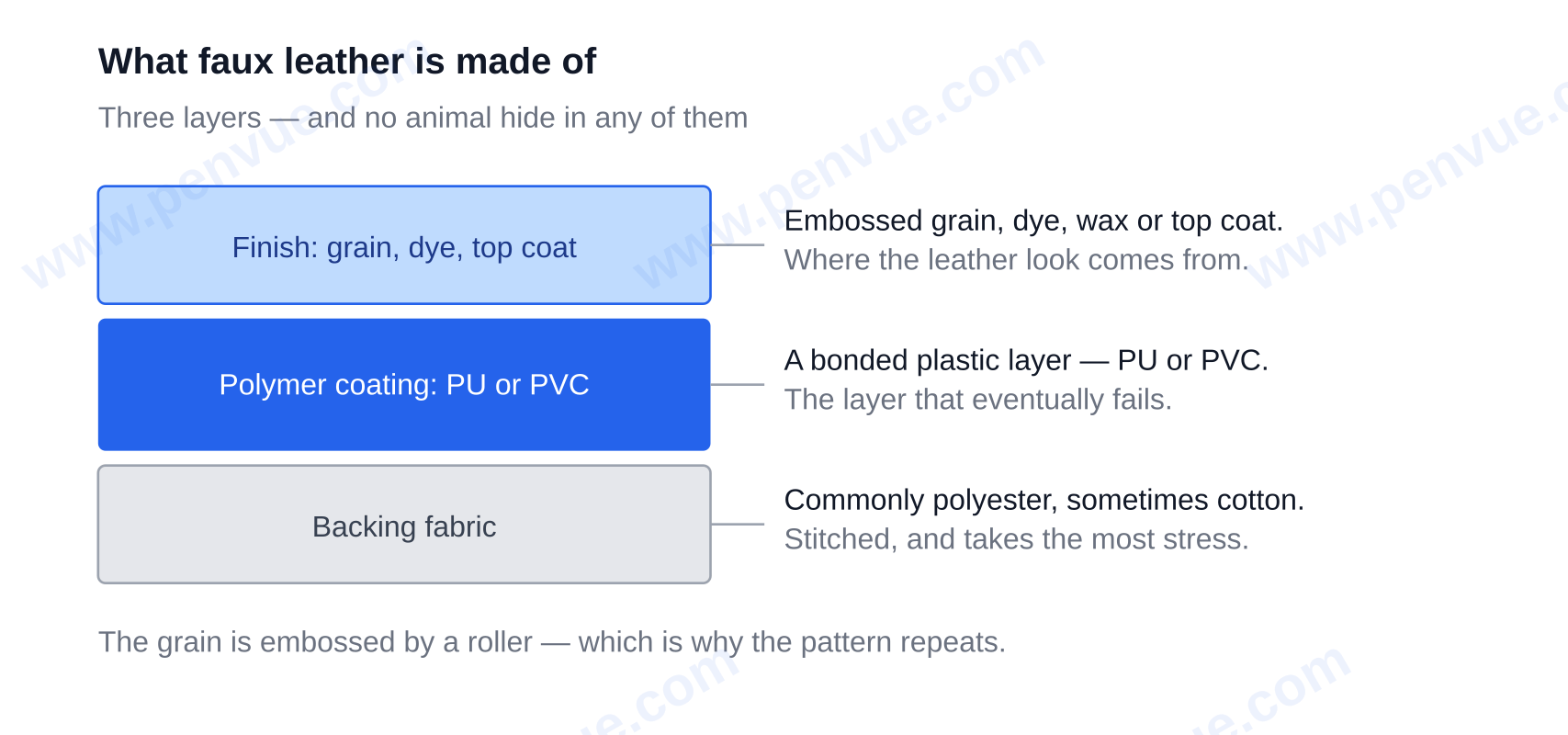
Three layers make up faux leather.
- The backing fabric — which can be made of various fabrics but is commonly polyester, sometimes cotton. This layer is often stitched and takes the most stress.
- The polymer coating — a bonded plastic layer, which can be PU or PVC. This is the layer that gives faux leather its texture and is the part that eventually fails.
- The finish — the outer layer typically consists of embossed grain, dye, and wax or a top coat, which is where the leather look actually comes from. Fibrenew has an excellent description of this build: a fabric backing covered with a bonded plastic coating, then imprinted with an imitation leather grain through embossing, wax, dye, PVC or polyurethane.
How faux leather is manufactured
A polymer is coated or laminated onto the base fabric, embossed with a grain by a roller, then colour and topcoat go on top. Because of this embossing roller, the pattern repeats. That single fact is the most useful tell you have, and this grain also proves useful when trying to identify faux leather in the identification section below.
So: no, faux leather does not contain any real leather. Bonded leather on the other hand does contain real leather — which is where the confusion with that term arises.
Why the Tag Says “Faux” — and What the Law Actually Requires
As stated previously, no competing explainer provides this information, however this is the information that is most relevant and useful when you are standing in a store. A retailer is not obligated to tell you what type of polymer you are purchasing when the label indicates it is faux leather, because “faux leather” does not hold any meaning the rules recognise.
What the FTC Leather Guides say you must be told
The FTC’s Leather Guides (16 CFR Part 24) state that where all or part of a product is made from non-leather material that appears to be leather, that fact must be disclosed — and the acceptable terms are named outright: “Not leather; Imitation leather; Simulated leather; Vinyl; Vinyl coated fabric; or Plastic.”
Read that list again. The words “Faux leather” and “vegan leather” do not appear on it. The Guides cover footwear, handbags, wallets, luggage and belts, and the honest caveat is that compliance with the Guides is voluntary — they encourage it rather than carrying the force of law on their own.
Why “vegan leather” and “PU leather” aren’t legal terms
The other section of the Guides provides the contrary definition. Unqualified use of the term “leather” is considered deceptive and unfair, unless the product is composed in all substantial parts of leather. Two consequences follow. “Genuine leather” on a tag has very little weight. And “PU leather” is a contradiction in terms — the qualifier tells you there’s no hide, while the noun implies there is.
From a product description standpoint, the ultimate definition of what actually is leather varies by location. Carl Friedrik notes the European Committee for Standardisation sets a 50% animal-hide minimum before a product can be called leather, so a product that is labelled as leather in one region may not be considered leather in another.
In practice, treat the tag as the start of the conversation rather than the answer. Start with three questions to gain more information than a product tag provides: what kind of polymer is used, is the coating laminated or coated, and what is the thickness? If the seller knows the product, they will provide answers to all three. Answering “it’s faux leather” gives you no new information.
Faux Leather vs Bonded Leather vs Real Leather: How to Read a Product Tag
Here you will find the comparison that exists nowhere else in one place — the three tiers of product tags you will actually see.
| Faux / synthetic leather | Bonded leather | Genuine / full-grain leather | |
|---|---|---|---|
| Animal hide content | None | Roughly 10–20% shredded scrap (BTOD) | Whole hide |
| Construction | Fabric backing plus PU or PVC coating | Leather scrap and fibre bound with a polyurethane binder onto a backing | Single piece of hide |
| Grain | Uniform, repeating — embossed by a roller | Embossed over the bonded surface | Irregular, non-repeating, unevenly spaced pores |
| Water on the surface | Beads | Beads | Absorbs and darkens slightly |
| Lifespan | About 2–5 years before irreversible peeling (Carl Friedrik) | Peeling and flaking within 1–3 years of regular use (BTOD) | Decades with care; develops patina |
The one rule for reading any leather tag
As counterintuitive as it may seem, bonded leather contains real hide and still fails faster than good faux. BTOD’s breakdown of real versus bonded versus faux leather asserts that roughly 10–20% of a product claimed to be bonded leather is real leather, that it peels within 1 to 3 years of regular use, and notes that high-quality PU faux leather often outlasts it. So product tags employing the term “leather” are doing the opposite of informing you.
So the rule is simple. Any tag that pairs “leather” with a qualifier — bonded, PU, faux, vegan, simulated, coated — is telling you the item is not solid hide. The qualifier is the whole message.
PU, PVC or Microfiber? The Three Kinds You’ll Actually Meet
- PU (polyurethane) — softer, thinner, drapes closest to real hide. Wikipedia notes PU has been the more popular of the two main polymers in recent years. It can actually be a good substitute for real leather because of its breathability, but it fails sooner than PVC.
- PVC (polyvinyl chloride, sold as vinyl) — harder and less easy to clean compared to other materials. It requires phthalate plasticizers to remain flexible and has no pores at all, but it’s more abrasion resistant, which is why it dominates commercial and healthcare upholstery.
- Microfiber faux leather — represented by Clarino and Ultraleather, with Alcantara in the suede register. The premium tier, closest to the feel of real leather, and also breathable, which addresses the major defect of other faux leathers in this category.
- Plant- and microbe-derived — mushroom/mycelium and pineapple and cactus “leathers” have also emerged recently, along with yeast and bacterial strains, which are now sitting alongside PU and PVC. Most still use a polymer binder or coating, so “plant-based” rarely means plastic-free.
Where the names came from: Presstoff, Rexine, Naugahyde, Corfam
Leather substitutes have been around for over 100 years — this is a century-old category, not a modern shortcut. Per Wikipedia: Presstoff, from 19th-century Germany, was made from tree and paper pulp, and was pressed into service for belts, straps, cases and sheaths when leather ran short in WWII Germany. In the 1920s, Rexine, a nitrocellulose-coated cloth sold in Britain, went for about a quarter of the cost of leather. Naugahyde dates from 1920, developed by the U.S. Rubber Company at its plant in Naugatuck, Connecticut — the name fuses the town with “hide.” DuPont’s Corfam followed in 1963 and was withdrawn by 1971.
The words follow the same pattern. “Leatherette” is a diminutive, and “pleather” is a portmanteau of plastic and leather. Like “faux,” which is just French for false, there have been 100 years of rebranding the same idea.
How Long Does Faux Leather Last — and Why Does It Peel?
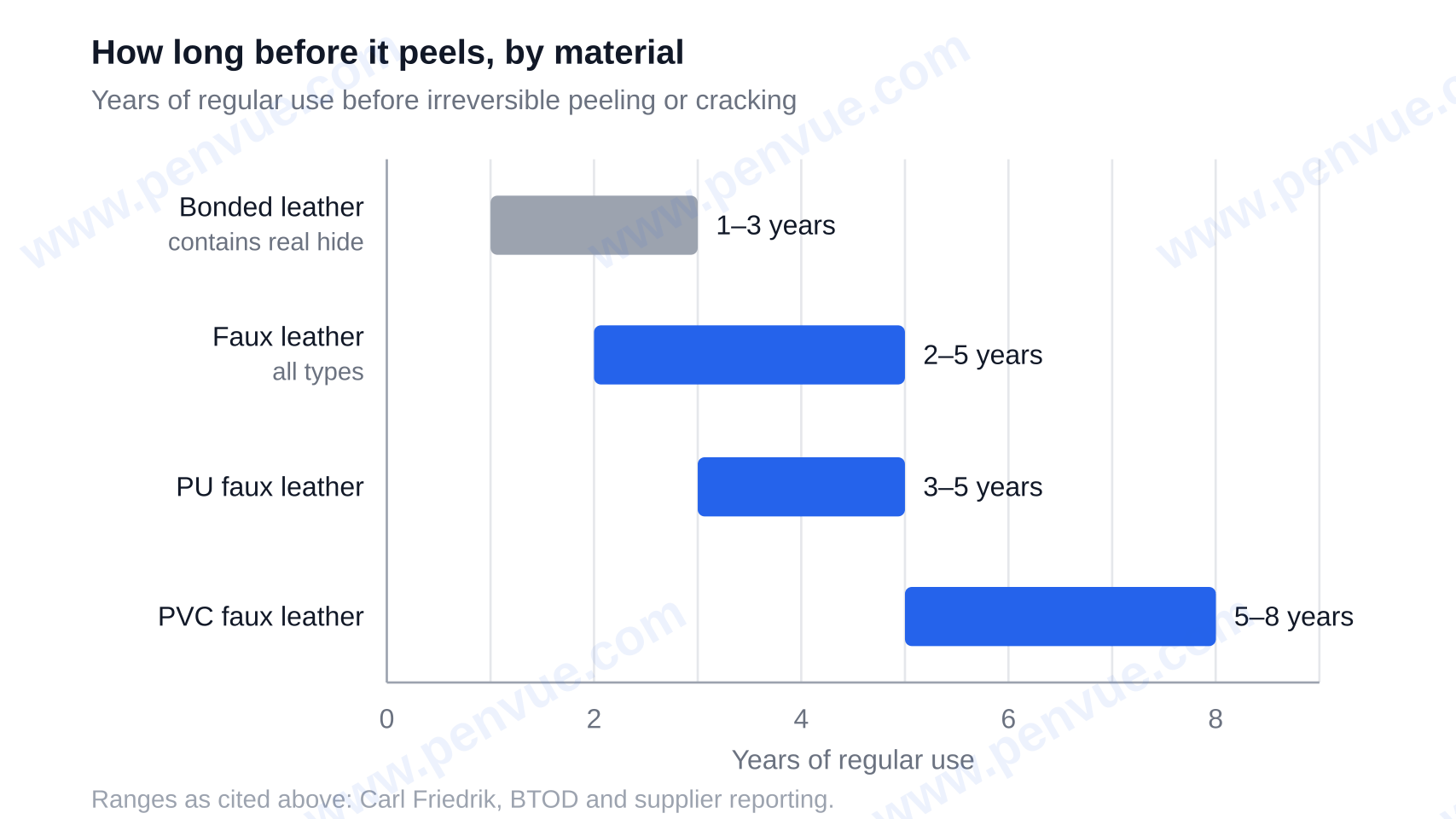
Carl Friedrik gives the headline figure: about 2–5 years before irreversible peeling and cracking set in. From the supplier side, the life expectancy splits by polymer — with daily use, PU faux leather begins to peel in roughly 3–5 years and PVC faux leather in roughly 5–8 years before cracking or peeling — and surface failure on smooth, high-gloss finishes shows up at around the three-year mark. Textured and microfiber finishes hide and resist wear better.
Why peeling can’t really be repaired
The overall failure mode of faux leather is hydrolysis: moisture is absorbed by the polymer coating and breaks it down from the inside out. That’s why heat and humidity shorten every figure above, and why a coat stored in a humid wardrobe ages faster than one stored in a dry environment. Abrasion at contact points — seat edges, armrests, strap shoulders — along with direct sunlight and artificial heat finish the job.
Which leads to the honest answer on repair: peeling is delamination of the coating from the backing, not a surface scuff. Patching and using vinyl compounds to mask the failure gives the illusion that the repair is effective, however it is not. They don’t bond the coating back to the backing, and once it starts, it spreads.
How to Tell Faux Leather From Real Leather Yourself
Five tests you can perform in a shop, no tools:
- Water drop — faux leather will cause the water to bead up and roll off; real leather will absorb the drop and darken slightly.
- Grain and pores — faux leather has grain and pores that are evenly spaced and repeated because a roller embossed it; real leather has irregular, non-repeating grain with unevenly spaced pores.
- Cut edge — real leather has a nice fibrous, layered edge. Faux leather edges cut clean and smooth and reveal the woven fabric backing under a thin plastic film. Examine seams, strap ends and the edges of cushions.
- Smell — faux leather has a strong chemical or plastic smell, strongest when new. Real leather has an organic, musty smell like an old book.
- Flex and warmth — real leather warms to the touch and will soften and crease like skin. Faux leather stays cool, stays stiff, folds stiffly and springs back.
The best way to check if faux leather is used on furniture is to look at the backs, sides and bottom. They’re often faux even when the seating surface is hide, and the tag rarely says so.
Who should skip faux leather entirely
Two groups, and faux leather’s disadvantages for “easy care budget picks” fail both. Anyone wearing a faux leather jacket for hours will have a clammy back, because PVC-based faux leather has no pores and does not breathe the way hide does. Choose a microfiber faux leather or real hide instead. And anyone who hears “plastic” and assumes waterproof: in reality the surface is water-resistant, not waterproof, and the fabric backing and the stitches are neither. Spills wipe off; a soaking in and accelerates hydrolysis.
While you’re examining the item, know the care routine too. Wipe away dirt using mild soap and a damp cloth, dry away from heat, and avoid hot water, high-heat dryers, harsh solvents and real-leather conditioner — conditioner will not penetrate the faux leather, so it just sits on the plastic.
The One Thing Worth Remembering
Faux leather is a fabric coated with plastic which is meant to resemble hide — cheaper, consistent batch to batch, wipe-clean, animal-free, and destined to peel in a few years rather than age into patina. It genuinely suits households with kids or pets, rental furniture, car interiors, craft and sewing projects, and occasional-wear pieces. That said, the word itself tells you very little, and that’s the real takeaway: “faux” is marketing, and only the polymer underneath predicts how the item will behave.
Next step: the best way to figure out what the material really is, is to find the tag or an exposed cut edge on the item you’re considering and look for the specific disclosure — vinyl, PU, PVC, microfiber or bonded. If the seller can’t tell you which one it is, assume the shortest lifespan in the table above and price the item accordingly. For more on this, see our Lifestyle coverage.
People Also Ask
Is faux leather the same as vegan leather?
Functionally, they are the same thing — both describe a leather-look material with no animal hide in it, and Wikipedia lists vegan leather alongside synthetic leather, leatherette, pleather and pseudoleather as names for the same category. The difference is framing: “vegan” is more of a philosophical term, emphasising the absence of animal product, not the absence of plastic. More often than not, vegan leather is made with PU or PVC on a polyester backing. Neither of those terms is on the FTC’s list of acceptable disclosures, so neither tells you which material you’re actually buying.
Is faux leather waterproof?
Not at all. Faux leather is water-resistant, which is not the same thing. The plastic coating repels a spill long enough for you to wipe it off, however the fabric backing and the stitched seams absorb water freely. A proper soaking gets into the backing and accelerates hydrolysis, the process where moisture breaks the polymer coating down from the inside. The best thing to do with a spill is to wipe it off promptly with a damp cloth and let the item dry away from any heat source.
Does faux leather crack in cold or hot weather?
Heat is the bigger threat. Heat and humidity speed up hydrolysis, which is the main reason the coating eventually peels, so a car seat left baking in direct sun or a jacket stored near a radiator ages much faster than one kept cool and dry. Supplier reporting puts PVC at roughly 5–8 years before cracking or peeling and PU at roughly 3–5 years of daily use — figures that assume reasonable conditions, not a hot dashboard. Avoid artificial heat entirely when drying it; give it time to dry naturally.
Can faux leather be stitched and used for sewing projects like real leather?
Yes, and it is one of the material’s genuine strengths. It is sold in rolls and by the yard, the colour and grain stay consistent from batch to batch, and unlike real hide it does not require breaking in or conditioning. One downside is that the backing is a woven fabric, so needle holes stay put and seams are a weak point for water. For a project that gets heavy flexing, a textured finish wears better than a smooth high-gloss one, which shows surface failure soonest.
Is faux leather more environmentally friendly than real leather?
There isn’t a definitive answer, and anyone offering one is simplifying. Faux leather uses no animal hide, but since it is petroleum-based it does not biodegrade. PVC in particular raises disposal concerns, including dioxin release when burned, and synthetic coatings shed microplastics in use. Plant- and microbe-derived options — mushroom, pineapple, cactus, plus yeast and bacterial strains — are becoming more readily available, but most still rely on a polymer binder or coating, so “plant-based” rarely means plastic-free.